
Review · 1-DAY TOURS
All Samarkand monument in one day
Samarkand rewards a full day. This bus tour links the city’s major monuments, from the blue-tiled Registan to the tomb of Tamerlane, with stops at an old paper mill and the ancient Afrasiab area. I like the low $90 price and the fact that transport and an English-speaking guide are included. I also like the unusual paper-making visit, which gives you something beyond grand domes and royal tombs. The main drawback is pace: seeing nearly every major sight in one day leaves little room to linger.
Guide Sunnat receives especially strong praise for being extremely helpful and well informed. If he is leading your group, you can expect the history to come alive rather than arrive as a string of dates. Bring a scarf for religious sites, a camera, and enough energy for a long sightseeing day.
In This Review
- Key points to know before you book
- Why this one-day Samarkand tour makes sense
- Gur-i Amir, where the Timurid story begins
- Rukhabad and the religious side of Samarkand
- Registan Square and its 70-minute history lesson
- Meros paper mill and an old Samarkand craft
- Afrasiab and the Mausoleum of St. Daniel
- Ulugbek Observatory and the city’s scientific mind
- Bibi-Khanum Mosque and the Siab Bazaar
- Shah-i-Zinda, the final stop
- Pace, transport, tickets, and practical planning
- Who should book this Samarkand day tour?
- Should you book it?
- FAQ
- How much does the Samarkand one-day tour cost?
- What is included in the price?
- Are entrance tickets and meals included?
- Where does the tour start and finish?
- Is the tour offered in English?
- Can I cancel the tour and receive a refund?
Key points to know before you book
- Gur-i Amir starts the day with Tamerlane’s tomb, a fitting introduction to the Timurid age that shaped Samarkand.
- Registan gets a 70-minute guided visit, giving you time to understand its three monumental madrasas.
- The Meros paper mill shows an old Samarkand craft, including how paper was made using traditional methods.
- The route reaches Afrasiab and the Mausoleum of St. Daniel, linking ancient ruins, religious tradition, and local legend.
- Shah-i-Zinda finishes the tour, with a long line of mausoleums covered in some of the city’s finest tilework.
- The $90 cost includes a guide and transport, but entrance tickets and meals cost extra.
Why this one-day Samarkand tour makes sense
Samarkand is not a city you can understand from one square alone. The famous Registan is essential, but the city’s story also runs through Timurid royal tombs, ancient Afrasiab, Islamic monuments, astronomical science, local markets, and working craft traditions.
This tour brings those pieces together in one day. You travel by bus between the sites, which matters because the sights are spread across the modern city and its outskirts. You do not have to arrange separate taxis or work out the order yourself.
The tour is aimed at first-time visitors who want a strong overview. I think that is exactly where it works best. You will see the key monuments and hear why Samarkand became one of Central Asia’s great cities. You will not get a slow, private exploration of every tile, inscription, or market stall.
The price is $90 per person. That is a reasonable rate for a full day with transport and an English-speaking guide, especially if you would otherwise pay for several short rides and separate guiding. Keep your budget open for entry fees and food, since neither is included.
The published rating is perfect, but it comes from only one verified booking. That is not enough to promise a flawless day for every group. Still, the praise for Sunnat is specific and useful: he was called extremely helpful and well informed, and the tour was considered ideal for someone with only a few days in Samarkand.
A few more options to weigh up in Samarkand
- Samarkand: Historical Monuments Guided Walking Tour
★ 4.8 · 446 reviews - Private Samarkand City Tour With Transportation
★ 5.0 · 149 reviews - A City Tour Of Samarkand: The Pearl Of The East
★ 5.0 · 133 reviews
Gur-i Amir, where the Timurid story begins
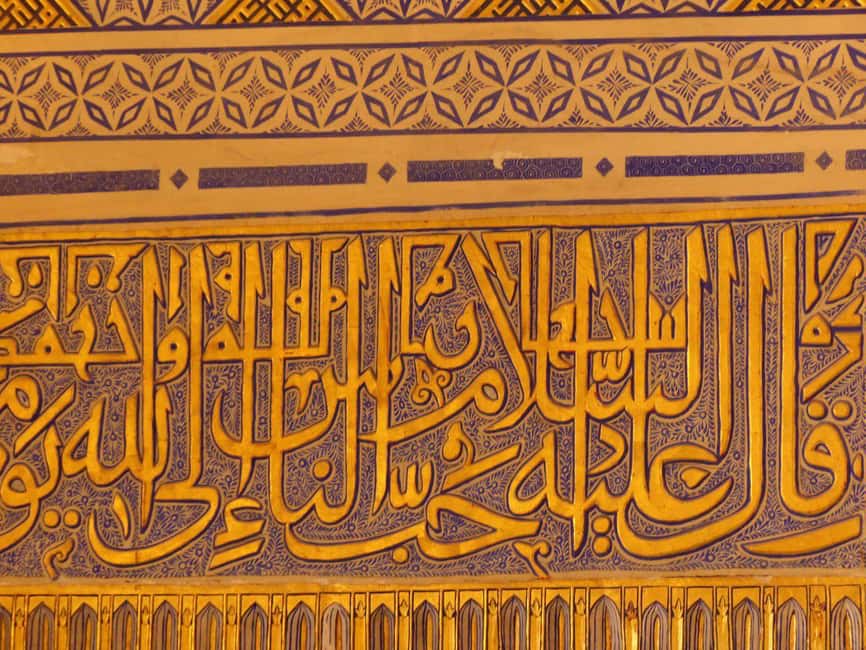
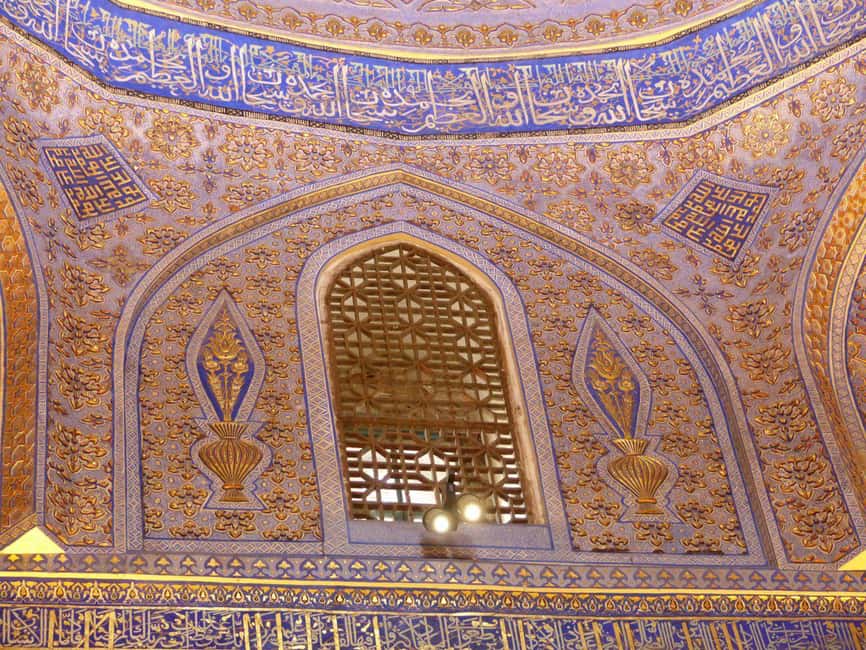
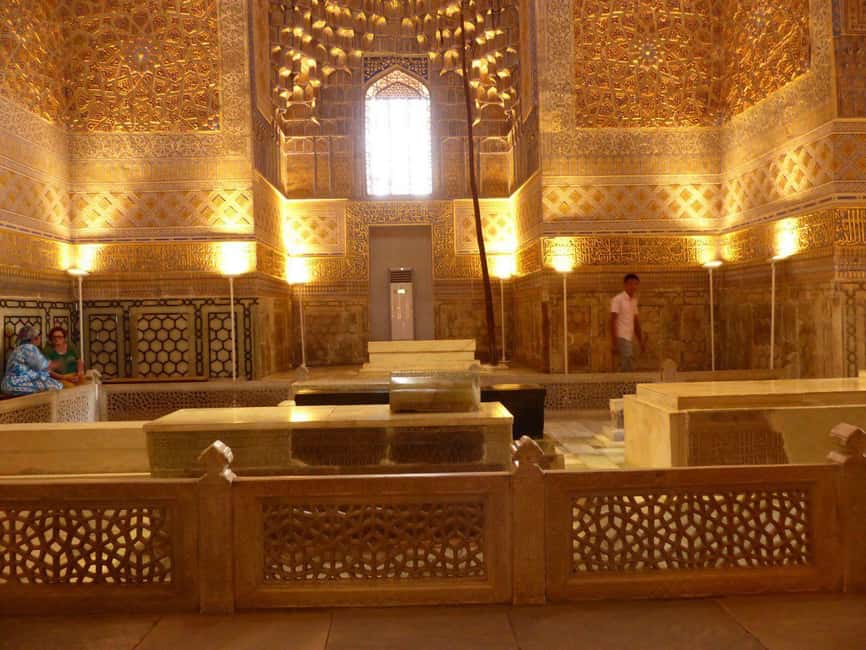
The meeting point is the Amir Temur Mausoleum, usually known as Gur-i Amir. This is the tomb of Tamerlane, the ruler better known in Central Asian history as Timur.
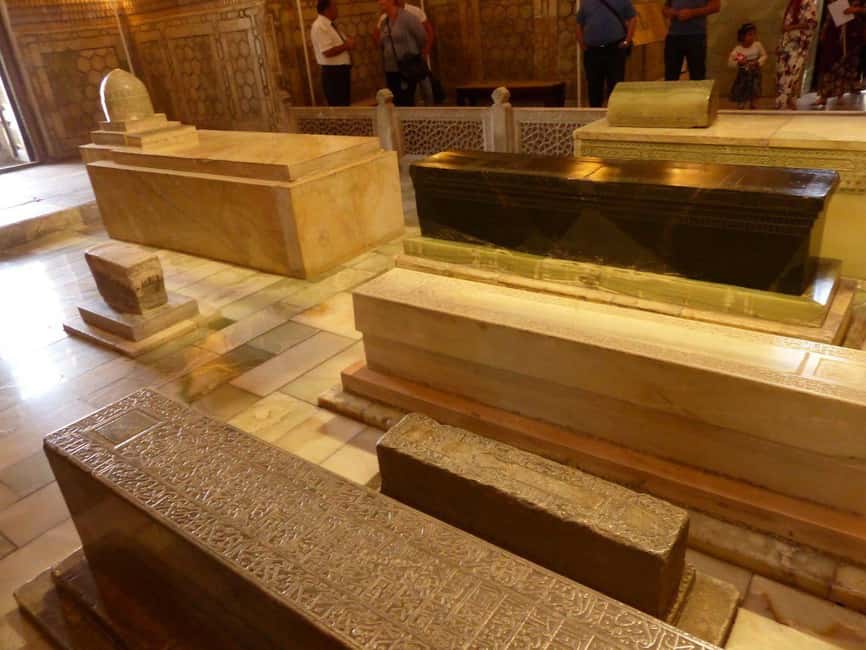
Gur-i Amir is more than a photo stop. It introduces the dynasty that made Samarkand the capital of a powerful empire in the 14th and 15th centuries. Timur’s sons Miranshah and Shahrukh, along with his grandson Ulugbek, were also buried in the underground crypt.
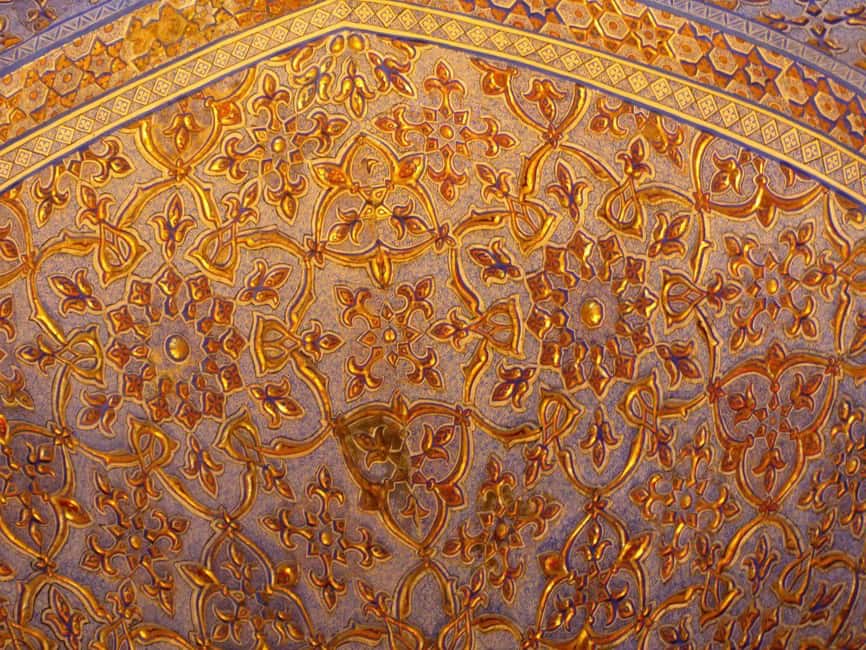
Inside, the focus is on royal burial and Timurid design. The monument’s scale and decoration help explain why Samarkand became known as the pearl of the East. Your guide can also connect the building to the larger story of Timur’s family and the rulers who followed him.
I like starting here because the visit gives the rest of the day a clear thread. You are not just seeing unrelated monuments. You are following the rise of a dynasty that changed the city.
The crypt is underground, and the tour information specifically notes the burial of several members of Timur’s family. If you want a detailed look at every architectural feature, the group format may feel quick. Take a moment to look upward and around you before moving on. The first stop sets the tone for the day.
Rukhabad and the religious side of Samarkand
The Rukhabad Mausoleum is also known as the Abode of the Spirit. It dates from the 14th century and is tied to a religious legend involving a small box said to contain seven hairs of the Prophet Muhammad.
That story is part of the appeal, but your guide should help separate local tradition from documented history. The mausoleum adds a quieter religious note after the royal grandeur of Gur-i Amir.
This is one of the stops where a good guide matters. A quick visit can otherwise become a name and a photograph. With explanation, you get a better sense of how sacred figures, royal patrons, and local belief overlap in Samarkand.
The tour promises good guiding, and Sunnat’s praise suggests that interpretation is one of its strengths. Still, remember that a group tour cannot always give everyone unlimited time at smaller sites.
Registan Square and its 70-minute history lesson
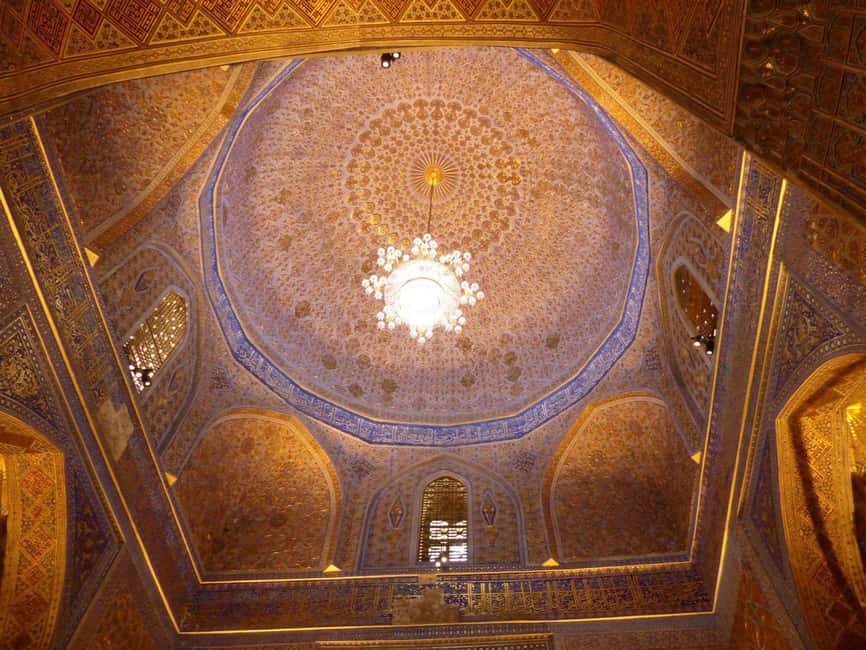
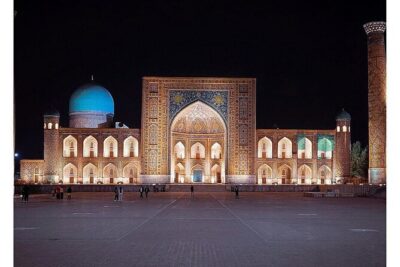
Registan Square is Samarkand’s main stage. Its name means Sandy Place, and the square is framed by three grand madrasas, or Islamic schools.
This is the stop most people picture when they think of Samarkand. The buildings combine monumental scale with elaborate tilework, geometric patterns, inscriptions, and tall entrance portals. The square is not simply attractive. It shows how rulers used architecture to express learning, faith, and political power.
The guided visit lasts 70 minutes. That is a useful amount of time for a first look. You should have enough time to hear the story of the square, examine the façades, and take photographs without reducing the visit to a quick stop.
I would use the first part of the visit to listen, then save time for your own look. Registan can feel visually overwhelming at first. A guide gives you the basic map, after which you can notice the details that appeal to you.
The limitation is that 70 minutes is still a fixed window. If you are fascinated by tile patterns or want to study every courtyard, you may wish for longer. The tour is designed to show you the essential structure and meaning, not to provide an academic architectural survey.
A completely different kind of day:
- Full Day Private Tour in Seven Lakes from Samarkand
★ 5.0 · 94 reviews - Samarkand One Day Tour: one day walking & group tour
★ 4.4 · 87 reviews - Samarkand: Shahrisabz Day Trip with Optional Local Guide
★ 4.9 · 81 reviews - Guide / excursion service in Samarkand
★ 5.0 · 57 reviews
Meros paper mill and an old Samarkand craft
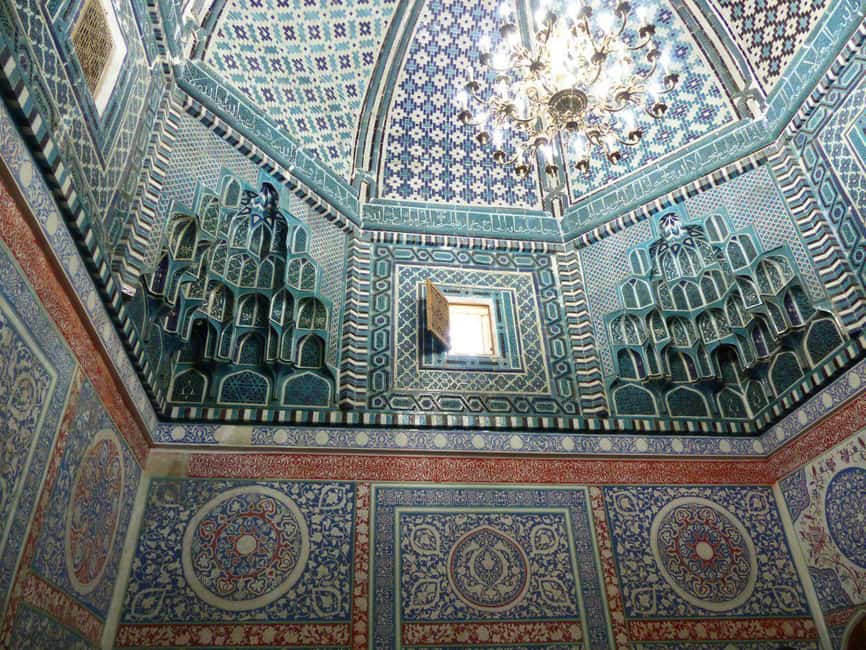
The Meros paper mill is one of the day’s most distinctive stops. It was founded by the Mukhtarov brothers, who helped revive local paper production using old Samarkand techniques.
This visit gives the schedule a welcome change of pace. You move from royal tombs and monumental squares to a practical craft. The focus is on how paper was made in ancient times, which makes the stop useful for understanding technology as well as culture.
Samarkand was connected to major trade routes, and paper mattered greatly in the medieval world. It supported writing, administration, religious study, and scholarship. The mill helps you picture that working side of the city.
I particularly like this inclusion because it prevents the tour from becoming a parade of domes. You see how knowledge was recorded, not just where rulers were buried. The visit may appeal most to you if you enjoy demonstrations and local traditions rather than only famous buildings.
The supplied details do not specify how long you stay or exactly which stages of production you will see. Expect the explanation to focus on traditional paper-making methods, and bring your camera if you want to record the process.
Afrasiab and the Mausoleum of St. Daniel
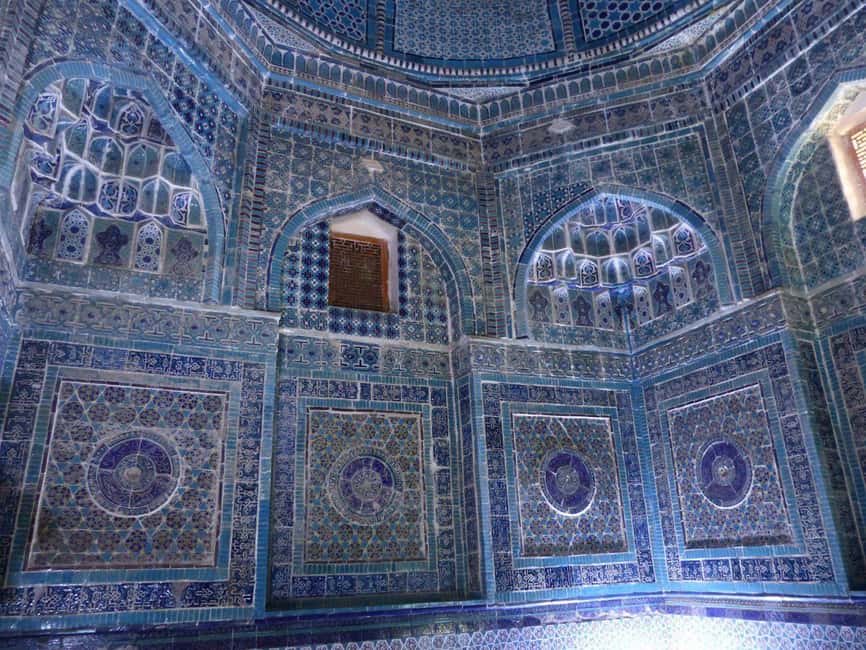
The ancient settlement of Afrasiab lies in the northeast of Samarkand. The city was once known as Marokanda and served as the capital of Sogdiana. Later, the old city became known as Afrasiab.
This part of Samarkand reaches further back than the Timurid monuments. The city’s story begins at least as early as the 6th century BC, with the Achaemenid dynasty, and Alexander the Great took control in the 4th century BC. Those names can blur together during a busy day, so listen for the basic sequence: early Sogdian and Persian roots, Alexander’s conquest, and later Timurid glory.
The Mausoleum of St. Daniel, or Daniyar, sits on the outskirts of the Afrasiab settlement. It is associated with a prophet honored in three religions. The building stretches along a hillside in a long form with five domes, while the Siab River flows below.
The setting gives this stop a different mood from Registan. Here, the site, hill, river, and religious tradition are all part of the experience. The tour also promises a look at 7th-century wall paintings, another reason to pay attention during the Afrasiab portion.
One striking detail is the 18-meter grave associated with St. Daniel. That unusual length is likely to prompt questions, so this is another place where your guide’s explanation adds real value. You are seeing a site shaped by belief and story, not just a standard tomb chamber.
Ulugbek Observatory and the city’s scientific mind
The Ulugbek Observatory sits on Kuhak Hill on the outskirts of Samarkand. It was built by Ulugbek, Timur’s grandson, in the 15th century.
Ulugbek was not only a ruler. He was also an astronomer, and the observatory reflects Samarkand’s role as a center of study. This stop changes the picture of the Timurid period. The dynasty is remembered for conquest and grand architecture, but it also supported mathematics and astronomy.
The remains help you imagine how scholars measured the movement of stars and planets. You will not need to be an astronomy specialist to appreciate the point: Samarkand was a place where science and royal ambition worked together.
Because the observatory is outside the central group of monuments, the bus transfer is useful. You avoid spending part of your day arranging transport to the hill. The tradeoff is that the day keeps moving, so take advantage of your guide’s explanation rather than expecting a long independent visit.
Bibi-Khanum Mosque and the Siab Bazaar
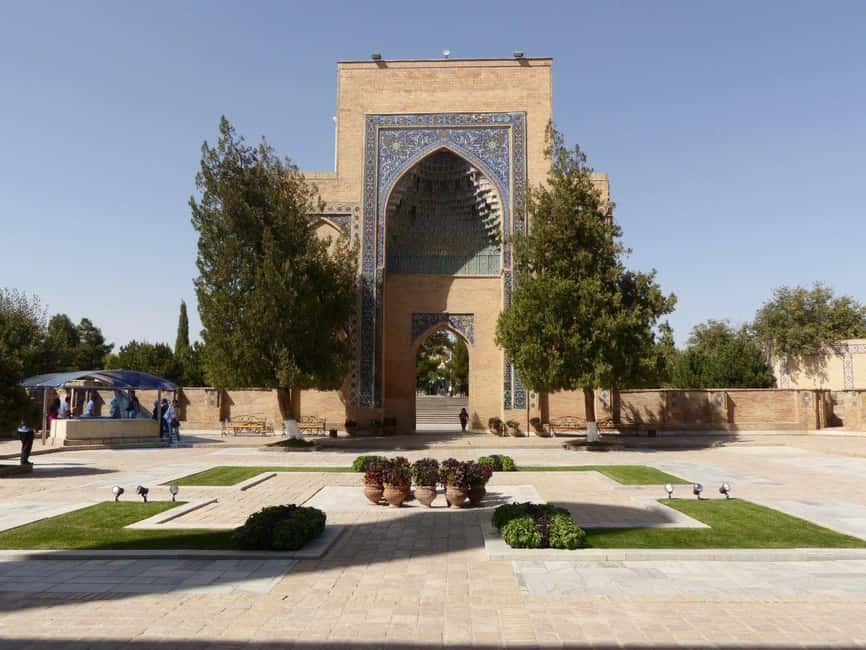
The Bibi-Khanum Mosque is one of Samarkand’s major 15th-century monuments. Its scale reflects the ambition of the Timurid era and makes a strong contrast with the more intimate mausoleums.
A large mosque can be hard to grasp from one angle. Walk your eyes from the main portal across the courtyard and up toward the domes. Your guide can explain the monument’s place in the city and its connection to the period when Samarkand served as the Timurid capital.
The nearby Siab Bazaar brings you back to daily life. Here, the city is not only a collection of monuments. It is also a place where people shop, eat, and carry on ordinary routines.
Food is not included in the tour, so the bazaar may be a useful place to consider local snacks or to get a sense of Samarkand’s market culture. The supplied details do not promise a tasting session or a long shopping break, so do not plan your day around a full meal there.
This pairing works well. Bibi-Khanum shows imperial scale, while Siab Bazaar shows the living city around it.
Shah-i-Zinda, the final stop
The tour finishes at Shah-i-Zinda, or the Living King. This necropolis is one of Samarkand’s most memorable places, with a series of mausoleums arranged along a passageway.
The name refers to a religious tradition, and the complex has been shaped over centuries. The tiled façades are the main visual reward, with blue, turquoise, and patterned surfaces packed closely together.
Ending here makes sense. After a day of royal tombs, sacred sites, ancient ruins, science, and markets, Shah-i-Zinda gathers much of Samarkand’s religious and artistic character in one place.
It is also a demanding final stop. You will have already spent hours moving through monuments, and the necropolis requires attention to detail. Wear comfortable shoes and keep your scarf handy. The tour is wheelchair accessible, but the exact ease of movement through every part of the historic complex is not specified, so ask the provider if you need detailed access information.
Pace, transport, tickets, and practical planning
This is a one-day group excursion by bus. Transport and guide service are included, while entrance tickets and meals are not. Check the total admission cost before booking so the $90 price does not become a surprise once you arrive.
Starting at Gur-i Amir and finishing at Shah-i-Zinda gives the day a clear route through the city. The published schedule names Registan as a 70-minute guided stop, but it does not give exact timings for every other monument. Plan for a full sightseeing day rather than a relaxed half-day outing.
Bring:
- A camera
- A scarf for religious sites
- Comfortable footwear
- Extra money for entrance tickets and food
Smoking is not allowed in the vehicle. The tour is offered in English and is wheelchair accessible. It is not considered suitable for people with hearing impairments, so anyone who relies on hearing support should confirm communication arrangements before paying.
Free cancellation is available up to 24 hours before departure, and you can reserve now and pay later. Starting times depend on availability.
Who should book this Samarkand day tour?
I would choose this tour if you are visiting Samarkand for the first time and want to cover the main sights without building a complicated plan. It is also a good fit if you have only a few days in the city and want one efficient day with an English-speaking guide.
The tour suits you if you enjoy historical context, group transport, and a broad introduction. The paper mill, Afrasiab, observatory, and bazaar make it more varied than a simple central-monument walk.
I would hesitate if you already know Samarkand well, prefer slow photography, or want to spend half a day at one monument. The route is ambitious, and the group format means the schedule comes first.
Should you book it?
Book this tour if your priority is coverage and value. For $90, you get a guide, bus transport, and a route that includes Samarkand’s best-known monuments plus several less predictable stops.
The strongest reason to book is the guiding. Sunnat has received especially warm praise for being helpful and well informed, which matters in a city where the difference between a quick visit and a meaningful one often comes down to explanation.
Skip it if you want complete independence or already have a strong grasp of the city. For a first visit, though, this is a practical way to get your bearings fast and see the great Timurid monuments, ancient Afrasiab, a working paper tradition, and Shah-i-Zinda in one demanding but rewarding day.
FAQ
How much does the Samarkand one-day tour cost?
The tour costs $90 per person.
What is included in the price?
Guide service and transport are included.
Are entrance tickets and meals included?
No. Entrance tickets and meals are not included.
Where does the tour start and finish?
The tour starts at the Amir Temur Mausoleum, Gur-i Amir Complex, and finishes at Shah-i-Zinda.
Is the tour offered in English?
Yes. The tour has a live English-speaking guide.
Can I cancel the tour and receive a refund?
Yes. You can cancel up to 24 hours in advance for a full refund. You can also reserve now and pay later.
Just added in Samarkand
- Wine tour in Samarkand (Baguizagan) English★ 5.0 · 2 reviews
- Uzbek wedding ceremony★ 5.0 · 2 reviews
- The Golden City of Samarkand: A Self-Guided Audio Tour★ 4.0 · 4 reviews
- Samarkand Capital of Amir Timur Private Tour with Transport★ 5.0 · 3 reviews
- Seven Lakes Panjakent: One-Day Adventure from Samarkand★ 5.0 · 3 reviews
- Shakhrisabz Private Day Tour from Samarkand★ 5.0 · 4 reviews
- Tadjikistan 7 Lakes Day Trip from Samarkand with Lunch★ 5.0 · 5 reviews
- “Hidden Paradise: Seven Lakes & Voru Village in 2 Days”★ 5.0 · 2 reviews
1-Day Tours, compared.
Samarkand One Day Tour – Departure From Tashkent
Read our review →
Samarkand One Day Tour: one day walking & group tour
Read our review →
Browse the lists this tour appears in