
Review · 1-DAY TOURS
Bukhara One Day Tour – Departure From Tashkent
Ancient Bukhara rewards a very long day. This private tour pairs the Afrosiyob high-speed train with a flight back to Tashkent, giving you a practical way to see the city when you cannot spare two or three nights. I like the easy hotel or airport pickup, and I like that the price includes transport, entrance fees, lunch, and a private guide. The main drawback is the schedule: you leave around dawn, reach Bukhara late in the morning, then race through a large historic center before a late flight home.
You get a lot for $249, especially with both train and air tickets included. The plan also lets your group move at its own pace rather than follow a large bus party. Still, this is not a gentle sightseeing day. Expect roughly 12 to 16 hours, limited rest, and only a few hours in Bukhara itself once the transport is removed.
In This Review
- Key points to know before booking
- Why this Bukhara day trip makes sense
- The real cost of seeing Bukhara in one day
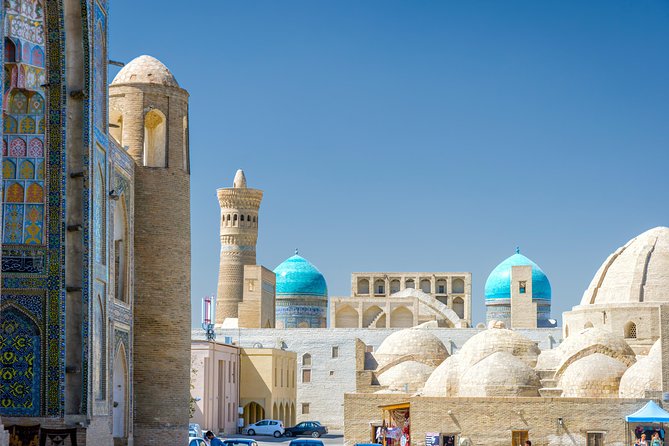
- Lyabi Khauz, where old Bukhara begins
- Magoki Attori and Chor Minor
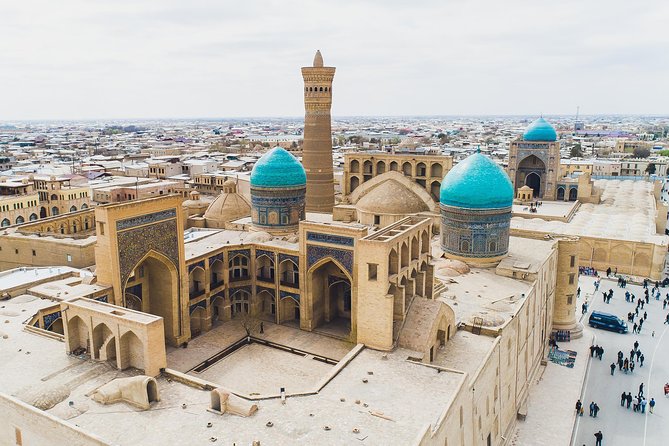
- Trading domes and the Kalyan complex
- Three madrasas, three different moods
- The Ark and Bolo Hauz Mosque
- Samanid Mausoleum and Chashma Ayub
- The schedule is the main challenge
- What the private guide and transport add
- Who should book this tour?
- Should you book the Bukhara One Day Tour?
- FAQ
- What time does the Bukhara day tour from Tashkent start?
- How long does the train take from Tashkent to Bukhara?
- Is the return flight from Bukhara to Tashkent included?
- Are entrance fees and lunch included?
- Is this a private tour?
- What fitness level is needed?
- Can I cancel for a full refund?
Key points to know before booking
- Afrosiyob train outbound: Leave Tashkent Railway Station at about 7:30 am and reach Bukhara at 11:17 am.
- Flight home included: After sightseeing, you fly from Bukhara back to Tashkent, then receive a transfer to your hotel or home.
- Private touring: Only your group takes part, so you can ask questions and adjust the pace within the tight schedule.
- Thirteen major sights: The route covers mosques, madrasas, mausoleums, trading domes, and the Ark citadel.
- Lunch and entrance fees covered: The $249 price includes the main practical costs, not just the guide.
- A demanding day: Early departure, extensive walking, and a late return make moderate fitness important.
Why this Bukhara day trip makes sense
Bukhara is far enough from Tashkent that the usual problem is not what to see, but how to get there. A train ride in one direction and a flight in the other solves that neatly. You avoid arranging separate rail tickets, airport transfers, local transport, admissions, and a guide.
The Afrosiyob is the strong point of the outbound plan. It leaves Tashkent at 7:30 am, after a transfer to the railway station at about 6:30 am, and arrives in Bukhara at 11:17 am. Four hours is still a long ride, but it is far more comfortable than spending the whole day on the road. You can rest during the journey, which matters because the return to Tashkent is scheduled around midnight.
Once you arrive, a guide and driver meet you at the station and take you toward the Old City. From there, the route brings together the main monuments in a logical cluster, with lunch included to keep the day moving.
I like the private format here. You can ask for a little more time at the Kalyan complex, move quickly through a shop, or ask your guide to explain a detail that catches your eye. One important caution: the time is still fixed by the return flight. Private does not mean leisurely.
A few more options to weigh up in Tashkent
- Best of Tashkent Mountains: Amirsoy, Chimgan & Charvak Trip
★ 4.8 · 567 reviews - Samarkand One Day Tour – Departure From Tashkent
★ 5.0 · 313 reviews - Tashkent City Tour
★ 5.0 · 121 reviews
The real cost of seeing Bukhara in one day
At $249 per person, this is not a bargain-basement excursion. It is easier to judge the price by looking at what it covers: the Tashkent to Bukhara train, the Bukhara to Tashkent flight, local transportation, lunch, admission fees, and a private guide.
Buying those pieces separately would take planning and would leave you responsible for matching a train arrival to a local guide and an evening flight. Here, those links are handled together. That gives the package solid value if your time in Uzbekistan is short.
The value is weaker if you already have several days in Bukhara. In that case, you may prefer to arrange a slower visit and spend less per day. You would have more time for quiet courtyards, museums, shopping, and meals without watching the clock.
Group discounts are offered, though the exact discount is not stated. Solo visitors should also remember that the listed price is per person. The private setup may cost more than a shared excursion, but it gives you direct attention and avoids a large group moving at the speed of its slowest member.
Lyabi Khauz, where old Bukhara begins
The first major stop is the Lyabi Khauz ensemble, planned for about an hour. Its center is a reservoir, or hauz, surrounded by major buildings: Kukeldash Madrasa to the north, the khanaka and Nodir Divan-begi building to the west, and a former trading street to the south.
This is a good opening stop because it gives you a feel for how Bukhara worked as an urban center. Water, religious schools, lodging, trade, and public space met here. Rather than looking at one isolated monument, you see a whole piece of city planning.
Use this hour to get your bearings and ask your guide how the ensemble functioned. The square is also one of the places where the city feels most social, though the exact atmosphere will depend on the time of day.
Magoki Attori and Chor Minor
The Magoki Attori Mosque receives about 30 minutes. It is an urban mosque set within a residential quarter, an important contrast to the grand open courtyards of the larger religious complexes. Its appeal comes from its place in the older city fabric and its compact scale.
The tour also includes the carpet museum here. That addition gives you a chance to connect Bukhara’s religious buildings with its long craft and trade traditions. If you prefer architecture, keep your eye on the building itself. If carpets interest you, this may be one of the stops where you want to use your private format and ask for extra explanation.
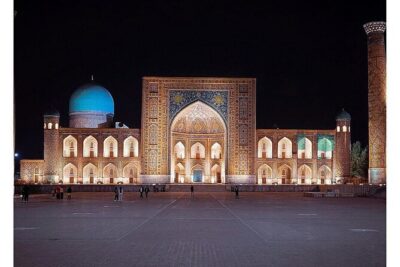
Chor Minor follows, with another 30 minutes. Its name means four minarets, and the nickname is plain to understand. Four small blue-domed towers decorate the corners of the square madrasa building, each with different decorative treatment.
Chor Minor is not as imposing as the Kalyan complex, but it is memorable because of its unusual outline. It sits behind Lyabi Khauz in a more open area, making it a useful stop for photographs and a welcome change from dense historic streets.
A completely different kind of day:
- Amirsoy, Chimgan & Charvak Full-Day Adventure
★ 4.9 · 82 reviews - Shymkent Day Tour from Tashkent
★ 4.6 · 71 reviews - Highlights of Tashkent (old and new part)
★ 5.0 · 60 reviews - 2 Days Tour to Bukhara and Samarkand from Tashkent by train
★ 5.0 · 53 reviews
Trading domes and the Kalyan complex
The trading domes are scheduled for 30 minutes. Their large domed structures once organized commerce, and shops today sell knives, jewelry, musical instruments, and souvenirs. This is one place where the tour can drift toward shopping.
That is not automatically a problem. You may find a useful keepsake here, and the domes explain how trade shaped the city. But time is scarce. If you would rather see another monument, tell your guide early that shopping is not your priority.
The Kalyan Minaret is one of Bukhara’s key sights. It rises from the Po-i-Kalyan complex and is among the city’s most recognizable landmarks. You have about 30 minutes, enough to look closely and hear the story of the monument, but not enough for a slow architectural study.
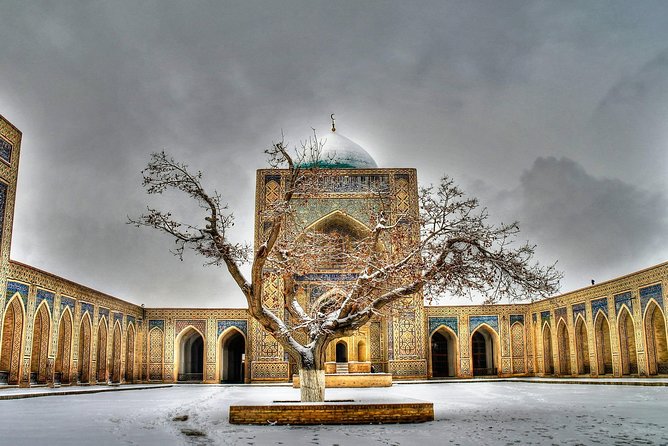
Next comes the Kalyan Mosque, a major fifteenth-century monument. Its scale gives you a sharp sense of the difference between a neighborhood mosque and a grand congregational mosque. The courtyard and surrounding brickwork are the main reasons to linger, but the schedule allows only half an hour.
Mir-i-Arab Madrasa completes this part of the complex. It remains an active institution where future imams and religious mentors study. That current use matters. You are not simply looking at a preserved shell, so respectful behavior and careful listening are important. The madrasa is one of the most interesting stops on the route, though access to working religious spaces can be limited.
Three madrasas, three different moods
Ulugbek Madrasa was built in 1417 by the architects Ismail Isfagani and Najmeddin Bukhari. Its design is restrained, with harmonious proportions and less decoration than some later buildings. That simplicity gives it a calm, serious character.
Abdulaziz-Khan Madrasa, built in 1651 and 1652, offers a different look. It was the last large madrasa built in Bukhara, with a four-iwan courtyard and a more unusual arrangement of rooms and domed structures. You can compare it with Ulugbek Madrasa rather than treating both as identical school buildings.
The schedule gives each madrasa 30 minutes. That is enough for a clear introduction, but not enough to study every tile, inscription, and courtyard detail. If architecture is your main reason for visiting Bukhara, these stops alone justify spending more than one day in the city.
The Ark and Bolo Hauz Mosque
The Ark of Bukhara is the city’s citadel and former residence of the Bukhara khans. Archaeological work places a citadel on this site as far back as the fourth century BC. Repeated construction and destruction formed the artificial hill, which rises about 20 meters.
The Ark helps you understand Bukhara as a seat of power, not just a center of worship and trade. Its walls and elevated position give the visit a different feel from the open madrasas. With only 30 minutes, you should focus on the main areas your guide selects rather than trying to see every corner.
Across from the Ark, Bolo Hauz Mosque dates to 1712. It is part of the historic city recognized by UNESCO and provides another useful contrast. The mosque is known for its relationship to the citadel and its setting in the Registan district.
This pairing works well. The Ark represents political authority, while Bolo Hauz shows the religious life that continued beside it. The half-hour allowance at Bolo Hauz is brief, so listen for the details that explain its place in the wider city.
Samanid Mausoleum and Chashma Ayub
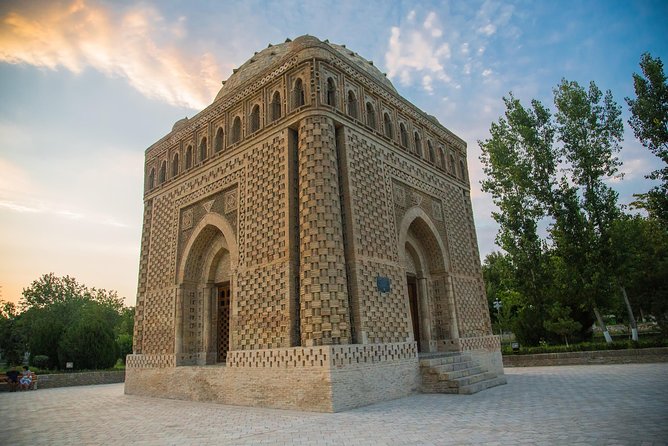
The Ismail Samani Mausoleum is one of the most important early Islamic buildings in Central Asia. Built in the tenth century, it is often described as the oldest funerary building of Central Asian architecture.
Its fame comes from its age, compact form, and brick construction. You do not need a huge amount of time to appreciate it, but you do need a guide who can explain why this small mausoleum matters. The stop lasts about 30 minutes.
Chashma Ayub Mausoleum includes a holy spring and now houses a Museum of Water. The original structure was ordered by Karakhanid rulers in the twelfth century and was rebuilt several times between the fourteenth and nineteenth centuries. The complex was completed during the reign of Timur.
This final stop adds a different layer to the day. You see a religious site, a spring, and a museum rather than another madrasa courtyard. By this point, though, fatigue may affect how much detail you can absorb. Keep water with you and do not feel obliged to rush through every display.
The schedule is the main challenge
The advertised duration is about 12 to 16 hours, and that range is believable. You leave for the railway station before sunrise, spend four hours on the train, tour Bukhara through the afternoon, wait or rest at the airport, fly back to Tashkent, and transfer onward to your hotel or home.
The sightseeing portion can feel especially tight. The itinerary lists thirteen stops, usually 30 minutes each, plus an hour at Lyabi Khauz and time for lunch. In practice, the time available after the 11:17 am arrival and before the evening flight does not allow a slow visit to every building.
One account described only about three hours for exploration. That helps explain why some people feel they see a lot but do not have enough time. Shopping stops can also eat into the monument time if you are not interested in buying anything.
The best approach is to choose your priorities before departure. I would give extra attention to Lyabi Khauz, the Kalyan complex, the Ark, and the Samanid Mausoleum. Treat the other stops as valuable introductions rather than full visits.
What the private guide and transport add
The guide and driver meet you at the Bukhara station, which removes one of the most stressful parts of a short independent visit. You do not need to negotiate a taxi immediately after a four-hour train ride.
The private guide can also make a rapid schedule more useful. A well-organized explanation helps you understand why each building matters, instead of seeing thirteen names blur together. One highly praised guide is named Dilf, and the guide was credited with making the day both memorable and well organized.
Transport is also provided throughout the tour and after the flight back to Tashkent. Still, confirm the meeting arrangement before departure. One unhappy account involved a missed pickup at Bukhara station and confusion with taxi drivers. The standard plan says a guide and driver meet you with the tour arranged, but having the local contact details and train information saved on your phone is sensible.
The return flight is another practical strength, but it introduces risk if schedules change. One booking failed because no return flight seat was available on the day, with a next-day alternative that did not work for the visitor. Confirm that both transport legs are secured before committing to the trip.
Who should book this tour?
I would choose this tour if you have only a day to spare, want the major monuments with a guide, and value having transport bundled together. It is especially useful for a first visit from Tashkent when adding overnight accommodation in Bukhara would disrupt the rest of your Uzbekistan plans.
It suits people with moderate physical fitness. You will walk through historic areas, climb or navigate uneven surfaces at some sites, and remain on the move for much of the day. The early start and late return are harder than the monument visits.
I would not choose it if you want slow photography, long museum visits, relaxed meals, or time to explore Bukhara after dark. Two or three days would give you a better feel for the city and reduce the pressure on every 30-minute stop.
The tour has a strong overall record, with a 4.6 rating from 37 ratings and 92 percent recommending it. The praise centers on friendly guides, good organization, smooth train and flight arrangements, and the amount of history covered in one day. The weaker experiences focus on stress around pickup or transport availability, not on the appeal of Bukhara itself.
Should you book the Bukhara One Day Tour?
Book it if your priority is maximum sightseeing with minimum planning. The combination of Afrosiyob, a flight back, lunch, admissions, a private guide, and local transport makes a difficult day possible.
Skip it if you can spare an overnight stay. Bukhara deserves more than a rapid circuit, and the price becomes harder to justify when you do not need the return flight and compressed schedule.
If you do book, confirm the return flight, save the meeting details, tell the guide which monuments matter most, and treat shopping as optional. Free cancellation is available up to 24 hours before the start time, but changes made inside that window are not accepted. Poor weather or failure to meet the minimum number of participants may lead to a new date or a full refund.
FAQ
What time does the Bukhara day tour from Tashkent start?
The listed start time is 7:00 am. Transfer to Tashkent Railway Station is planned for about 6:30 am, with the Afrosiyob train leaving at 7:30 am.
How long does the train take from Tashkent to Bukhara?
The Afrosiyob high-speed train takes about four hours. The stated schedule is arrival in Bukhara at 11:17 am after the 7:30 am departure.
Is the return flight from Bukhara to Tashkent included?
Yes. Economy-class flight tickets from Bukhara to Tashkent are included in the tour price.
Are entrance fees and lunch included?
Yes. Entrance fees for all listed sightseeing places and lunch are included.
Is this a private tour?
Yes. Only your group participates in the private tour or activity.
What fitness level is needed?
The tour requires a moderate level of physical fitness. The day includes extensive sightseeing and a long overall travel period.
Can I cancel for a full refund?
You can cancel at least 24 hours before the experience start time for a full refund. Cancellations or changes made less than 24 hours before the start time are not accepted for a refund.
Just added in Tashkent
- Uzbekistan and Tajikistan 9-Day Tour★ 5.0 · 1 review
- Tashkent International Airport (TAS) to Tashkent – Arrival Private Transfer★ 5.0 · 2 reviews
- Uzbek Brews & Views: Tashkent Craft Beer Discovery Tour★ 5.0 · 2 reviews
- 8-Day Private Tour in Uzbekistan with Pick Up★ 5.0 · 2 reviews
- Uzbekistan Tour – 6 Days 5 Nights★ 5.0 · 4 reviews
- Uzbekistan Private Tour 6 Days★ 5.0 · 1 review
- Tashkent to Tashkent International Airport (TAS) – Departure Private Transfer★ 5.0 · 1 review
- Full Day Private Tour to Fergana Valley from Tashkent★ 5.0 · 1 review
1-Day Tours, compared.
Samarkand One Day Tour – Departure From Tashkent
Read our review →
Samarkand One Day Tour: one day walking & group tour
Read our review →

Browse the lists this tour appears in