
Review · 6-DAY EXPERIENCES
Uzbekistan Private Tour 6 Days
Silk Road wonders come with serious logistics. This six-day private tour links Khiva, Bukhara, and Samarkand with Tashkent, taking care of the domestic flight, train tickets, hotels, drivers, local guides, and monument entry fees. That makes it appealing if you want to see Uzbekistan’s major historic cities without arranging every transfer yourself.
I especially like the way the route moves across the country rather than wasting time returning to Tashkent between stops. I also like the private format, since you can set the pace with a local guide in each city. The main drawback is the schedule: the 5 a.m. pickup on Day 2, the seven-hour road transfer from Khiva to Bukhara, and the early train from Samarkand to Tashkent make this a busy trip, not a slow holiday.
The price is $995 per person, based on shared double or twin accommodation. It includes five breakfasts, three-star or central boutique hotels, air-conditioned transport, the Tashkent to Urgench flight, two train journeys, guides, and entry fees. Lunch, dinner, insurance, tips, photography charges, and single-room costs are extra.
In This Review
- Five details that shape the experience
- Why this six-day route works
- Day 1: A simple arrival in Tashkent
- Day 2: Khiva and the walled city of Itchan Kala
- Day 3: Crossing the Kyzylkum Desert to Bukhara
- Day 4: Bukhara’s old town and Silk Road monuments
- Day 5: Samarkand’s monumental heart
- Day 6: Tashkent’s old quarter and modern center
- What the $995 price really covers
- Clothing, cash, and practical planning
- Who should book this tour?
- FAQ
- What cities does the tour visit?
- How long does the tour last?
- Where does the tour begin?
- What time is the first pickup?
- Is the tour private?
- Is accommodation included?
- Are meals included?
- Which transport tickets are included?
- Are monument entrance fees included?
- What happens if the high-speed train is unavailable?
- Is photography free?
- Is a single room available?
- Do I need to bring a passport copy?
- What is the cancellation policy?
Five details that shape the experience
- Khiva arrives early and fully formed: You spend about six hours exploring Itchan Kala, a walled open-air museum packed with mosques, madrassas, mausoleums, and narrow lanes.
- The Khiva to Bukhara transfer is the hard day: The private drive takes about seven hours, crosses the Amu Darya, and passes through the Kyzylkum Desert.
- Bukhara is explored mostly on foot: The route brings together the Ark, Kalon Minaret, Lyab-i-Hauz, a synagogue, a mosque, and old trading areas.
- Samarkand gets the grand finale: Registan, Shah-i-Zinda, Bibi Khanym Mosque, Gur Emir Mausoleum, and the Ulugh Beg Observatory fill Day 5.
- Transport is included, but timing can change: Domestic flights and high-speed trains depend on availability. If the Afrosiyab train is unavailable, a comfortable regular train is used instead.
- Religious sites require modest clothing: Cover your shoulders and knees. Women should carry a scarf or shawl for holy places.
Why this six-day route works
Uzbekistan is not a place where the famous sights sit neatly beside one airport. Tashkent is in the east, Khiva far to the west, Bukhara farther southeast, and Samarkand beyond it. This tour solves the main transport puzzle by combining air travel, private road transport, and trains.
The route is especially useful for a first visit. You get the country’s best-known historic centers without having to compare flight schedules, reserve several trains, find an airport transfer in Urgench, or negotiate a long desert drive. In each city, a local English-speaking guide handles the sightseeing.
The private setup matters. You are not tied to a large group’s walking speed or forced to spend an hour at a site that does not interest you. The itinerary can be adjusted around your interests, though the transport schedule means flexibility has limits.
You should still think of this as a concentrated introduction rather than a restful tour. Day 2 starts before sunrise, Day 3 is largely spent in a vehicle, and Day 6 combines an early train with a final city tour and airport transfer. The reward is a lot of Uzbekistan in a short time.
A few more options to weigh up in Tashkent
- Best of Tashkent Mountains: Amirsoy, Chimgan & Charvak Trip
★ 4.8 · 567 reviews - Samarkand One Day Tour – Departure From Tashkent
★ 5.0 · 313 reviews - Tashkent City Tour
★ 5.0 · 121 reviews
Day 1: A simple arrival in Tashkent
Your driver meets you outside Tashkent International Airport and takes you to the hotel. The transfer takes about 30 minutes, and no sightseeing is scheduled.
That spare first day is useful because the next morning begins at 5 a.m. Use it to settle in, connect to the hotel internet, and organize your passport and personal items. Hotel check-in is after 2 p.m., so an early arrival may require waiting before your room is ready.
Accommodation is in a highly rated three-star hotel or a centrally located boutique hotel. Rooms are shared as a double or twin unless you pay the single supplement, listed as $30 per night. Breakfast is included during the tour, but meals beyond breakfast are your responsibility.
Day 2: Khiva and the walled city of Itchan Kala
The driver collects you at 5 a.m. for the 7 a.m. flight from Tashkent to Urgench. This is an early start, but flying is the practical choice. A road journey would consume far more of your limited time.
At Urgench Airport, walk outside the terminal. Drivers wait beyond a metal fence, and yours should be holding a name board. The transfer to Khiva is about 35 kilometers and takes roughly an hour.
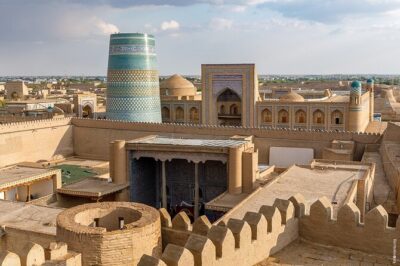
Khiva’s historic center, Itchan Kala, is the visual star of the tour. The entire inner city covers about 26 hectares and is enclosed by defensive walls. Today it functions as an open-air museum and a state historical archaeological museum.
You will walk through narrow lanes lined with low houses, mosques, mausoleums, and Islamic schools. The setting makes Khiva feel different from a collection of separate monuments. The walls, alleys, and buildings form one complete old city.
The planned six-hour visit includes Muhammad Amin Khan Madrassa, built in 1855, and the unfinished-looking Kalta Minor minaret. You also see Zindon, the old city jail, and Kunya Ark, the former citadel. Muhammad Rakhim Khan Madrassa dates from 1871, while the Pakhlavan Mahmud Mausoleum and Islam Khoja Madrassa add religious and architectural depth.
This is a full sightseeing block, so wear comfortable shoes and carry water. The tour description does not promise a midday hotel rest, and the early flight makes the first day of sightseeing physically demanding. Still, the reward is immediate: you begin with one of Central Asia’s most carefully preserved walled cities.
Day 3: Crossing the Kyzylkum Desert to Bukhara
The drive from Khiva to Bukhara takes about seven hours, with the full transfer listed at roughly eight hours. You cross the Amu Darya, known in antiquity as the Oxus, and continue through the Kyzylkum Desert.
This is the least glamorous part of the route, but it is also one of the most useful. A private vehicle lets you make the journey directly rather than piecing together separate transport. You can stop for lunch at a chayxana, or traditional tea house, if you wish. Lunch is optional and not included.
Be realistic about the distance. This day is about getting from one historic center to another, not about a string of attractions. Bring snacks, water, and something to read. The air-conditioned vehicle is a practical comfort, especially on a long desert crossing.
The value here lies in the route design. The tour does not pretend that Khiva and Bukhara are close. It handles the awkward connection so you can continue the trip without arranging a separate driver or losing another day to transport planning.
A completely different kind of day:
- Amirsoy, Chimgan & Charvak Full-Day Adventure
★ 4.9 · 82 reviews - Shymkent Day Tour from Tashkent
★ 4.6 · 71 reviews - Highlights of Tashkent (old and new part)
★ 5.0 · 60 reviews - 2 Days Tour to Bukhara and Samarkand from Tashkent by train
★ 5.0 · 53 reviews
Day 4: Bukhara’s old town and Silk Road monuments
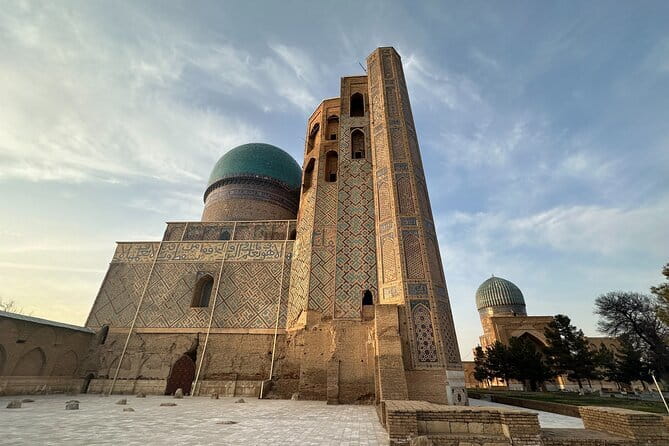
Bukhara receives a full walking tour, and this is where the schedule becomes more relaxed. The old city brings together architecture, religious buildings, food traditions, crafts, and the memory of a major trading center.
The first stop is Bolo Hauz Mosque, an 18th-century Friday mosque made up of a reservoir, mosque, and minaret. It remains a functioning place of worship, so the visit is from outside. That restriction is worth knowing before you arrive. Religious sites are not museum displays, and access can depend on their active use.
Next comes the Ark of Bukhara. The citadel’s construction reaches back to the beginning of the first millennium BC, though the buildings you see today were restored mainly during the 18th to 20th centuries. Its long history is best understood as a record of repeated destruction and rebuilding rather than one untouched fortress.
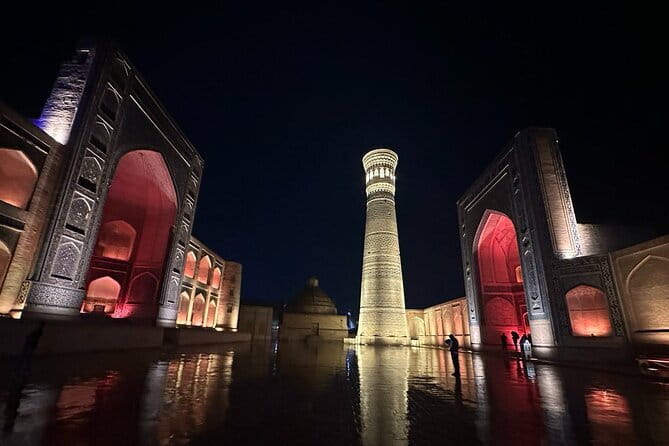
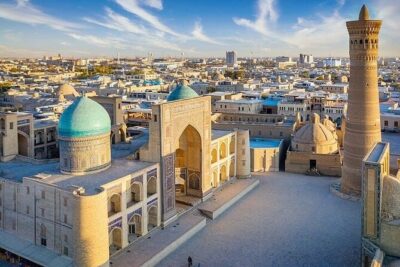
The Poi Kalon complex is the great architectural centerpiece. Its name means the foot of the tall, and the complex includes the Kalon Mosque, a madrassa, and the famous minaret. The minaret dates to the 12th century, while parts of the wider complex span the 12th to 16th centuries. It served as a place of trade, worship, and scholarship along the Silk Road.
The Magoki-Attori Mosque occupies an especially layered site. Before the Arab invasion, the location held a Buddhist monastery and later a Zoroastrian temple. The building now contains a carpet-weaving museum, though the description frankly warns that the museum is dull. That honesty helps you set your expectations. Visit for the site’s earlier religious layers and architecture, not for a major museum collection.
Lyab-i-Hauz is a good place to pause. The complex was built around a pond by Nadir Divan Begi, the grand vizier of Bukhara, around 1620. Water, shade, and surrounding buildings give the square a social quality that helps you picture Bukhara as a living city rather than a set of ruins.
The route also includes the Bukhara Synagogue, located south of Lyab-i-Hauz in the old Jewish quarter. The synagogue is often closed, so inside access is not guaranteed. If it is open, you may see an old Torah. The stop is still worthwhile because Bukhara’s Jewish community has been part of the city since forced migrations from Merv and Shiraz in the 14th century.
A statue of Hodja Nasreddin, seated on his donkey, adds a lighter note. Uzbeks claim the homespun philosopher and humorist as a son of Bukhara, although he is also associated with Turkey and other parts of the region.
Late in the afternoon, you transfer 15 kilometers to Bukhara railway station and take the train to Samarkand, subject to availability. On arrival, a driver meets you outside Samarkand station and takes you to the hotel.
This is an efficient day, but it packs a lot into one walking tour before a station transfer. Keep your day bag light, and do not count on a long evening in Samarkand.
Day 5: Samarkand’s monumental heart
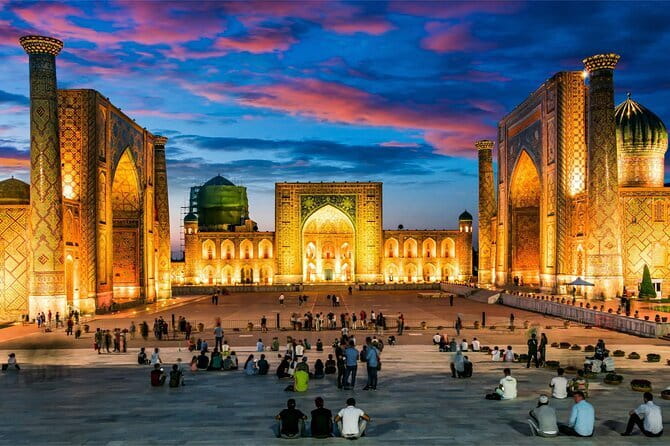
Samarkand gets the tour’s fullest sightseeing day. Once known as Marakanda in ancient Greece, the city has long been tied to the Silk Road and to the rule of Amir Timur, often called Tamerlane in Europe.
The Ulugh Beg Observatory introduces a more scientific side of the city. Ulugh Beg, Amir Timur’s grandson, was an astronomer-king who built the observatory in the 15th century. This stop gives the day a useful change of pace after the grand religious architecture.
Shah-i-Zinda is one of the most spiritual places on the route. The complex contains mausoleums dating from the 12th through the 20th centuries and served as a burial place for royal figures and nobles. Its importance is not only visual. You are walking through a sacred cemetery that continued to develop across many centuries.
Bibi Khanym Mosque dates from the 15th century and was built in honor of Saray Mulk Khanum, Amir Timur’s chief wife. Gur Emir Mausoleum, from the 15th century, is the tomb of the king and one of the city’s central memorial buildings.
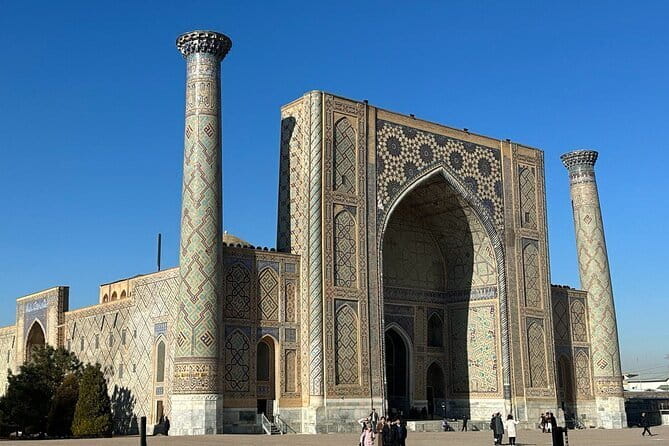
Then comes Registan Square, the grand finish. Its three madrassas date from the 15th through 17th centuries, with Islamic designs and calligraphy covering the facades. The one-hour visit gives you time to look closely rather than simply take the standard wide photograph.
Samarkand’s monuments are large and formal. If you prefer small lanes, intimate interiors, and street-level details, Khiva and Bukhara may feel more personal. If you want scale and spectacle, Samarkand is the strongest day of the tour.
Day 6: Tashkent’s old quarter and modern center
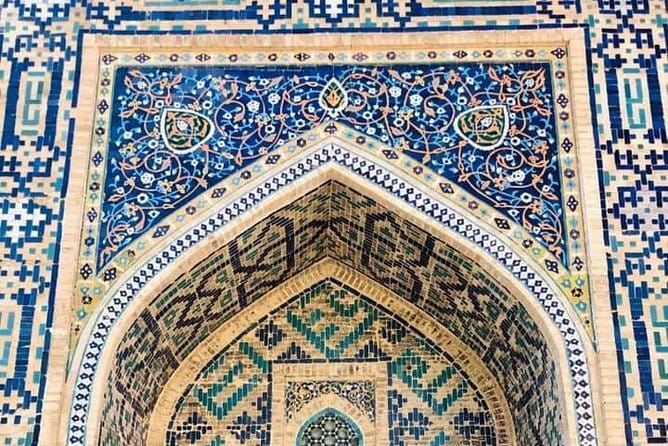
The final day starts early again. You transfer to Samarkand station and take the train to Tashkent, subject to availability. At Tashkent station, a guide meets you and begins the city sightseeing.
The Monument of Courage Earthquake Memorial recalls the devastating earthquake of April 26, 1966. It sits near the estimated epicenter and gives you a short look at a major turning point in modern Tashkent.
The Khazrati Imam Complex is the historical spiritual heart of the city. It includes the functioning Khazrati Imam Friday Mosque, Barak-Khan Madrassa, Tellya Sheikh Mosque, the Muyi Moborak Library, and the mausoleum of Abu Bakr Mohammed Kaffal Shashi.
The library holds rare Oriental manuscripts, including the famous Caliph Osman Koran from the seventh century. Barak-Khan Madrassa now serves as a shopping area, so this stop connects religious architecture with present-day crafts and commerce.
Chorsu Bazaar is the commercial heart of Tashkent and has served that role for hundreds of years. You have about 40 minutes here, enough for a focused look at the market rather than a long shopping session. If you plan to buy souvenirs, carry extra Uzbek currency or dollars and keep purchases manageable for the airport transfer.
Amir Timur Square closes the city tour with a look at modern Tashkent. The green square includes flowers, fountains, a statue of Amir Timur on horseback, the Hotel Uzbekistan, the Museum of Amir Timur, the Tashkent Clock Towers, and other political and cultural buildings.
The airport transfer takes about 25 minutes. Because the train, sightseeing, and airport transfer all happen on the same day, confirm the final timing with the operator. The itinerary may change based on domestic air ticket availability and train schedules.
What the $995 price really covers
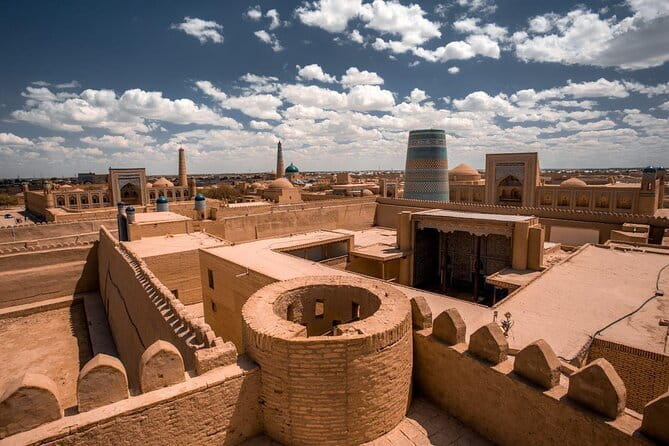
At $995 per person, the tour is not a budget backpacking option, but it includes many costs that can add up quickly. You receive:
- Accommodation in a shared double or twin room
- Five breakfasts
- The Tashkent to Urgench domestic flight
- Private Khiva to Bukhara transport
- Bukhara to Samarkand train travel
- Samarkand to Tashkent train travel
- Air-conditioned vehicle transfers
- English-speaking local guides in all four cities
- Monument entrance tickets
The strongest value is the combination of private transfers and city guides. The Khiva to Bukhara road connection alone would be a major planning task, while the guides help turn impressive buildings into understandable places.
The price does not include lunch or dinner, travel insurance, tips, hotel extras, or photography charges. Photography costs $5 for cameras, while phone photography is free. A single room adds $30 per night, so solo passengers should calculate the final amount before booking.
The tour also offers group discounts, and pickup is available. Border pickup can be arranged on request. Confirmation is provided at booking, and you must send a passport copy for hotel and train reservations.
Clothing, cash, and practical planning
Dress modestly at religious sites. Men and women should cover shoulders and knees, and clothing should not be tight, revealing, or transparent. Women should bring a headscarf or shawl for holy places.
Carry extra U.S. dollars for food, souvenirs, tips, and other personal expenses. ATMs are available, but they dispense local currency rather than U.S. dollars and may impose withdrawal limits.
The tour is private, so only your group participates. Most people can take part, and the route is near public transportation, though the included private vehicle and trains do most of the practical work.
Train availability is an important condition. During the high season, the Afrosiyab high-speed train may not be available. In that case, the operator uses the most comfortable class of regular train. One account of the route described the Afrosiyab as useful but not comparable with Japan’s Shinkansen or France’s TGV. That is a fair expectation: the train saves time, but it is transportation, not the main attraction.
Free cancellation is available if you cancel at least 24 hours before the start time. Changes or cancellations inside that window are not accepted for a refund.
Who should book this tour?
I would choose this tour if you want Uzbekistan’s major Silk Road cities in one carefully arranged trip. It suits first-time visitors, couples, friends, and small family groups who value private guiding and do not want to manage several tickets and long-distance connections.
I would hesitate if you want leisurely mornings, long restaurant meals, or substantial free time in each city. The itinerary is tightly packed, especially on Days 2, 3, and 6. It is also less suitable if you dislike long drives or cannot manage early departures.
Book it for the route, the included transport, and the private format. Skip it if you want to stay longer in each city and are happy to arrange hotels, trains, flights, and guides yourself. For a six-day introduction, the $995 package offers a practical way to see Khiva, Bukhara, Samarkand, and Tashkent without carrying the full planning load.
FAQ
What cities does the tour visit?
The tour visits Tashkent, Khiva, Bukhara, and Samarkand.
How long does the tour last?
The tour lasts approximately six days.
Where does the tour begin?
It begins at Tashkent International Airport, at Kumarik ko’chasi 13 in Tashkent.
What time is the first pickup?
The listed start time is 5 a.m. The Day 2 hotel pickup is also at 5 a.m. for the 7 a.m. flight to Urgench.
Is the tour private?
Yes. Only your group participates in this private tour.
Is accommodation included?
Yes. Accommodation is included in a highly rated three-star hotel or a centrally located boutique hotel. Double or twin shared rooms are provided.
Are meals included?
Five breakfasts are included. Lunch and dinner are not included.
Which transport tickets are included?
The Tashkent to Urgench domestic flight, the Bukhara to Samarkand train, and the Samarkand to Tashkent train are included.
Are monument entrance fees included?
Yes. Entrance tickets to the listed monuments are included.
What happens if the high-speed train is unavailable?
The operator uses the most comfortable class of regular train when the high-speed train is unavailable during the high season.
Is photography free?
Phone photography is free. Photography with cameras costs $5.
Is a single room available?
Yes. A single-room supplement of $30 per night applies.
Do I need to bring a passport copy?
Yes. You should send a copy of your passport after booking so the operator can arrange train tickets and hotels.
What is the cancellation policy?
You can cancel at least 24 hours before the experience start time for a full refund. Cancellations or changes made less than 24 hours before the start time are not accepted.
Just added in Tashkent
- Uzbekistan and Tajikistan 9-Day Tour★ 5.0 · 1 review
- Tashkent International Airport (TAS) to Tashkent – Arrival Private Transfer★ 5.0 · 2 reviews
- Uzbek Brews & Views: Tashkent Craft Beer Discovery Tour★ 5.0 · 2 reviews
- 8-Day Private Tour in Uzbekistan with Pick Up★ 5.0 · 2 reviews
- Uzbekistan Tour – 6 Days 5 Nights★ 5.0 · 4 reviews
- Tashkent to Tashkent International Airport (TAS) – Departure Private Transfer★ 5.0 · 1 review
- Full Day Private Tour to Fergana Valley from Tashkent★ 5.0 · 1 review
- Uzbekistan 4 Days Private Tour Tashkent-Bukhara-Samarkand-Tashkent bullet train★ 5.0 · 1 review
6-Day Experiences, compared.
Uzbekistan 6 days private tour Tas-Khiva-Buk-Sam-Tas
Read our review →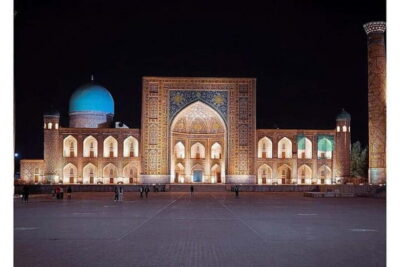
Uzbekistan 6 Days Private Tour Khiva-Bukhara-Samarkand by Train
Read our review →
5 Nights / 6 Days Uzbekistan Tour Tashkent Samarkand and Bukhara
Read our review →Browse the lists this tour appears in