
Review · CITY TOURS IN TASHKENT
Full Day Private City Tour in Tashkent
Tashkent rewards curious eyes. This private tour ties together grand Soviet spaces, Islamic landmarks, local crafts, and daily market life in one well-planned day. I like the private format, which lets your group move at its own pace, and I like the mix of major sights with ordinary city scenes. The main drawback is the packed schedule: several stops are brief, while the museum and Khast-Imam complex require most of your time.
At $90 per person, the tour can be good value if your group wants a driver, a licensed local guide, transport, and entrance tickets handled together. You should confirm the pickup details, since the tour offers hotel pickup but also lists Amir Temur Square as the starting point. Also budget a small cash fee for museum photography.
In This Review
- Key things to know before you book
- A useful first day in Uzbekistan
- Amir Temur Square and the modern capital
- Alisher Navoi Theater, viewed from outside
- Two hours with Uzbek craft at the Applied Art Museum
- Independence Square and the Earthquake Memorial
- Khast-Imam, Tashkent’s old religious center
- Tashkent Metro, an underground gallery
- Chorsu Bazaar, where the day becomes local
- What $90 per person really covers
- Who will get the most from this tour
- Booking details worth checking
- Should you book the Tashkent city tour?
- FAQ
- How long does the Tashkent city tour last?
- What time does the tour start?
- Is hotel pickup included?
- Is this a private tour?
- What is included in the price?
- Are photography and video fees included?
- Can I cancel for a full refund?
Key things to know before you book
- Tashkent in one day: You cover eight major stops in roughly 6 to 7 hours, including the metro and Chorsu Bazaar.
- A useful private setup: Only your group participates, with an air-conditioned vehicle, driver, and licensed local guide.
- The strongest cultural stops: The Museum of Applied Art and Khast-Imam receive the most time and offer the best look at Uzbekistan’s artistic and religious traditions.
- Metro stations are part of the sightseeing: Tashkent’s underground system is treated as an architectural attraction, not just a way to get around.
- Bring small cash: Museum photo and video fees cost about $1 to $2 per museum and are paid at the entrance.
- Plan for a fast pace: Short visits at several squares and memorials give you a broad introduction, not a slow, detailed study of each place.
A useful first day in Uzbekistan
Tashkent is often treated as a gateway to Samarkand and Bukhara. That undersells it. The capital has its own story, shaped by Islamic scholarship, Soviet rebuilding, modern independence, traditional crafts, and the plain rhythm of market shopping.
This tour gives you a broad first look without asking you to solve the city’s transport system on your own. The air-conditioned vehicle matters, especially when you are moving between outdoor monuments and indoor sights. Your guide and driver also keep the day moving, which is helpful when eight stops must fit into six or seven hours.
The private arrangement is the biggest practical advantage. You are not waiting for a large group at every corner, and you can ask questions as the city changes from polished central avenues to the old-city district. Still, this is not a leisurely walking tour. You will see many places, but the shorter stops work best as introductions.
The tour begins at 10:00 a.m. and is scheduled to end back at the meeting point. Hotel pickup and drop-off are included, but I would confirm the exact pickup point in advance. That small check avoids confusion between a hotel pickup and the listed start at Amir Temur Square.
More City Tours in Tashkent
- Tashkent City Tour
★ 5.0 · 121 reviews - Tashkent city tour
★ 5.0 · 50 reviews - Tashkent: Private Full-Day City Tour on a Premium Car
★ 4.8 · 38 reviews
Amir Temur Square and the modern capital
The first stop is Amir Temur Square, a green central space with flowers, fountains, and a mounted statue of Amir Timur. You receive about 30 minutes here, enough for photos and a first orientation to the modern center of Tashkent.
Amir Timur is one of the most important figures in Uzbek history, and his image appears throughout the country. The square gives your guide a natural place to explain how the city presents its past in a modern national setting.
Do not expect a long museum-style lesson at this stop. The value is visual and geographic. You get your bearings, see a formal civic space, and begin to understand how wide and open central Tashkent feels. Since admission is free, you are not paying extra for a quick outdoor visit.
Alisher Navoi Theater, viewed from outside
The Alisher Navoi Theater is a handsome building designed by Alexey Shchusev and constructed between 1942 and 1947. It opened to mark the 500th anniversary of Alisher Navoi, the celebrated Uzbek poet and thinker.
The tour allows about 20 minutes here, and the visit takes place outside the building. That limitation matters. You can examine the exterior and hear about its place in Tashkent’s cultural life, but you should not book this tour expecting an interior theater visit or a performance.
This short stop works well beside the square because it adds a cultural layer to the capital’s formal center. You see how theater, literature, and public architecture helped shape the city. The building is also a good reminder that Tashkent’s identity is not only about mosques and bazaars.
Two hours with Uzbek craft at the Applied Art Museum
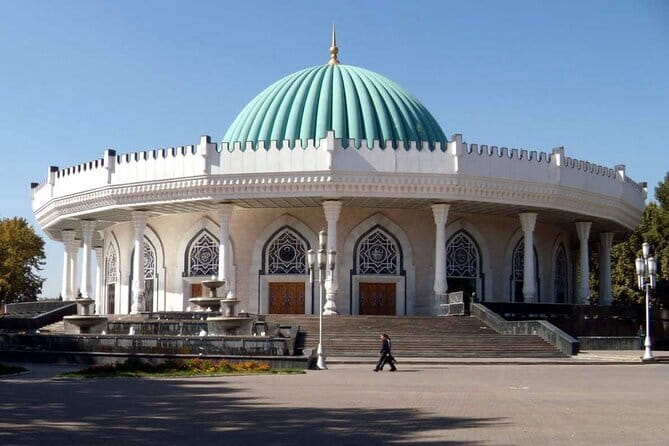
The Museum of Applied Art is the longest single museum stop, at about two hours. I consider that sensible. If you rush through Uzbekistan’s decorative arts, you miss one of the clearest ways to understand regional life.
The collection covers work from the early 19th century to the present. It includes carving, ceramics, embroidery, weaving, coin-related crafts, and other forms of handwork. The holdings are arranged in 20 sections and include more than 7,000 objects, although only some are displayed at a given time.
Your guide can help connect the objects to places around Uzbekistan:
- Chust is known for knives and tyubeteikas, the traditional skullcaps.
- Rishtan is linked with blue ceramics.
- Margilan is known for satin fabrics.
- Bukhara is associated with gold embroidery.
The museum groups its works into traditional regional styles, mid-20th-century pieces with ornamental patterns, and modern works influenced by current design. That range keeps the visit from feeling like a display of only old objects.
I like this stop because it gives context for things you may later see in markets and shops. Patterns, fabrics, ceramics, and carved details become easier to recognize. The possible downside is simple: two hours is a long time if decorative art is not your interest. If it is, this is one of the best places on the route to slow down and ask questions.
Museum photography and video are not included. Expect a cash charge of about $1 to $2 per museum, so keep small notes available.
A completely different kind of day:
- Best of Tashkent Mountains: Amirsoy, Chimgan & Charvak Trip
★ 4.8 · 567 reviews - Samarkand One Day Tour – Departure From Tashkent
★ 5.0 · 313 reviews - Amirsoy, Chimgan & Charvak Full-Day Adventure
★ 4.9 · 82 reviews - Shymkent Day Tour from Tashkent
★ 4.6 · 71 reviews
Independence Square and the Earthquake Memorial
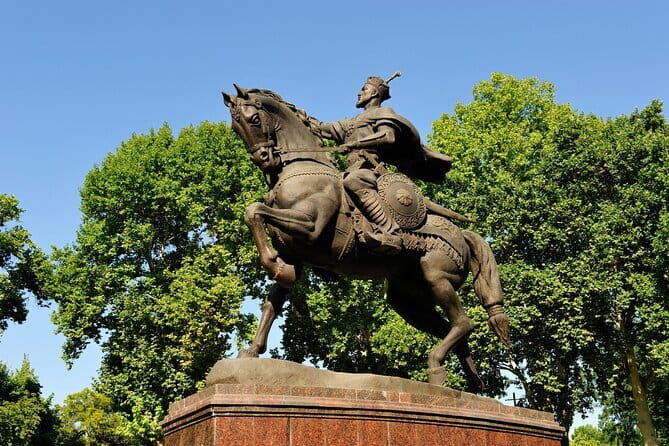
Independence Square, also called Mustakillik Square, occupies about 20 minutes of the tour. It was formerly known as Red Square and is now a broad walking area near the Anhor River, with fountains and many trees.
The stop gives you a look at the capital’s political and civic face. It is a place of open space and ceremony rather than old masonry or market noise. Your guide can place it within Uzbekistan’s modern national story, while you take in the scale of the avenues and planted areas around it.
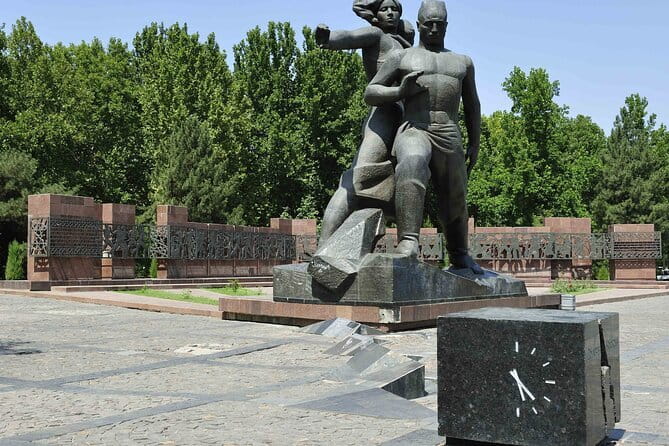
After that comes the Monument of Courage Earthquake Memorial, with another 20-minute visit. The monument remembers the major earthquake that struck Tashkent and destroyed much of the city. The disaster changed the capital’s appearance and helps explain why so much of central Tashkent feels planned, spacious, and rebuilt.
These two stops are short, so treat them as visual pauses rather than full sightseeing sessions. You will learn more if you ask your guide to connect the earthquake to the city’s reconstruction and the meaning of independence in public spaces.
Khast-Imam, Tashkent’s old religious center
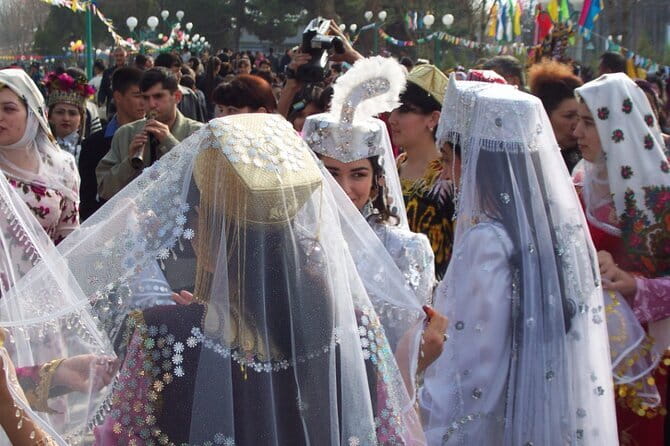
The Ensemble Hazrati Imam, commonly called Khast-Imam, receives about 90 minutes. For many people, this will be the most important stop of the day.
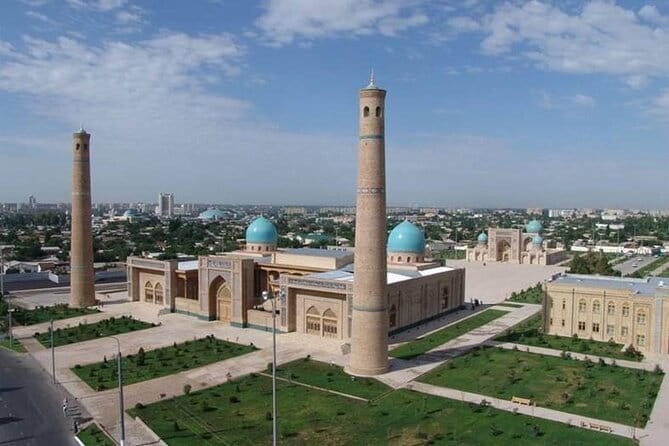
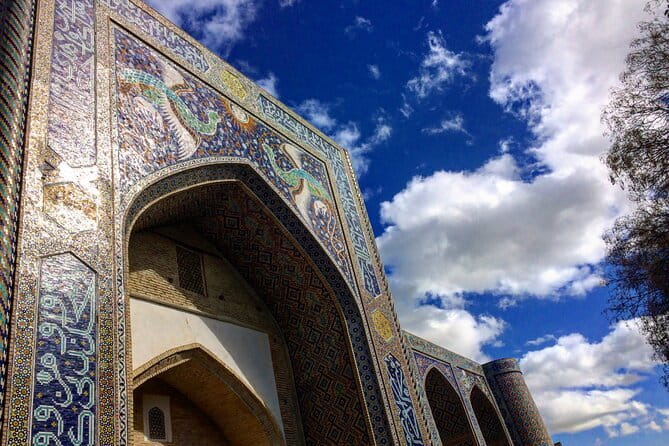
The complex lies in the old city and includes the Tillya Sheikh Mosque, Abu Bakr Kaffal Shashi Mausoleum, Barak Khan Madrasah, and Imam al-Bukhari Islamic Institute. Together, these buildings give you a stronger sense of Tashkent as a center of Islamic learning and worship.
The visit is valuable because it changes the tone of the tour. Earlier stops show civic planning, national symbols, and artistic production. Here, you encounter religious buildings and a historic district that connect Tashkent to the wider Muslim world.
Allow time to notice the different roles of the buildings. A mosque is not the same as a mausoleum, and a madrasah is not simply an old school building. Your guide can explain how each part fits into the ensemble and why the square matters to local religious life.
Dress respectfully for this stop. The supplied tour details do not specify a dress code, but a conservative approach is sensible at active or important religious sites. Ask your guide about photography and where you may enter.
The 90-minute allocation is generous compared with the short square visits, yet the complex can still feel rushed if you want detailed architectural study. I would use the time for both explanation and quiet observation rather than trying to photograph every corner.
Tashkent Metro, an underground gallery
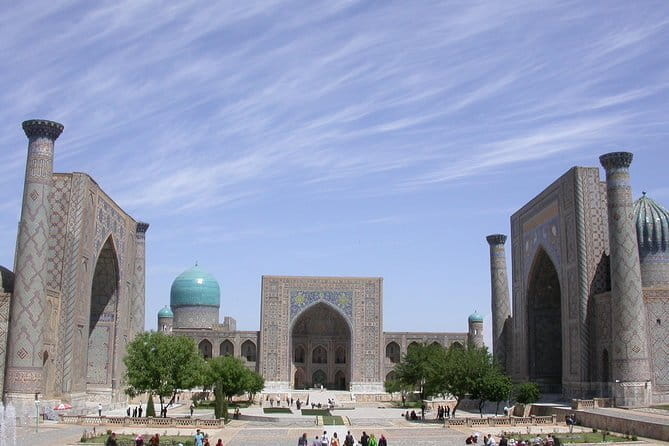
Tashkent’s metro opened in 1977 as the first underground system in Central Asia. The tour sets aside about 30 minutes to see it.
This is one of the most distinctive parts of the day because the metro is treated as architecture. Stations use marble, granite, columns, decorative reliefs, and different visual designs. Instead of viewing the underground only as transport, you get a short look at a public art and engineering project.
The metro also adds variety. After the open squares and religious complex, you move below street level and see another side of the capital. A half-hour will not cover every station, but it gives you a sample of the system’s design.
The tour includes the entrance ticket. Keep in mind that the metro is a working transport network, so the experience is different from entering a quiet museum. Your guide can help you focus on the stations selected for the visit and explain how the system fits into city life.
Chorsu Bazaar, where the day becomes local
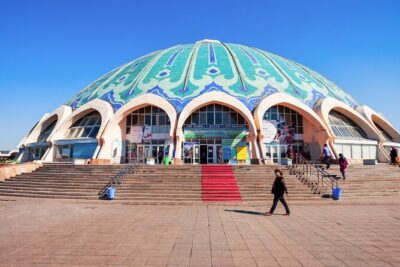
The final listed stop is Chorsu Bazaar, with about 45 minutes. This farmers market operates beneath a huge cupola and sells spices, grain, dairy products, and seasonal fruit.
This is where the tour shifts from monuments to daily life. You can watch shoppers compare produce, see the colors of local clothing, and get a feel for the pace of an ordinary market. It is also the place where your senses do the work: the smells of spices, the piles of food, and the movement around the stalls tell you more than a formal square can.
Forty-five minutes is enough for an introduction, but not enough for a slow market expedition. If you want to browse carefully or buy gifts, you may need to decide what matters most. Ask your guide about products, prices, and how to handle purchases before you start shopping.
Chorsu is a strong final stop because it leaves you with a human-scale impression of Tashkent. You have seen the capital’s official spaces and historic buildings, then finish among food sellers and shoppers. That contrast gives the day a better balance.
What $90 per person really covers
The $90 price is easiest to judge by looking at what you would otherwise need to arrange. It includes an air-conditioned vehicle, a local licensed guide, the driver, hotel pickup and drop-off, entrance fees to the museums and sites, and all listed taxes and fees.
For a private 6 to 7-hour day, that bundle can be worthwhile, especially if you are splitting the cost with companions. You are paying for a dedicated vehicle and guide, not simply admission to a set of attractions. The value is strongest for first-time visitors who want an organized overview without sorting out routes between widely separated parts of the city.
The price is less compelling if you already know Tashkent, prefer public transport, or want to spend a whole day at only one or two places. The schedule is broad by design. You pay for coverage and convenience more than for long, unhurried visits.
Group discounts may be available, and the activity is private, so ask for the current group rate if several people are booking together. Tips for the guide and driver are not included. Photo and video charges at museums are also extra, usually $1 to $2 per museum in cash.
Who will get the most from this tour
I would recommend this tour to a first-time visitor with one full day in Tashkent, especially if you want the main landmarks explained in context. It also suits families, couples, and small groups who value a private vehicle and a flexible setting for questions.
The tour is a good fit if you want a little of everything: public squares, architecture, applied art, religious sites, underground stations, and market life. The supplied practical information says most people can participate, and the route is near public transportation, though the organized vehicle means you do not need to depend on it during the tour.
You may want another plan if you dislike quick stops or prefer a slow photography day. The two-hour museum visit and 90-minute Khast-Imam visit are the only parts with much breathing room. The other landmarks receive around 20 to 45 minutes.
Communication appears to be a strength of the operator. One Japanese-language review describes prompt replies after booking and an itinerary sent early with the guide’s and driver’s contact details. That kind of preparation is useful in a destination where clear meeting arrangements matter.
The tour has a rating of 5 from two posted reviews, including praise for the guide’s helpful manner, polite service, and strong local understanding. That is encouraging, but the sample is small. I would treat it as a positive signal, not a guarantee that every departure will feel identical.
Booking details worth checking
Confirmation is provided at booking. The tour is private, and only your group participates.
The listed start time is 10:00 a.m. at Amir Temur Square, with the activity ending back at the meeting point. Pickup and drop-off at your hotel are offered, so confirm whether the vehicle will collect you at your accommodation or whether you must meet at the square.
Free cancellation is available until 24 hours before the local start time. If you cancel or request changes inside that 24-hour window, you should not expect a refund or an accepted change.
You are responsible for checking Uzbekistan’s current entry requirements before arrival. The tour information directs you to verify the country’s visa policy, and those rules can change.
Should you book the Tashkent city tour?
Book it if you want an efficient first introduction to Tashkent, prefer a private group, and value a guide who can connect the metro, crafts, Islamic sites, and modern city planning. The inclusion of transport and entrance tickets makes the $90 price reasonable for many small groups.
Skip it if you want to linger at every sight, spend most of the day shopping, or explore independently by metro. The itinerary moves quickly, but it covers an unusually wide slice of the city. For a first day, that broad view can help you decide where to return on your own.
FAQ
How long does the Tashkent city tour last?
The tour lasts approximately 6 to 7 hours.
What time does the tour start?
The listed start time is 10:00 a.m.
Is hotel pickup included?
Yes. Hotel pickup and drop-off are included, although the listed meeting point is Amir Temur Square. Confirm the exact pickup arrangement before the tour.
Is this a private tour?
Yes. Only your group participates.
What is included in the price?
The price includes an air-conditioned vehicle, all listed taxes and fees, a local licensed guide, entrance tickets to the museums and sites, and hotel pickup and drop-off.
Are photography and video fees included?
No. Museum photo and video charges are paid in cash at the entrance and cost about $1 to $2 per museum.
Can I cancel for a full refund?
Yes, if you cancel at least 24 hours before the experience start time. Cancellations or changes made less than 24 hours before the start are not refunded or accepted.
Just added in Tashkent
- Uzbekistan and Tajikistan 9-Day Tour★ 5.0 · 1 review
- Tashkent International Airport (TAS) to Tashkent – Arrival Private Transfer★ 5.0 · 2 reviews
- Uzbek Brews & Views: Tashkent Craft Beer Discovery Tour★ 5.0 · 2 reviews
- 8-Day Private Tour in Uzbekistan with Pick Up★ 5.0 · 2 reviews
- Uzbekistan Tour – 6 Days 5 Nights★ 5.0 · 4 reviews
- Uzbekistan Private Tour 6 Days★ 5.0 · 1 review
- Tashkent to Tashkent International Airport (TAS) – Departure Private Transfer★ 5.0 · 1 review
- Full Day Private Tour to Fergana Valley from Tashkent★ 5.0 · 1 review
City Tours in Tashkent, compared.
Welcome to Tashkent (City Tour with local guide)
Read our review →
Tashkent city Night Tour with Dinner & Free Pro Photography
Read our review →
Tashkent Private Full-Day City Tour on a Premium Car
Read our review →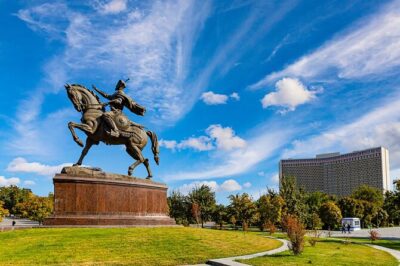
Tashkent City Tour with Hotel Pickup and Drop off
Read our review →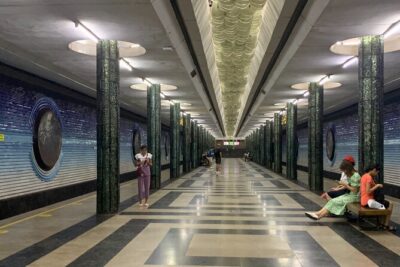
Browse the lists this tour appears in