
Review · TRAIN EXPERIENCES
Uzbekistan 6 Days Private Tour Khiva-Bukhara-Samarkand by Train
Ancient cities, one smart route. This six-day private tour connects Khiva, Bukhara, and Samarkand with licensed local guides, private transfers, centrally located hotels, and train tickets included. I like the efficient eastward route and the fact that the major museum and monument fees are covered. I also like the careful connection planning, with drivers meeting you at airports and railway stations.
The main consideration is pace. You cover three major cities in less than a week, and the second day includes several hours on the train from Khiva to Bukhara. Train schedules can vary, and the Bukhara to Samarkand service depends on availability, so this trip suits you best if you prefer a well-organized overview to a slow, stay-put holiday.
In This Review
- Five useful things to know before booking
- Why this six-day route works
- Day 1: Urgench to the tiled streets of Khiva
- Day 2: A final Khiva morning and the train to Bukhara
- Day 3: Bukhara’s pools, domes, and royal fortress
- Day 4: Free time, then onward to Samarkand
- Day 5: Timur, Registan, and Samarkand’s sacred quarter
- Hotels, transport, guides, and what the price really buys
- Who should book this Uzbekistan tour?
- Should you book it?
- FAQ
- Where does the tour begin?
- How long does the tour last?
- Which cities are included?
- Are train tickets included?
- How long is the train from Khiva to Bukhara?
- Are hotels included?
- Are breakfasts included?
- Are entrance fees included?
- Is this a private tour?
- Can the tour be customized?
Five useful things to know before booking
- Khiva begins at the airport: You are met at Urgench Airport and transferred directly to the walled city of Itchan Kala.
- The route uses trains, not long road hauls: Rail links carry you from Khiva to Bukhara and then toward Samarkand.
- The private format keeps the schedule flexible: Only your own group takes part, and the tour can be customized at no or small extra charge.
- Major admissions are covered: Entrance fees to the listed museums and monuments are included, though photo and video charges usually cost $1 to $2 per museum.
- The price covers the costly basics: At $800 per person, you receive five nights, five breakfasts, guides, transport, train tickets, and airport transfers.
- Planning matters: The tour is commonly reserved well ahead, with an average booking lead time of about 153 days.
Why this six-day route works
Uzbekistan is not a country you want to experience as a string of disconnected day trips. Khiva, Bukhara, and Samarkand each have a different feel, yet together they tell a clear story of Central Asian cities, Islamic architecture, royal power, trade, scholarship, and pilgrimage.
This route moves in one direction. You arrive in Urgench, visit Khiva, take the train to Bukhara, continue by rail to Samarkand, and fly home from there. That arrangement avoids backtracking, which saves both time and energy.
The private setup matters here. Your airport pickup, city transfers, and guide arrangements are handled for your group rather than folded into a large coach schedule. You can also ask for changes, including an added desert or mountain detour. The advertised policy says customization comes at no charge or a small charge, but you should confirm the exact cost before booking.
The tour is priced at $800 per person. That is not simply a payment for sightseeing. It includes five nights in centrally located, highly rated three-star or boutique hotels, breakfast each morning, private air-conditioned transport, local guides in all three cities, train tickets, admission fees, and 24-hour customer service.
That package can offer good value, especially if you would otherwise need to arrange three hotels, several transfers, two rail journeys, city guides, and monument tickets yourself. The main weakness is that the exact hotels and train classes are not specified in the information provided. Ask for those details before paying if room standards or rail comfort are important to you.
More rail trips between the cities:
- Urgench Airport / Railway Station – Khiva Transfer
★ 3.0 · 2 reviews - 2 Days Tour to Bukhara and Samarkand from Tashkent by train
★ 5.0 · 53 reviews - Tashkent Airport & Train Station Pick Up & Drop Off
★ 4.5 · 50 reviews
Day 1: Urgench to the tiled streets of Khiva
Your arrival begins simply. A driver meets you in the Urgench Airport arrival hall, holding a sign with your name. The listed airport meeting and transfer time is short, about 15 minutes, before you reach Itchan Kala in Khiva.
Itchan Kala is Khiva’s walled inner city, laid out as a regular rectangle measuring about 650 by 400 meters. Its brick walls reach up to 10 meters high, and the old town covers about 26 hectares. This is the part of Khiva that gives the city its special character: you are not moving between isolated ruins, but walking through a compact historic quarter filled with former palaces, mosques, religious schools, courtyards, and narrow streets.
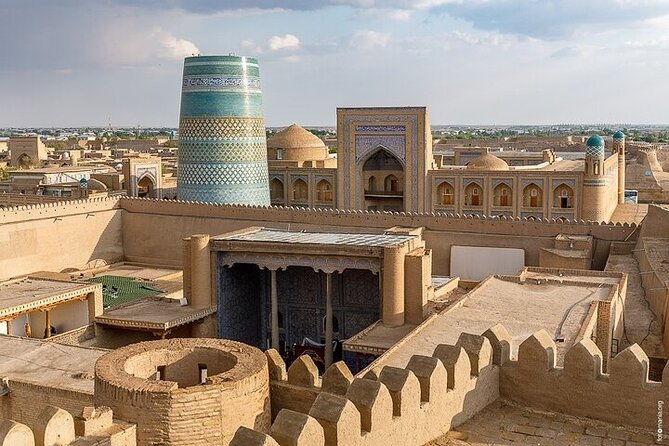
The first major sight is Kalta Minor, the short minaret. Its unfinished form is the point. Mohammed Amin Khan began it in 1851 with the goal of creating a tower more than 70 meters high, but construction stopped at 29 meters. Glazed tile and majolica cover the structure, giving it a finish far more elaborate than its incomplete height suggests.
Allow two hours for Kunya Ark, Khiva’s large citadel. It sits against the western wall of Itchan Kala and served as the khan’s fortified center. The current layout began under Arang Khan in the late seventeenth century, though the site reaches further back. This is one of the places where a guide adds real value, because the citadel is easier to understand when you can separate royal quarters, defensive spaces, and ceremonial areas.
The Pahlavan Mahmud Mausoleum offers a different mood. Pahlavan Mahmud was a poet, philosopher, strongman, and reputed healer. What began as a modest memorial grew into a larger religious complex with a khanaka and mosque. Its large blue-tiled dome is one of Khiva’s most memorable architectural details.
Khiva’s Juma Mosque is unusual for its forest of wooden columns and quiet interior. It occupies a central position in Itchan Kala, an appropriate location for a Friday mosque where the khan’s name was once read during prayers. The planned visit lasts about an hour.
Tash Khauli Palace, built between 1830 and 1838 for Allakuli Khan, shows royal Khorezm at its most decorative. You then continue to the Islam Khodja Complex, which includes a madrasa and minaret and is linked to Islam Khodja, a grand vizier and cousin of Muhammad Rahmi Bahadur II.
This is a full first day. If your flight arrives early, the schedule gives you a strong introduction to Khiva. If you arrive tired, the number of major stops may feel demanding. The good news is that the following morning returns you to Itchan Kala for another four hours, so you do not need to absorb every detail at once.
Day 2: A final Khiva morning and the train to Bukhara
The second morning gives you more time inside Itchan Kala. Use it to revisit the places that caught your attention, enter additional monuments, or simply walk the old streets without rushing from one stop to the next.
The tour then transfers you to Khiva railway station. The train to Bukhara is scheduled to depart at either 3:00 p.m. or 6:00 p.m., depending on the date. The listed rail segment takes about six hours, so this is not a quick hop. It is a major travel block, but it also keeps you off the road and turns the distance between western and central Uzbekistan into part of the experience.
You arrive in Bukhara and transfer from the station to your hotel. The evening plan is light, which is sensible after a long rail journey. Since the railway timing depends on the day, confirm your exact departure and arrival times before booking flights, meals, or independent evening plans.
Day 3: Bukhara’s pools, domes, and royal fortress
Bukhara is more spread out in feel than Khiva, though many key sights are still grouped within the old center. Your day starts at Lyab-i-Hauz, a square built around a historic water reservoir. The ensemble includes the Nodir Divan Begi Madrasa, a khanaka, the pool, and a caravanserai.
The pool gives this area a calmer rhythm. It was a social and practical center, and today it is a natural place to pause between monuments. Two hours are planned here, giving you time to appreciate the surrounding buildings rather than treating the square as a quick photo stop.
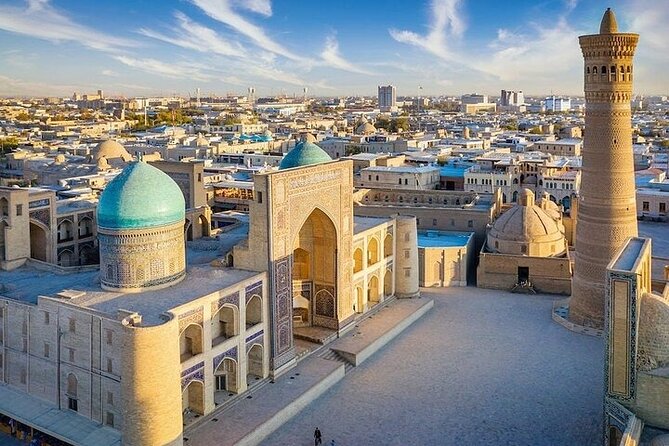
Next comes the Po-i-Kalyan complex and its great minaret. The Kalyan Minaret was built in 1127 and reaches 45.6 meters. The surrounding complex includes the Friday Mosque and Mir-i-Arab Madrasa. The minaret survived the Mongol conquest, reportedly because Genghis Khan was so impressed by it that he spared it. That story may be polished by time, but it helps explain why the tower has such weight in Bukhara’s identity.
The Ark of Bukhara is a royal fortress within the city. Bukhara’s rulers lived here for more than a thousand years, and the site served as the center around which the medieval city grew. Allow an hour. The Ark is a place for understanding power and administration, not just admiring tilework.
Across from the fortress, Bolo Hauz Mosque is known for its relationship to the artificial pond in front of it. Begun in 1712, it is one of the finest major buildings from Bukhara’s pre-modern period. The visit is brief, about 30 minutes, but its carved wooden columns and setting make it worth your attention.
Maghak-i Attari Mosque reaches further back than most of the city’s Islamic monuments. It served earlier as a Buddhist and Zoroastrian temple, and its brickwork shows how older sacred sites could be absorbed into later religious life. That layered use makes the building especially valuable for anyone interested in Central Asian history beyond the usual royal and Islamic monuments.
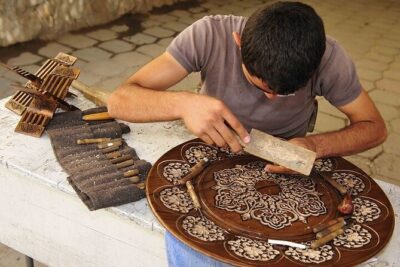
The day finishes in the trading domes, medieval market buildings where artisans still work. You may find workshops and small goods here rather than a modern shopping center. This is a good place to browse at your own pace and buy something connected to local craft.
A few more options to weigh up in Khiva and Urgench
- Khiva: Historical City Highlights Guided Walking Tour
★ 4.8 · 156 reviews - Transfer: Bukhara – Khiva via Ancient Fortresses
★ 4.5 · 101 reviews - Daytrip From Khiva To Ancient Fortresses
★ 4.6 · 60 reviews - Khiva Historical City Highlights Guided Walking Tour
★ 5.0 · 30 reviews
Day 4: Free time, then onward to Samarkand

Bukhara receives a half-day of free time before your next train. Four hours is enough for a second look at the old center, a slower meal, or additional monuments not included in the guided route.
This free period is one of the better design choices in the schedule. The previous day covers many major sites, and you may want time without a guide to return to Lyab-i-Hauz, inspect the trading domes, or simply sit with a cup of tea. The tour description calls this a chance for a treasure hunt, but keep your plans flexible because you must reach Kagan Railway Station.
Kagan Station is about 15 kilometers from Bukhara, and the transfer takes around 20 minutes. The train to Samarkand is subject to availability. Once you reach Samarkand, a short transfer takes you to your hotel.
The rail arrangement is efficient, but it is also the itinerary’s main uncertainty. You should confirm the Bukhara to Samarkand train before finalizing your travel dates. If service is unavailable on your chosen day, ask how the operator will handle the transfer and any extra cost.
Day 5: Timur, Registan, and Samarkand’s sacred quarter
Samarkand receives the tour’s biggest sightseeing day. Start at Gur Emir Mausoleum, the reconstructed tomb of Timur, also known as Tamerlane. The building dates to 1404 and 1405, and its interior is tied to the memory of the conqueror and his family. The site also contains a large piece of green jade, described as the world’s largest.
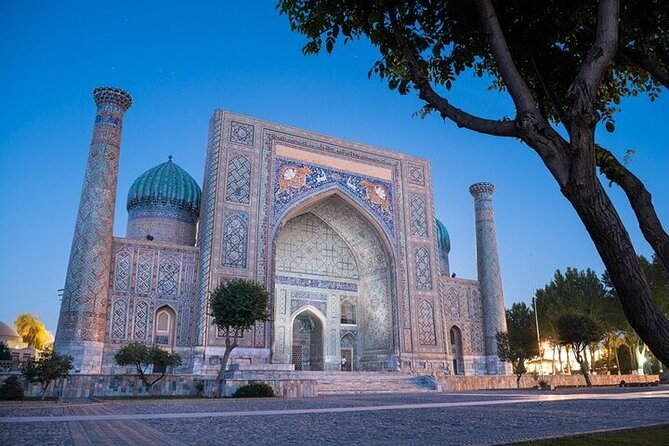
Then comes Registan, Samarkand’s great square. Three madrasas frame it: Ulugbek, Sherdor, and Tillokori. The square took its present form through repeated rebuilding, and the two-hour visit gives you time to examine the facades, courtyards, and shifting patterns of blue, gold, and white tile.
Bibi Khanym Mosque recalls the scale of Timur’s ambitions. Built between 1399 and 1404 after his campaign in Delhi, it was named for his wife and intended to have one of the tallest minarets of its time. The planned stop is only 30 minutes, so you may want to use the time for the main exterior view and central courtyard rather than trying to inspect every corner.
Nearby Siab Bazaar adds everyday life to a day otherwise filled with monuments. Its produce and handicrafts show the practical side of Samarkand. You have about 30 minutes, which is enough for a quick walk and perhaps a small purchase, but not a long meal or careful market browse.
Shah-i-Zinda is one of the most visually detailed sites on the route. The ensemble occupies the southeastern mound of Afrosiab and includes 44 tombs in more than 20 mausoleums. Its religious importance comes from the association with Kusam ibn Abbas, described here as a first cousin of the Prophet Muhammad. The complex is also a functioning sacred space, so respectful clothing and behavior are wise.
The final stop is Ulugh Beg Observatory. Only the foundations and part of a large sextant remain, but the site points to Samarkand’s scientific life under Timur’s grandson. Ulugh Beg was an astronomer, scientist, and architect, and his work helped advance astronomy in the region. The planned visit lasts an hour.
This day is packed. You move from one major sight to another, with six stops and a good deal of standing and walking. I would treat it as the grand finale, but not expect much unscheduled time.
Hotels, transport, guides, and what the price really buys
The package includes five nights in centrally located, highly rated three-star or boutique hotels. Central locations are useful in Khiva, Bukhara, and Samarkand because they reduce the time spent getting to the old centers. The exact hotel names are not supplied, so ask for them before booking if you care about room size, elevator access, or bathroom style.
An air-conditioned vehicle handles airport and station transfers and local transport. That matters in a six-day route with several changes of city. You are not left to find a station taxi after a long train ride.
Licensed local guides are provided in each city. This is important at places such as Kunya Ark, the Ark of Bukhara, and Shah-i-Zinda, where architecture alone does not explain the politics, beliefs, and personalities behind the buildings. The guides are local to each destination rather than one guide following the entire route.
One useful sign of organization comes from a previous booking that added Tashkent to the plan. The drivers, guides, and hotel staff all had printed copies of the itinerary, and the connections between four cities were arranged in advance. That does not guarantee every future connection will run perfectly, but it suggests the operator is used to coordinating multi-city programs.
Five breakfasts are included. Lunches and dinners are not listed, giving you room to choose your own meals. The only stated extra room cost is a $25 per person, per night single supplement. Photo and video fees at museums generally cost $1 to $2 per museum and are paid in cash. Tips for guides and drivers are not included and are appreciated for good service.
Visa support is available if your nationality does not qualify for a visa waiver, but you remain responsible for securing the correct visa online or through an Uzbek embassy. Check this before booking flights.
Who should book this Uzbekistan tour?
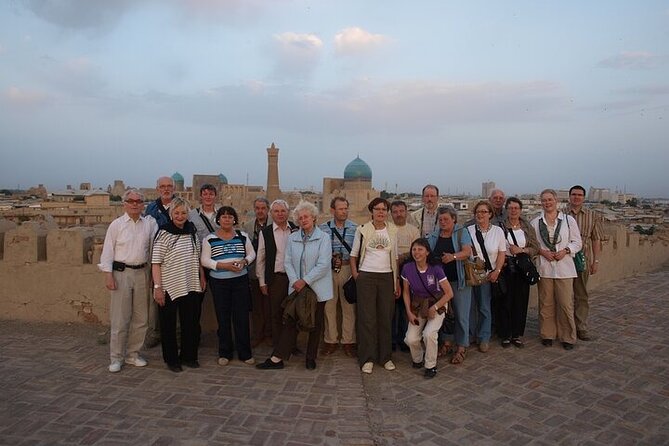
I would recommend it if you want the main Silk Road cities in one organized trip and value private transfers more than independent transport planning. It is especially suitable for first-time visitors, couples, families, and small groups that want guides but do not want to join a large coach tour.
You should also consider it if you have only six days and want to avoid backtracking. The train journeys make the route more practical than arranging separate road transfers between all three cities.
I would hesitate if you prefer slow mornings, long market visits, or several free days in each place. Samarkand’s sightseeing day is dense, and the Khiva to Bukhara train takes about six hours. You may also want to ask about train class, hotel names, and the exact handling of schedule changes before committing.
The cancellation terms are fairly clear: cancel at least three full days before the local start time for a full refund. Cancellations or changes inside that window are not accepted for a refund.
Should you book it?
Book this tour if you want a well-planned first look at Uzbekistan’s three headline cities with the costly basics bundled into one price. The route is logical, the private format is useful, and the included guides and admissions remove much of the usual planning work.
Do not book it expecting a leisurely retreat. This is a brisk historical tour, with full sightseeing days and important rail connections. Before paying, confirm the hotel names, train departures, rail class, and any added desert or mountain detour. For a short visit with limited time, the $800 package offers a practical way to see Khiva, Bukhara, and Samarkand without managing every transfer yourself.
FAQ
Where does the tour begin?
The tour begins at Urgench Airport in Urgench, Uzbekistan. A driver meets you at the arrival hall exit with a sign showing your name.
How long does the tour last?
The tour lasts six days and includes five nights of accommodation.
Which cities are included?
The route includes Khiva, Bukhara, and Samarkand. Arrival is through Urgench, and departure is from Samarkand Airport.
Are train tickets included?
Yes. Train tickets for the Khiva to Bukhara and Bukhara to Samarkand portions are included. The Bukhara to Samarkand train is subject to availability.
How long is the train from Khiva to Bukhara?
The listed train journey takes about six hours. Departure is scheduled at either 3:00 p.m. or 6:00 p.m., depending on the travel date.
Are hotels included?
Yes. Five nights are included in centrally located, highly rated three-star or boutique hotels.
Are breakfasts included?
Yes. The package includes five breakfasts.
Are entrance fees included?
Yes. Entrance tickets to the listed museums and monuments are included, along with all fees and taxes. Photo and video charges are separate and generally cost $1 to $2 per museum.
Is this a private tour?
Yes. Only your own group participates in the tour.
Can the tour be customized?
Yes. The tour can be customized at no charge or for a small charge. Desert and mountain detours are available as possible additions, so confirm the exact plan and price before booking.
Just added in Khiva and Urgench
- Urgench Airport / Railway Station – Khiva Transfer★ 3.0 · 2 reviews
- Traditional Khiva Cooking Class with Market Visit & Lunch★ 5.0 · 4 reviews
- Transfer From Khiva To Bukhara★ 5.0 · 2 reviews
- Old Khiva Stories with Your Local Guide★ 5.0 · 5 reviews
- Day Trip Top 3 Fortresses departure from Khiva Self-Guided Tour★ 5.0 · 2 reviews
- Plov Tour : Taste, Tradition & History of Plov with a local guide★ 5.0 · 1 review
- Master Class – Uzbek Bread (Khiva)★ 3.5 · 4 reviews
- A Night In The Kyzylkum Desert [2] From Khiva★ 4.5 · 3 reviews
Train Experiences, compared.
2 Days Tour to Bukhara and Samarkand from Tashkent by train
Read our review →
Uzbekistan 3 Day Private Tour Tashkent-Bukhara-Samarkand Bullet Train
Read our review →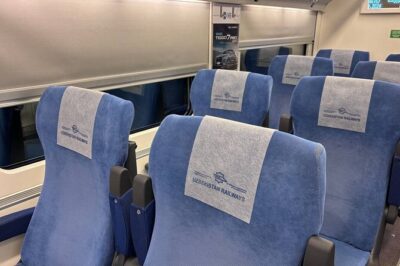
Afrosiyob high speed train tickets – Guaranteed Pass
Read our review →
Samarkand One Day Private Tour from Tashkent with Bullet Train
Read our review →
Samarkand Airport / Railway Station – Samarkand City Transfer
Read our review →
Transfer Tashkent Airport / Railway Station – Hotel
Read our review →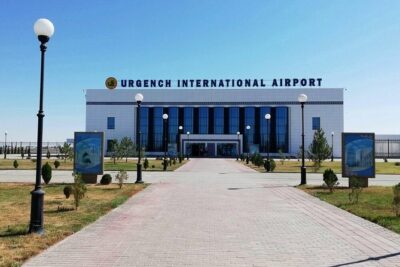
Urgench Airport / Railway Station – Khiva Transfer
Read our review →Browse the lists this tour appears in