
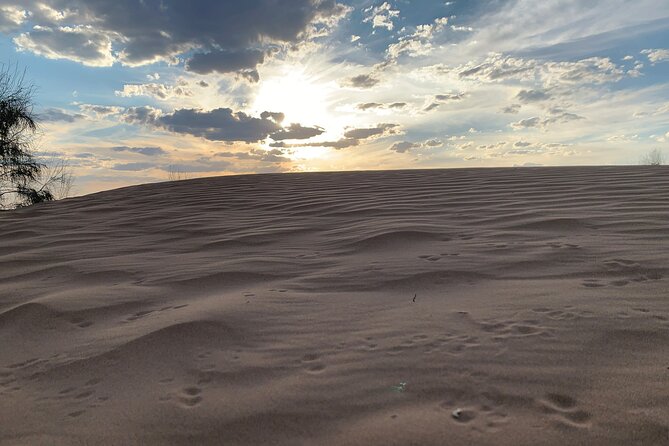
Review · ANCIENT FORTRESSES OF KHOREZM
Day Trip Top 3 Fortresses departure from Khiva Self-Guided Tour
Fifty fortresses, three worth your day. This private trip from Khiva takes you into Karakalpakstan’s semi-desert to see Kyzyl Qala, Toprak Qala, and Ayaz Qala, where ancient walls rise from open sand and scrub. I like the air-conditioned private vehicle and the fact that entrance tickets are included, so the day is simple to manage.
I also like the compact route: Kyzyl Qala to Toprak Qala takes about 10 minutes, followed by roughly 45 minutes to Ayaz Qala. The main consideration is that this is a self-guided outing, with no English guide included, and lunch is your responsibility.
In This Review
- Key points at a glance
- Why leave Khiva for the Ellik Qala forts?
- Starting at Khiva’s west gate
- Kyzyl Qala, the red fortress
- Toprak Qala, the former city of sand
- Ayaz Qala, the day’s big finish
- What the self-guided format really means
- Transport, timing, and comfort
- Is $60 a fair price?
- Who should book this fortress trip?
- Booking and cancellation advice
- FAQ
- How long does the fortress trip take?
- Which fortresses are included?
- Is transportation included?
- Are entrance tickets included?
- Is lunch included?
- Is an English guide included?
- Where does the trip start and finish?
- Should you book it?
Key points at a glance
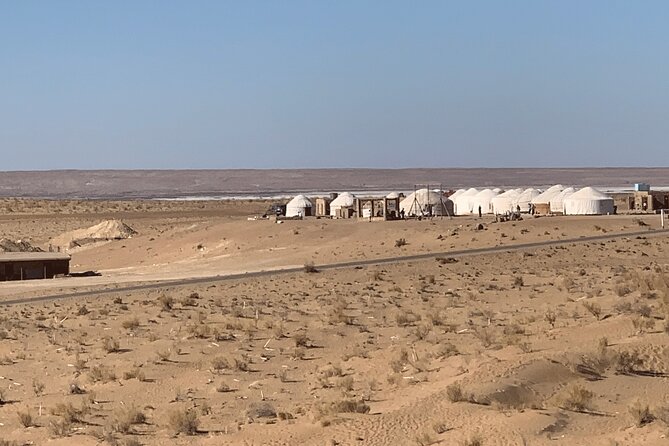
- Three major desert fortresses in one seven-hour trip: You visit Kyzyl Qala, Toprak Qala, and Ayaz Qala rather than trying to arrange separate transport.
- A genuinely private outing: Only your own group participates, giving you a quieter and more flexible day than a large coach tour.
- Ancient walls in a striking setting: Some fortifications date back more than 2,000 years, and parts of Ayaz Qala’s walls still reach 10 meters high.
- A practical transfer from Khiva: The total driving distance is about 210 kilometers, with an air-conditioned vehicle included.
- Independent sightseeing: Tickets are covered, but you explore the sites without an English-speaking guide.
- Good value at $60 per person: The price makes the most sense for two or more people who want private transport and a full day beyond Khiva.
Why leave Khiva for the Ellik Qala forts?
Khiva’s Ichan Kala is a superb place to walk, but the fortresses outside the city show a different side of the region. Here, old settlements and defensive walls are scattered across the semi-desert east and north of Urgench, in the area traditionally known as Ellik Qala, or the 50 fortresses.
The name is a useful clue, though the area contains about 20 known forts rather than exactly 50 surviving sites. Many were once part of settlements, palaces, or defensive networks linked to ancient Khorezm. Irrigation was central to life here. When canals failed or shifted, towns lost their water supply and were eventually left to the desert.
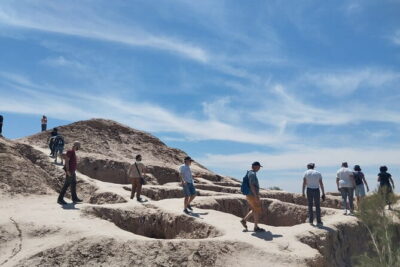
That slow disappearance gives the sites their particular appeal. You are not walking through a restored complex with polished floors and complete roofs. You see exposed brick, broken walls, empty courtyards, and broad views with very little around them. I find that much more revealing than a tidy reconstruction because the setting helps explain why these places mattered and why they vanished.
The three stops also give you a useful progression. Kyzyl Qala is compact and defensive. Toprak Qala gives you the remains of a major city and palace. Ayaz Qala provides the grandest visual finish, with long walls set on a flat hilltop.
More desert fortresses of Khorezm:
- Transfer: Bukhara – Khiva via Ancient Fortresses
★ 4.5 · 101 reviews - Daytrip From Khiva To Ancient Fortresses
★ 4.6 · 60 reviews - Guided Tour To Old Fortresses
★ 5.0 · 25 reviews
Starting at Khiva’s west gate
The meeting point is at the west gate of Ichan Kala, listed as 99H4+CRQ in Khiva. Pickup is offered, but confirm the exact pickup arrangement when booking if you are not beginning at the gate.
The day lasts about seven hours, including all driving, sightseeing, and a possible lunch break. After breakfast, you leave Khiva for the first fortress. The drive to Kyzyl Qala takes less than an hour, making this an easy morning departure rather than an exhausting cross-country transfer.
The total route covers about 210 kilometers. That matters because the fortresses are not close enough to connect sensibly by ordinary public transport in one day. Hiring a car independently may be possible, but this outing removes the need to arrange a driver, negotiate separate admission, or work out the sequence yourself.
The private format is another practical advantage. Only your group takes part, so you are not tied to the pace of a large bus. That does not mean the trip includes a guide. The driver handles the transport, while you visit the ruins on your own.
A French-language comment praises the driver’s friendliness, which fits the most important role here: safe, pleasant transport between widely separated sites. Since no guide is included, you should be comfortable reading the site information available at each fortress or preparing a little before leaving Khiva.
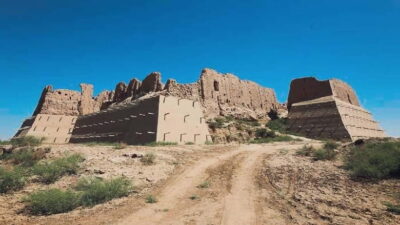
Kyzyl Qala, the red fortress
Your first stop is Kyzyl Qala, meaning Red Fortress in Uzbek. You have about 40 minutes here, and admission is included in the $60 price.
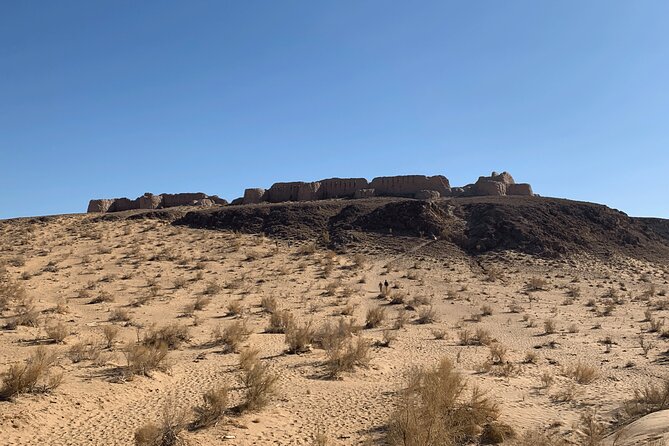
The fortress dates from the first to fourth centuries AD and was part of ancient Khorezm. It spent centuries buried in the desert before Professor Tolstov identified it in 1938. That detail gives the stop extra weight. What looks at first like a weathered mound is the remains of a place that disappeared from ordinary sight and later returned through archaeological work.
Forty minutes is enough to walk around the main remains and take in the structure, but it is not a long archaeological visit. Without an English guide, you may get more from it if you have already read a short description of ancient Khorezm and the role of fortified settlements.
I would treat Kyzyl Qala as an introduction rather than the main event. It prepares you for the scale and isolation of the next two sites. The short transfer to Toprak Qala, around 10 minutes, keeps the morning moving and avoids a long wait between stops.
Toprak Qala, the former city of sand
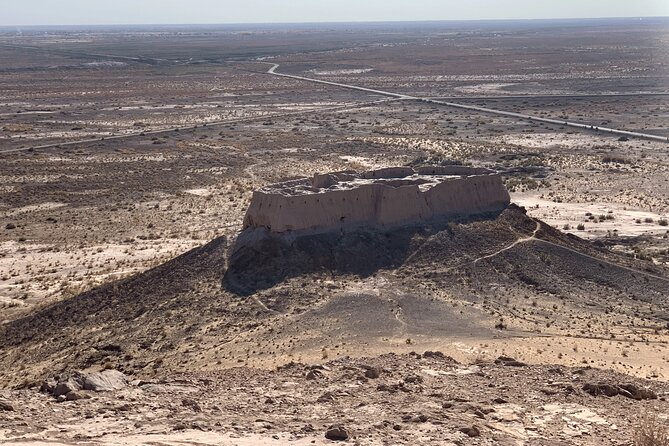
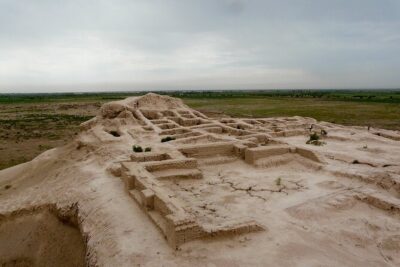
Toprak Qala means Sand Fortress. It was once the largest city in the region, measuring roughly 350 by 500 meters. Those dimensions help you understand that this was not simply a small outpost. It was a substantial urban center with palatial buildings and an organized settlement.
The city was eventually marooned by the destruction of its irrigation canals. Water failure turned a functioning center into a place surrounded by sand. The story is especially clear here because the size of the site contrasts with its present emptiness.
You have one hour at Toprak Qala. That is the longest scheduled visit of the first two stops, and it should be. The site offers more room to explore and more structure to interpret. Excavations by the Russian archaeologist Tolstov uncovered palace friezes dating from the second and third centuries AD.
The word palace can create the wrong expectation. You will not find a complete royal residence waiting for you. Instead, you see archaeological remains that hint at the importance of the complex and help you picture the former city. The lack of a guide means you will need to supply some of the explanation yourself, but the physical scale does much of the work.
I would use this hour to move slowly rather than rush from wall to wall. Look at how much ground the settlement covered, then consider the canals that once made life possible. This is the stop where the relationship between water, power, and settlement becomes easiest to grasp.
More self-guided walks in Khiva and Urgench:
- The Golden City of Samarkand: A Self-Guided Audio Tour
★ 4.0 · 4 reviews
Ayaz Qala, the day’s big finish
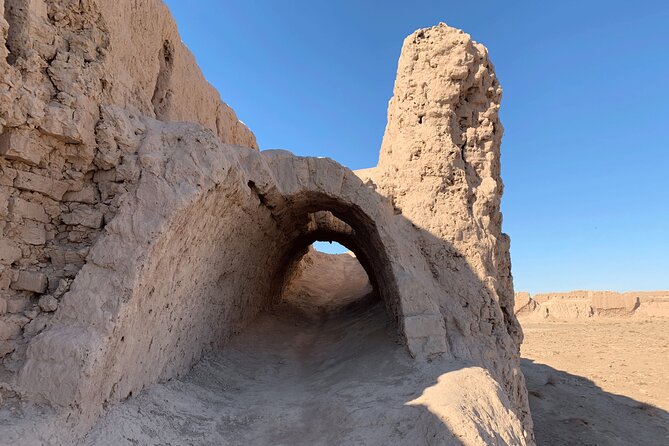
Ayaz Qala is the strongest reason to choose this particular three-fort route. It is described as a must-see fortress in the desert, and the setting helps explain why. The outer walls sit on a flat hilltop, giving you a clear sense of the fort’s size and position.
Parts of the walls survive at heights of up to 10 meters. The fortifications date back at least to the fourth century BC, making Ayaz Qala older than the other two stops in the broad sequence presented here. You can see why it is often treated as the visual highlight: long surviving walls, open surroundings, and a site large enough to feel defensive rather than domestic.
The scheduled visit lasts one hour. That should allow time to examine the surviving sections and understand how the hilltop position helped protect the settlement. Since the experience is self-guided, take your time with the basic questions: Which side would an approaching force face? How were people and supplies moved? What could defenders see from the walls?
Do not expect a fully preserved fortress. These are ruins exposed to a harsh climate, and the appeal comes from what remains rather than from intact rooms. You might find the loose, open quality thrilling, while someone looking for reconstructed interiors may find it sparse.
After Ayaz Qala, the drive back to Khiva takes about one hour and 40 minutes. That final stretch makes the day longer than the sightseeing schedule alone suggests. Plan for a full outing, not a quick morning excursion.
What the self-guided format really means
The title describes this as a self-guided tour, and that is an important part of the decision. You get transport and entrance tickets, but no English guide. The driver is not presented as an archaeological interpreter, so you should not expect a running explanation during the journey or a guided walk at each fortress.
For an independent visitor, this can be a strength. You can look around without listening to a long lecture, choose your own pace, and focus on photography or the parts of the ruins that interest you most. The private format also makes it easier to pause briefly or spend your attention where you want.
The trade-off is context. These forts are old, damaged, and spread across wide areas. Without background information, you may miss why a wall mattered, how the canal system worked, or how the sites fit into ancient Khorezm.
I would prepare a few notes before breakfast. Even a basic timeline covering the first millennium BC through the early centuries AD will make the remains easier to read. If you want detailed archaeological interpretation in English, this is probably not the right format unless you arrange a guide separately.
Transport, timing, and comfort
The included air-conditioned vehicle is not a minor detail. The route is long, and much of the day is spent crossing open semi-desert between Khiva and the forts. Air conditioning makes the transfer more comfortable and gives you a reliable base between walks.
The driving breakdown is straightforward:
- Less than one hour from Khiva to Kyzyl Qala
- About 40 minutes at Kyzyl Qala
- Around 10 minutes to Toprak Qala
- About one hour at Toprak Qala
- Roughly 45 minutes to Ayaz Qala
- Around one hour at Ayaz Qala
- About one hour and 40 minutes back to Khiva
The schedule also allows for a lunch break if needed, but lunch is not included. Bring food or arrange your plan with the driver before leaving. Do not assume a meal is waiting at one of the forts.
Good weather is required. These sites are exposed, and poor conditions can make both the drive and the walks unpleasant or unsafe. If the operator cancels because of weather, you are offered another date or a full refund.
Is $60 a fair price?
At $60 per person, the value depends heavily on group size. For a private seven-hour trip with an air-conditioned vehicle, entrance fees, and transport over roughly 210 kilometers, the price is reasonable, especially if two or more people share the outing.
You are paying for convenience more than luxury. The package does not include lunch, an English guide, or a restored attraction with elaborate visitor facilities. The main product is a practical private transfer to three difficult-to-reach archaeological sites.
Solo visitors may find the cost harder to justify, since the same private vehicle expense is carried by one person. A couple, family, or small group gets better value because everyone shares the transport while still enjoying a private day.
The included admission tickets also help keep the final cost clear. You do not need to add entrance fees at each fortress, though you should still budget for lunch and any personal expenses.
Who should book this fortress trip?
I would recommend it to you if you have already seen Khiva’s main sights and want a day focused on ancient ruins, open space, and archaeology. It suits people who enjoy forming their own impressions rather than needing every stop explained by a guide.
It is also a good fit for a small private group that wants a simple route. You leave from Khiva, visit three of the area’s strongest sites, and return to the city without arranging several separate rides.
You may want another option if you need extensive English commentary, dislike long drives, or prefer polished museums and intact buildings. The fortresses are exposed ruins, and the day includes a substantial amount of time in the vehicle.
The trip should work for most participants, and service animals are allowed. It is also near public transportation at the Khiva meeting point. Still, the individual sites involve outdoor sightseeing around ancient walls, so anyone with mobility concerns should ask the operator for specific details before booking.
Booking and cancellation advice
Confirmation is provided at booking. The activity can be canceled without charge up to 24 hours before the start time for a full refund. Cancellations or changes made less than 24 hours before departure are not accepted for a refund, and the cut-off follows local time in Uzbekistan.
Because the trip depends on good weather, I would avoid placing it at the very end of a tightly scheduled Khiva stay. A weather cancellation may be moved to another date, but you need a spare day for that solution to help.
FAQ
How long does the fortress trip take?
The total duration is approximately seven hours, including driving, sightseeing, a possible lunch break, and the return journey to Khiva.
Which fortresses are included?
The trip visits Kyzyl Qala, Toprak Qala, and Ayaz Qala in Karakalpakstan.
Is transportation included?
Yes. An air-conditioned vehicle is included, with transport from Khiva to the fortresses and back.
Are entrance tickets included?
Yes. Admission tickets to all three fortresses are included in the price.
Is lunch included?
No. Lunch is not included, though the schedule allows for a lunch break if needed.
Is an English guide included?
No. This is a self-guided tour, and an English guide is not included.
Where does the trip start and finish?
It starts at the west gate of Ichan Kala in Khiva, at 99H4+CRQ, and ends back at the meeting point.
Should you book it?
Book this trip if you want the easiest way to reach three major fortress ruins beyond Khiva and you are happy to explore without an English guide. The private vehicle, included tickets, friendly driver report, and well-planned sequence make the $60 price sensible for a couple or small group.
Skip it if you need guided archaeological detail or want to spend every minute walking rather than driving. For independent-minded visitors, though, Ayaz Qala’s hilltop walls, Toprak Qala’s former city scale, and Kyzyl Qala’s buried-and-recovered story make this a strong day outside Khiva.
Just added in Khiva and Urgench
- Urgench Airport / Railway Station – Khiva Transfer★ 3.0 · 2 reviews
- Traditional Khiva Cooking Class with Market Visit & Lunch★ 5.0 · 4 reviews
- Uzbekistan 6 Days Private Tour Khiva-Bukhara-Samarkand by Train★ 5.0 · 4 reviews
- Transfer From Khiva To Bukhara★ 5.0 · 2 reviews
- Old Khiva Stories with Your Local Guide★ 5.0 · 5 reviews
- Plov Tour : Taste, Tradition & History of Plov with a local guide★ 5.0 · 1 review
- Master Class – Uzbek Bread (Khiva)★ 3.5 · 4 reviews
- A Night In The Kyzylkum Desert [2] From Khiva★ 4.5 · 3 reviews
Ancient Fortresses of Khorezm, compared.
Transfer: Bukhara – Khiva via Ancient Fortresses
Read our review →
Private Daytrip to 7 Ancient Fortresses of Khorezm
Read our review →
Browse the lists this tour appears in