
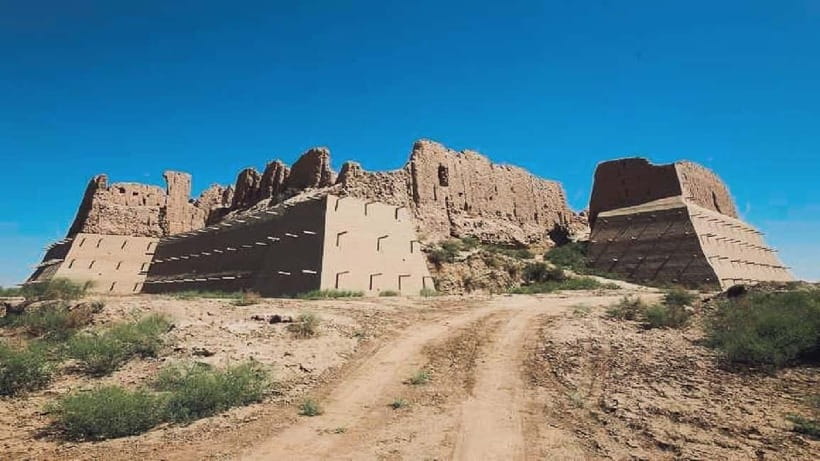
Review · ANCIENT FORTRESSES OF KHOREZM
Daytrip from Khiva to Five Ancient Fortresses
Ancient walls rise from the desert. This private trip from Khiva takes you across Karakalpakstan to five Khorezm fortresses, including spectacular Ayaz-Kala and the sprawling remains of Toprak-Kala. I like the flexible departure time and the comfort of a private, air-conditioned vehicle. I also like that one price covers up to three people, making the $115 cost fair for a small group. The main drawback is simple: this is transport with sightseeing stops, not a full guided archaeology tour.
You should also prepare for limited English from some drivers and a long day on rough roads. Driver Izzat has earned praise for being friendly and helpful despite the language barrier, while other visitors have reported fast driving and poor lunch recommendations. Bring patience, water, and a little curiosity. Some forts are grand ruins; others are low, difficult-to-read remains.
In This Review
- Five things to know before you go
- Why these fortresses matter beyond the photo stop
- The seven-hour route from Khiva or Urgench
- Guldursun-Kala and the scars of a lost city
- Ayaz-Kala, the day’s clearest fortress experience
- Kavat-Kala, where the scale is hard to see
- Toprak-Kala, a royal residence in ruins
- Kyzyl-Kala and the practical business of survival
- The driver question: transport or guided tour?
- What the $115 price really buys you
- How to prepare for a better day
- Who should book this fortresses day trip?
- Should you book it?
- FAQ
- Where does the Five Fortresses day trip begin?
- Where can I be dropped off after the tour?
- How long does the trip last?
- How many people can join the private group?
- What is included in the $115 price?
- Are entrance tickets included?
- Is a guide included?
- Is lunch included?
- Can I cancel the booking?
Five things to know before you go
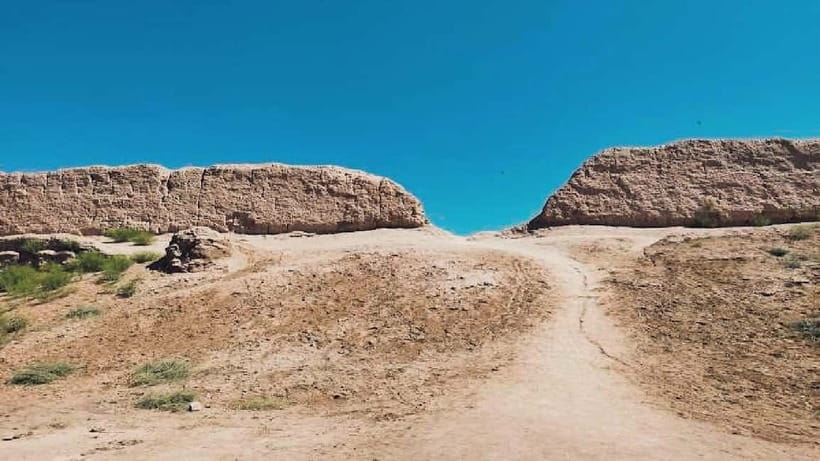
- Ayaz-Kala is the visual star: It is actually a group of three fortresses arranged around a hill, and it gives you the clearest sense of Khorezm’s old defensive world.
- Toprak-Kala adds royal drama: This former residence of Khorezmian rulers once held decorated rooms, fine objects, coins, and religious remains.
- Kavat-Kala is huge but subtle: Its wider complex stretched about 15 kilometers along the Gavhore Channel, though much of what you see today may be hard to identify.
- The driver is not always a guide: You receive private transportation and some basic help, but detailed explanations are not guaranteed.
- Entry fees are extra: Allow for separate site payments, with one report noting payments of about 20,000 Uzbek som at three stops.
- The price works best for three people: At $115 per group of up to three, the transport value is much stronger when shared.
Why these fortresses matter beyond the photo stop
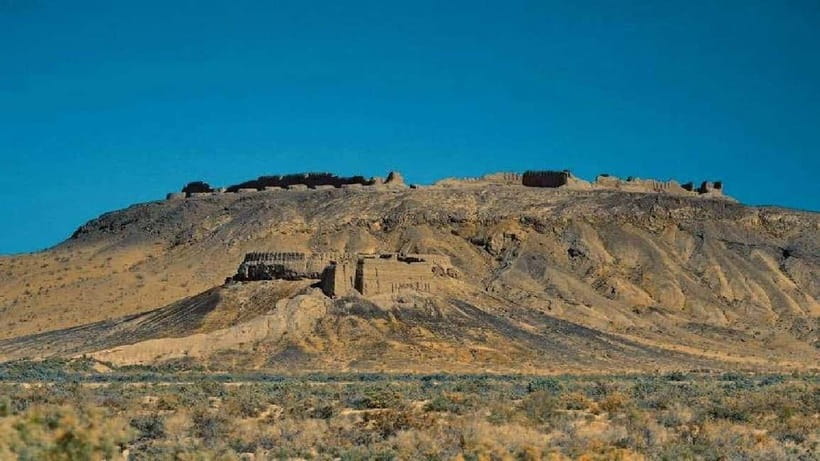
Khorezm was not protected by one famous castle. It was defended by a network of fortified settlements, walls, watchtowers, citadels, and desert outposts. These ruins sit in the wider Karakalpakstan region, where the flat surroundings make every wall easier to read against the horizon.
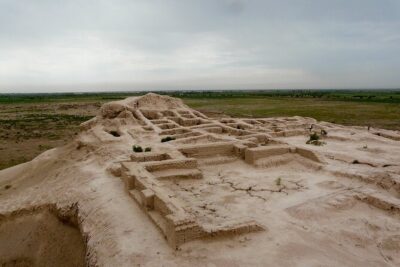
You are not visiting polished monuments with restored interiors and neat museum displays. You are seeing earthen fortifications, often made from adobe, that have survived wind, heat, war, neglect, and centuries of change. That is the appeal. The setting does much of the work.
The history also reaches across several periods. Guldursun-Kala began as an ancient fortified settlement, while Toprak-Kala later served as a ruling residence. Kyzyl-Kala shows the practical side of defense, with double walls, corner towers, smoke signals, and a system of ceramic pipes intended to bring water into the fort.
I find the contrast useful. Ayaz-Kala gives you the big visual moment. Toprak-Kala helps you picture government and court life. Kyzyl-Kala explains how people prepared for attack. Guldursun-Kala and Kavat-Kala fill in the wider network, though they demand more imagination.
More desert fortresses of Khorezm:
- Transfer: Bukhara – Khiva via Ancient Fortresses
★ 4.5 · 101 reviews - Daytrip From Khiva To Ancient Fortresses
★ 4.6 · 60 reviews - Private Daytrip to 7 Ancient Fortresses of Khorezm
★ 5.0 · 25 reviews
The seven-hour route from Khiva or Urgench
The trip lasts about seven hours and includes pickup and return to a hotel in Khiva, or pickup from Urgench airport or train station. You can also arrange drop-off in either Khiva or Urgench.
A private, air-conditioned vehicle matters here. The fortresses are spread across open country, so this is not a compact walking tour. You spend much of the day in the car, moving from one site to the next. The private setup lets you travel at your own pace, ask for photo stops, and avoid being tied to a large group.
The stated price is $115 for a group of up to three people. That is a reasonable transport price for a full day outside Khiva, especially if three people share it. For one person, it becomes a much more expensive outing per head. Remember that entry tickets and lunch are not included.
Departure time is flexible, which helps in a hot, exposed region. A morning start may give you cooler walking conditions, while a later departure could offer sunset light at some stops. The route information includes sunset time at several fortresses, but the exact timing depends on your agreed departure and the day of your visit.
Drivers are trained to follow the program, but English ability varies. You might receive useful background, or you might get only short explanations and directions. If you want detailed history, bring notes or arrange a separate guide. Do not assume the person behind the wheel will provide a formal tour at every ruin.
Guldursun-Kala and the scars of a lost city
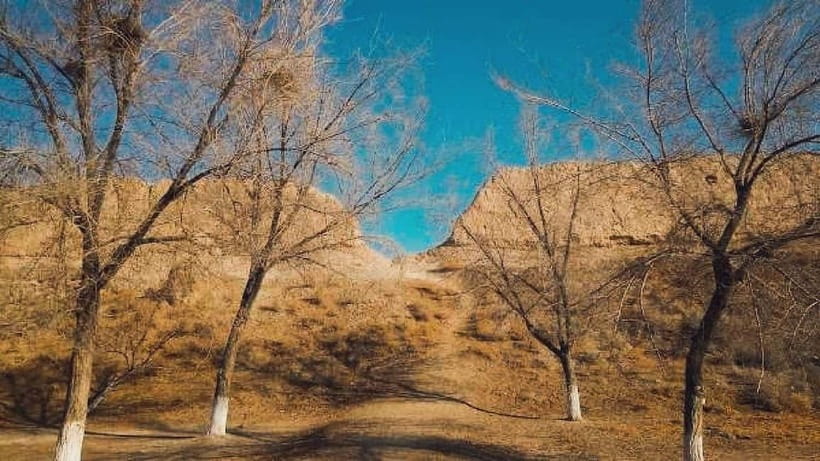
Guldursun-Kala is dated to the second or first centuries BC and covers about 35 hectares. Its rectangular fortification was built with thick adobe walls arranged in two rows, with loopholes built into the defenses.
That design tells you what mattered here. This was not simply a walled village. It was a large fortified settlement, planned for protection and observation. From the remains, you can start to picture soldiers watching approaches across open ground.
The site was later abandoned for reasons that remain unclear, then occupied again around 1220 during the rule of Shah Ala ad-Din Muhammad. That date places its final occupation close to the Mongol attacks on the Khwarezmian Empire. The timing gives the ruins a sharp historical edge. You are looking at a place caught in the difficult final years of a powerful medieval state.
The stop is mainly a walk and photo visit. It may appeal most to you if you enjoy reading ruins and imagining the structure beneath the eroded walls. If you want complete towers, intact rooms, or a clearly marked museum route, Guldursun-Kala may feel spare.
Take your time here if the driver allows it. Look for the double wall arrangement and the defensive openings rather than expecting one single picture-perfect fortress. The value is in the scale and the sense of a settlement that once had a serious military purpose.
Ayaz-Kala, the day’s clearest fortress experience
Ayaz-Kala is the stop most likely to stay with you. It is often described as one of the most striking fortresses of ancient Khorezm, and the reason is easy to understand once you see its position near the Sultan Uizdag ridge.
Ayaz-Kala is not one building. It is a complex of three fortresses grouped around a hill. That arrangement gives the visit more shape than a single ruined wall. You can look from one part of the site toward another and understand how the fortifications worked together.
The name is linked to a Turkic word meaning frosty or cold. The fortress is in the Ellikkala district, about 96 kilometers from Khiva. Those distances explain why the private vehicle is so useful. Getting here independently can require more planning than simply joining a direct day trip.
You receive time for sightseeing, photographs, and walking. I would make Ayaz-Kala the place where you slow down. The broad views and elevated setting help you understand why the fortresses were built here, and the remains are more immediately legible than those at some of the smaller stops.
The site is self-guided on this trip. That is both a strength and a weakness. You can wander without a group schedule, but you may miss the meaning of walls, terraces, and separate fortress sections unless you have read up beforehand.
If you can choose where to spend extra time, choose Ayaz-Kala. It is the best match for a first visit to the Khorezm fortresses and the most rewarding stop for photography.
A few more options to weigh up in Khiva and Urgench
- Khiva: Historical City Highlights Guided Walking Tour
★ 4.8 · 156 reviews - Khiva Historical City Highlights Guided Walking Tour
★ 5.0 · 30 reviews - Aral Sea Adventures (2 day)
★ 5.0 · 30 reviews - Guided Tour To Old Fortresses
★ 5.0 · 25 reviews
Kavat-Kala, where the scale is hard to see
Kavat-Kala is different from Ayaz-Kala. It is a large complex of medieval monuments stretching for about 15 kilometers along the Gavhore Channel, with a width of roughly 2 to 3 kilometers.
From the 12th to 13th centuries, the central area was heavily populated. About 90 estates once existed there, and the main fortress measured around 160 to 190 meters. Those numbers help you understand that Kavat-Kala was more than an isolated stronghold. It was part of a wide inhabited oasis.
The problem is that scale does not always translate into a clear visit. Much of the residential and clay architecture has disappeared or become difficult to recognize. You may see traces rather than dramatic walls. One part of the experience is learning to accept that archaeology is often fragmentary.
Kavat-Kala remains under study, so its value is strongest if you enjoy places where the story is still being pieced together. You will get a break, a visit, and time to look around, but you should not expect the same immediate impact as Ayaz-Kala.
This is one of the stops where a good explanation would help most. If your driver speaks little English, use your own notes to connect the visible remains with the former estates, channel, and settled oasis. Otherwise, the stop can feel like a short pause between larger monuments.
Toprak-Kala, a royal residence in ruins
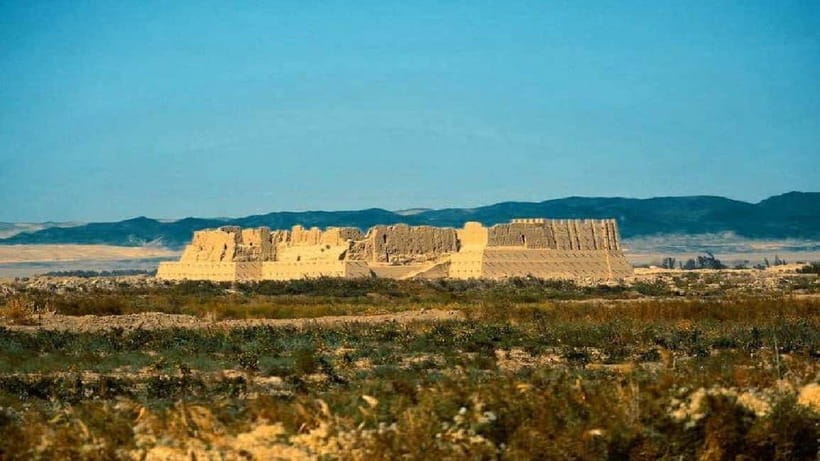
Toprak-Kala was built in the third century and served as a residence for Khorezmian rulers until about AD 305. That role makes it different from a simple frontier fort. It was a place of government, ceremony, and court life.
The settlement later declined after repeated aggressive wars forced the rulers to leave. Over time, the city fell into decay. Even in ruin, the plan of the site can help you imagine a royal center rather than just a military shelter.
Archaeological work found coins, Zoroastrian ossuary fragments, ceramics, wool and silk fabrics, gold ornaments, and a necklace containing 300 beads made from glass, paste, amber, and coral. These finds reveal a society with trade, craft skill, religious customs, and access to valuable materials.
The objects themselves are not necessarily all on display during your visit, so do not expect a museum collection at the fortress. Their importance is in helping you picture what once filled the rooms. The bare adobe walls become easier to understand when you know they held decorated spaces, storage, ceremonies, and administration.
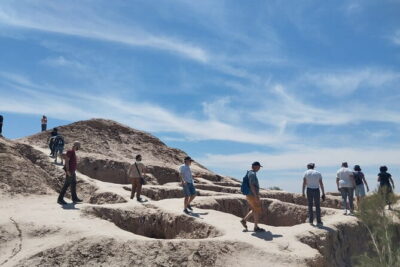
Toprak-Kala includes time for walking, photographs, and a break. Wear shoes that can handle uneven ground, and bring water. This is an exposed archaeological site, not an indoor attraction with shade at every turn.
For me, Toprak-Kala is one of the essential stops because it gives the route a human and political center. Ayaz-Kala shows defense in a dramatic setting. Toprak-Kala suggests the rulers who commanded that defense.
Kyzyl-Kala and the practical business of survival
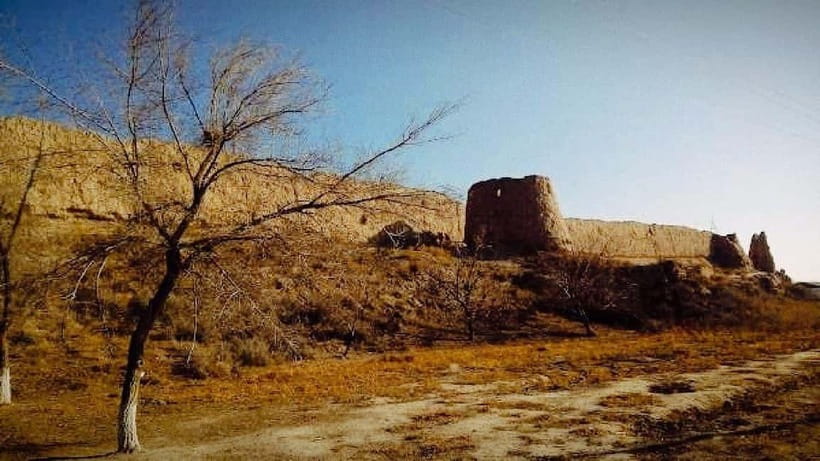
Kyzyl-Kala served as a refuge during raids by nomadic armies. Its defenses were built for warning and fast protection. Smoke signals could announce an approaching enemy, giving people time to prepare and move inside the citadel.
The fortress had a double wall with watchtowers at the corners. That detail is easy to appreciate on foot because it turns the site into a practical diagram. You can think about sight lines, warning systems, and the need to protect people as well as supplies.
The water system is especially interesting. Ceramic pipes were installed to provide a continual water supply to the fort. In a dry region, that is not a minor feature. A strong wall is useful only if people inside can survive a siege.
Kyzyl-Kala is visited with time for walking, photographs, and sightseeing. A safety briefing is also included in the schedule, which is sensible around old walls and uneven surfaces. As with the other sites, the stop is self-guided unless your driver offers additional information.
The fortress may not have the same instant visual impact as Ayaz-Kala, but it adds practical detail to the day. You leave with a better idea of how these settlements worked during danger, not just how they looked from a distance.
The driver question: transport or guided tour?
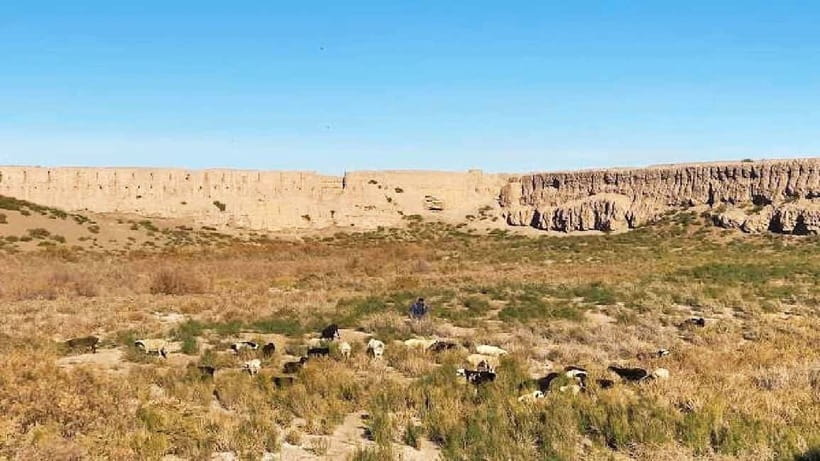
This is the most important point to understand before booking. The service provides private transportation, not a guaranteed professional guide.
Some drivers offer helpful background and make the day pleasant. Izzat, for example, has been praised for being friendly, accommodating, and eager to share aspects of local culture despite limited English. Another particularly warm experience included a stop to taste several kinds of melon on the return journey, a small local touch that can make a long drive feel more personal.
Communication can also be limited. English may be enough for meeting times, site stops, and basic requests, but not for a detailed account of Khorezmian politics or archaeological research. If history is the main reason you are going, prepare your own reading or arrange a separate guide.
Driving standards also deserve attention. One complaint described very fast driving that felt unsafe, and another account raised concern about speed on poor roads. That does not mean every driver will behave this way, but you should feel free to ask for a slower pace. Your safety matters more than shaving a few minutes off the route.
Lunch is optional and not included. Be cautious about accepting an unpriced menu or a restaurant recommendation without checking costs first. One bad experience involved a poorly rated restaurant and a menu without prices. Carry snacks, and agree clearly on where you want to eat.
What the $115 price really buys you
At $115 per group of up to three, the strongest value is convenience. You receive hotel or airport pickup, round-trip air-conditioned transport, parking fees, flexible departure time, and return to Khiva or Urgench.
Shared between three people, that is about $38 per person before entry fees. For a full day reaching several remote sites, the figure is sensible. Shared between two people, it is still defensible if you value a private vehicle and a flexible route. Alone, it is harder to call a bargain.
The price does not cover entry tickets, a guide, or lunch. One account described paying around 20,000 som at three sites, though the person was unsure if one charge was official. Carry Uzbek som and ask for the fee at each entrance before paying.
The trip has earned an overall rating of 4.4 from 15 reviews, with strong praise for friendly drivers, flexible stops, and the beauty of the forts. The less favorable experiences focus on three issues: limited English, fast driving, and some weak stops. The rating makes sense when you see the product for what it is: a useful private outing with uneven interpretation and uneven archaeological impact.
How to prepare for a better day
Wear sturdy walking shoes and clothes suited to sun and wind. Several sites involve walking around exposed adobe ruins, and the route includes open country rather than shaded city streets.
Bring water, snacks, sunscreen, and a charged phone. You will want your phone for photographs, maps, translation, and notes about each fortress. Since the tour is self-guided at the stops, a short history guide on your phone can make Kavat-Kala and Guldursun-Kala much more rewarding.
Before departure, confirm four things with the driver:
- The pickup time and exact address
- The preferred driving speed
- Your lunch plan and expected prices
- How much time you want at Ayaz-Kala and Toprak-Kala
Tell the driver if you want more time for photographs. The private format makes this possible, and one positive experience included a driver who stopped where requested.
You should also decide if you want all five sites. The route includes them, but not every fortress will feel equally worthwhile. The biggest payoff is likely Ayaz-Kala and Toprak-Kala, while the others provide additional context for the wider fortified region.
Who should book this fortresses day trip?
I would recommend it to you if you want to get beyond Khiva without arranging several separate transfers. It is especially useful for couples, friends, or a family of up to three who want their own vehicle and a flexible day.
It suits people who enjoy ruins, wide-open scenery, and historical settings more than polished attractions. You need to be comfortable with self-guided visits and the possibility that some sites will look like low earthworks rather than complete castles.
I would be more cautious if you require fluent English guiding, dislike long drives, or want every stop to deliver a dramatic monument. You may prefer a shorter outing focused on Ayaz-Kala and Toprak-Kala, with a dedicated guide.
Should you book it?
Book this trip if your priority is easy private transport from Khiva to a remote group of ancient sites. The value is good for three people, and the combination of Ayaz-Kala, Toprak-Kala, and Kyzyl-Kala gives you striking views, royal history, and practical defensive detail.
Book with realistic expectations. You are paying for a driver and vehicle, not a full archaeological lecture. Confirm the lunch arrangement, request safe driving, budget for entry fees, and bring your own background notes. If you do that, this can be a memorable day in one of Uzbekistan’s most unusual historical regions.
FAQ
Where does the Five Fortresses day trip begin?
Pickup is available from hotels in Khiva, as well as Urgench airport or train station.
Where can I be dropped off after the tour?
Drop-off is available in Khiva or Urgench.
How long does the trip last?
The stated duration is seven hours.
How many people can join the private group?
The price covers a private group of up to three people.
What is included in the $115 price?
The price includes pickup, drop-off, a round-trip air-conditioned vehicle, private transportation, flexible departure time, and parking fees.
Are entrance tickets included?
No. Entry tickets are not included and must be paid separately at the sites.
Is a guide included?
No. A guide is not included. The driver takes you between the fortresses and may provide some information, but English ability can be limited.
Is lunch included?
No. Lunch is optional and costs extra.
Can I cancel the booking?
You can cancel up to 24 hours in advance for a full refund. You can also reserve now and pay later.
Just added in Khiva and Urgench
- Urgench Airport / Railway Station – Khiva Transfer★ 3.0 · 2 reviews
- Traditional Khiva Cooking Class with Market Visit & Lunch★ 5.0 · 4 reviews
- Uzbekistan 6 Days Private Tour Khiva-Bukhara-Samarkand by Train★ 5.0 · 4 reviews
- Transfer From Khiva To Bukhara★ 5.0 · 2 reviews
- Old Khiva Stories with Your Local Guide★ 5.0 · 5 reviews
- Day Trip Top 3 Fortresses departure from Khiva Self-Guided Tour★ 5.0 · 2 reviews
- Plov Tour : Taste, Tradition & History of Plov with a local guide★ 5.0 · 1 review
- Master Class – Uzbek Bread (Khiva)★ 3.5 · 4 reviews
Ancient Fortresses of Khorezm, compared.
Transfer: Bukhara – Khiva via Ancient Fortresses
Read our review →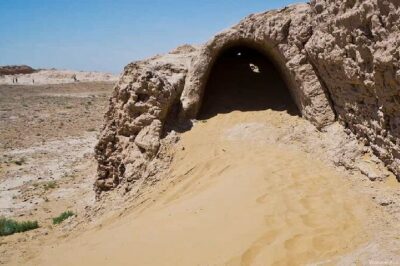
Private Daytrip to 7 Ancient Fortresses of Khorezm
Read our review →

Private Bukhara-Khiva Transfer via Ancient Fortresses
Read our review →Browse the lists this tour appears in