
Review · WALKING TOURS IN KHIVA AND URGENCH
Khiva Walking Tour
Khiva rewards slow looking. This private walking tour brings you through a compact Uzbek old town filled with palaces, mosques, madrasas, and towering minarets. I like the well-planned route, which covers the major sights without requiring transport, and I like the choice of English, Russian, French, or German guides. The main drawback is that entrance tickets are not included, so the advertised $90 is not the full cost for two people.
The tour is best for you if you want a clear introduction to Khiva in one long morning or afternoon. Guides have been praised for kind, informative service, and French-speaking guide Izzat helped make one visit especially rewarding. Wear good shoes, start early in summer, and leave room in your budget for several separate admissions.
In This Review
- Key points to know before you book
- Why Khiva works so well on foot
- Beginning at Ata Darvaza and Muhammad Amin Khan Madrasa
- Kunya Ark, where Khiva’s rulers worked and received visitors
- From Muhammad Rahimkhan II Madrasa to Djuma Mosque
- Tosh Hovli Palace and the royal Harem
- The eastern gates, schools, and the Islamkhudja Minaret
- Pahlavan Makhmud, the final major stop
- A possible clay-oven bread stop
- What $90 really buys you
- Timing, comfort, and language choices
- Who should book this Khiva walking tour?
- Should you book it?
- FAQ
- Where does the Khiva walking tour begin?
- How long does the tour last?
- What is the price of the private tour?
- Are entrance tickets included?
- Is a professional guide included?
- Which languages are available?
- Can the start time be changed?
- Is the tour wheelchair accessible?
- Can I climb the minarets during the tour?
- What should I bring?
- Is cancellation available?
- Can I reserve now and pay later?
Key points to know before you book
- Khiva’s western gate is the easy meeting point: You meet at the ticket office by Ata Darvaza, the main western gate.
- The route covers Khiva’s major monuments: Expect the Kunya Ark, Djuma Mosque, Tosh Hovli Palace, Islamkhudja complex, Pahlavan Makhmud complex, and more.
- The guide is the main value: A private professional guide gives context to a dense group of monuments that can otherwise blur together.
- The tallest minaret is part of the route: The Islamkhudja Minaret is one of Khiva’s defining sights, but climbing minarets is not included.
- Tickets cost extra: Admissions to the listed sites are separate and can add noticeably to the $90 group price.
- Bread-making may appear along the way: You might catch local bread being prepared in a clay oven, though this depends on timing and luck.
Why Khiva works so well on foot
Khiva is unusually suited to a walking tour. Its old center is compact, and its major buildings are gathered within the historic walled city. Instead of spending time in vehicles, you move from a madrasa to a mosque, then from a palace to a citadel, with the next stop often close at hand.
That compact layout also creates a small problem. Khiva can feel like a parade of grand facades if you do not know what each building was for. A guide helps separate a religious school from a royal reception hall, and a working mosque from a decorative palace courtyard.
I like the way this tour follows Khiva’s main sights in a logical order. You begin at Ata Darvaza, then work through the central monuments before reaching the eastern part of the old city and finishing at the Pahlavan Makhmud complex. At four and a half hours, it is long enough to provide real context, but not so long that every blue tile starts to look the same.
The private format matters. Your group can include up to two people for the $90 price, and the start time can be arranged when booking or changed by request. That flexibility is useful if you arrive by train, have a hotel check-in to manage, or want to avoid the worst summer heat.
More Walking Tours in Khiva and Urgench
- Khiva: Historical City Highlights Guided Walking Tour
★ 4.8 · 156 reviews - Khiva Historical City Highlights Guided Walking Tour
★ 5.0 · 30 reviews - Khiva Walking Tour
★ 4.5 · 15 reviews
Beginning at Ata Darvaza and Muhammad Amin Khan Madrasa
Your meeting point is the ticket office at Ata Darvaza, Khiva’s western gate. This is a practical place to begin because it puts you directly inside the old city, with no need to find a distant office or arrange a transfer.
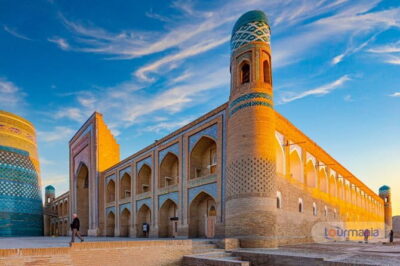
The first major sight is Muhammad Amin Khan Madrasa, described as the largest madrasa in this part of Khiva. A madrasa was a school for Islamic learning, but these buildings also helped define the city’s public image. Look for the scale and repeated patterns of the facade before moving on. The building introduces the grand architectural style that continues throughout the tour.
Nearby, you see the Kalta Minor Minaret. Its broad, unfinished form is one of Khiva’s most recognizable sights. It does not have the slim, soaring shape you might expect from a traditional minaret. Instead, its unusual proportions make it immediately memorable.
This opening section is a good reason to begin early in summer. The tour lasts four to five hours, and much of the route is outdoors. An early start gives you cooler conditions and more comfortable light for photographs.
Kunya Ark, where Khiva’s rulers worked and received visitors
Kunya Ark is the old citadel and one of the most important stops on the route. This was not just a fortress in the simple military sense. It was a royal center with spaces for administration, formal receptions, coin production, and seasonal use.
The panoramic view tower is a highlight for anyone who can climb it. From above, Khiva’s dense concentration of tiled buildings and minarets becomes easier to understand. The view also shows why Khiva is often described as an open-air museum. Its historic core has the feel of a complete urban setting rather than a single isolated monument.
The citadel includes the coinage yard, along with summer and winter reception areas for the khan. These details help you picture how the city functioned, not just how it looked. A palace was a workplace, a ceremonial stage, and a place where visitors waited for access to the ruler.
Keep an eye on the extra costs here. The tour includes a professional guide, but entrance tickets to the specified monuments are not included. There are multiple admissions across the route, so ask for the current total before you begin if you want a precise budget.
From Muhammad Rahimkhan II Madrasa to Djuma Mosque
The Muhammad Rahimkhan II Madrasa continues the architectural story, but the Djuma Mosque changes the mood. This is a columned mosque with more than 120 carved wooden columns. The interior is less about a huge open hall and more about rhythm, shadow, and closely spaced supports.
I find columned mosques rewarding because they ask you to look carefully. Instead of one grand central view, you notice how the columns create a forest of repeated forms. Each carved support contributes to the atmosphere, and the low, shaded interior offers a welcome break from the bright streets.
The mosque also shows why a guide is useful in Khiva. A quick solo visit can become a photograph and a short pause. With explanation, the building becomes part of the city’s religious and architectural development.
The route includes several religious buildings, so modest, comfortable clothing is a sensible choice. You should also wear shoes that can handle several hours of walking and repeated stops.
A completely different kind of day:
- Transfer: Bukhara – Khiva via Ancient Fortresses
★ 4.5 · 101 reviews - Daytrip From Khiva To Ancient Fortresses
★ 4.6 · 60 reviews - Aral Sea Adventures (2 day)
★ 5.0 · 30 reviews - Private Daytrip to 7 Ancient Fortresses of Khorezm
★ 5.0 · 25 reviews
Tosh Hovli Palace and the royal Harem
Tosh Hovli Palace is the second major khan’s palace on the tour. Its name is often translated as Stone Courtyard, and its purpose was not simply to provide a fine residence. It was a place for royal life, official meetings, private rooms, and controlled movement.
The harem is one of the major draws. You also see summer and winter reception areas, a special reception room, and a secret corridor. These details give the palace a more personal scale than the large citadel. The Kunya Ark presents official power; Tosh Hovli lets you think about the routines and restrictions of court life.
A particularly unusual detail is the gift car associated with Tsar Alexander III. It is the sort of object that adds a link to wider regional politics and changing relations between Khiva and the Russian Empire. Ask your guide to place it in context, since the object is more meaningful when you understand why it ended up in the palace.
The palace can be a busy stop on a full route, and you will probably want time for photographs. If you are especially interested in royal architecture, tell the guide early so the visit does not feel rushed.
The eastern gates, schools, and the Islamkhudja Minaret
After the central monuments, the tour continues toward the eastern gates, Said Niyaz Mosque, and Said Niyaz Madrasa. This part of the route helps you see that Khiva was more than a line of famous buildings around a central square. Religious schools, neighborhood mosques, and city gates formed a working urban center.
The Islamkhudja complex is one of the tour’s headline stops. The Islamkhudja Minaret is identified as the tallest minaret in Uzbekistan and the tallest in this region. It is also one of Khiva’s clearest symbols, rising above the low historic buildings and giving you a useful point of reference as you walk.
The complex includes a madrasa that houses a museum of applied art. The museum adds a different kind of interest after the large architecture. Instead of looking only at walls and towers, you get a closer view of decorative work and objects connected with local artistic traditions.
The nearby Islamkhudja School is also worth noting. It was the first modern and secular school in Khiva, marking a change from the older religious education system. That contrast gives the route a useful sense of time. Khiva is not frozen in one period, even though the old city can feel wonderfully preserved.
Climbing minarets is not included in the tour. The listed experience provides access to the monuments and the guide, but any ascent is specifically excluded. If reaching the top is important to you, ask in advance about current access and extra charges.
Pahlavan Makhmud, the final major stop
The Pahlavan Makhmud Complex is presented as the final highlight, and it is a fitting ending. Pahlavan Makhmud is one of Khiva’s best-known cultural and spiritual figures, and the complex has a strong place in the city’s identity.
Calling it the cherry on the cake may sound promotional, but the description makes sense in practical terms. By this point, you have seen royal buildings, schools, mosques, defensive gates, and towering minarets. The complex brings the route back to devotion, memory, and local tradition.
Your guide can help you notice the difference between this kind of sacred site and the more official spaces at the palaces. If you want a quiet finish, say so. Four and a half hours of concentrated sightseeing is a lot, and the last stop deserves more than a quick photograph before rushing away.
A possible clay-oven bread stop
Along the route, you may have the chance to see local bread being prepared in a clay oven. This is not guaranteed. It depends on luck and on what is happening in the neighborhood when you pass.
That uncertainty is part of its appeal. It is not a scheduled performance added for visitors. If the timing works, you get a small glimpse of daily life between the grand monuments. Keep your expectations realistic, though. The tour is built around Khiva’s historic sights, not around a food demonstration.
What $90 really buys you
The price is $90 per private group of up to two people. For a couple or two friends, that works out to $45 each before entrance fees. The cost is easier to justify if you want a private route, a guide in your preferred language, and the chance to adjust the start time.
The guide is the core purchase. A professional guide can make the difference between seeing attractive tilework and understanding why Khiva has a citadel, two royal palaces, many madrasas, and several important religious complexes packed into one old city.
The price does not include admission tickets to all the specified sites. Because there are multiple monuments, the final spend will be higher than $90. The tour also excludes personal expenses and any minaret climb. I would treat the advertised amount as the guiding fee, not the complete sightseeing budget.
For a private half-day introduction, the value is solid if you plan to visit many monuments anyway. It is less attractive if you only want a short orientation walk or prefer to explore every building at your own pace.
Timing, comfort, and language choices
The start time is set when you book, and it can be changed by request. In summer, an earlier start is recommended. That advice is worth taking seriously because the route lasts about four and a half hours and includes substantial outdoor walking.
Wear comfortable shoes and comfortable clothes. There is no need to dress for a formal event, but you should be ready for a long period on foot and for entering religious buildings. Smoking indoors is not allowed.
Guiding is available in English, Russian, French, and German. The French option may be especially useful if you prefer detailed explanations in French. One highly praised visit ran from 9:30 in the morning to 3 in the afternoon, with Izzat serving as the guide. That longer timing suggests the exact pace can vary, particularly when a group spends extra time at the monuments.
The experience is wheelchair accessible, though the separate note about minaret access is important. The accessible route and the ability to climb towers are not the same thing. If you need a fully step-free plan for every stop, confirm the details before booking.
Who should book this Khiva walking tour?
I would choose this tour if you have limited time in Khiva and want the city explained in one organized visit. It suits first-time visitors, couples, friends, and anyone who wants a private guide rather than a large group.
It is also a good fit if you care about architecture but want more than pretty photographs. The route includes royal rooms, a harem, a coinage yard, a columned mosque, a secular school, applied arts, and a sacred complex. That variety gives you a better sense of how Khiva worked.
You may want another plan if your priority is climbing minarets, spending long periods inside each museum, or keeping costs as low as possible. The extra admissions matter, and four and a half hours can feel fast if you stop for every detail.
The experience has earned a 4.7 rating from 22 verified bookings. The strongest praise centers on kind guides, clear information, and full coverage of Khiva’s main monuments. French-speaking service, including guide Izzat, has been particularly useful for at least one visitor.
Should you book it?
Book this Khiva walking tour if you want an efficient, private introduction to the old city and are happy to pay monument tickets separately. The route is broad, the meeting point is simple, and the guide gives the grand buildings a human and practical context.
Before you commit, budget for admissions, request an early summer start, and confirm your preferred language. If those points suit you, $90 for up to two people is a fair price for a guided half-day through Khiva’s palaces, mosques, schools, and minarets.
FAQ
Where does the Khiva walking tour begin?
The tour begins at the ticket office by Ata Darvaza, the western main gate of Khiva.
How long does the tour last?
The stated duration is 4.5 hours, with the overall description giving a range of about four to five hours.
What is the price of the private tour?
The price is $90 per private group of up to two people.
Are entrance tickets included?
No. Entrance tickets to the specified monuments are not included, and there may be multiple separate admissions.
Is a professional guide included?
Yes. A professional live tour guide is included.
Which languages are available?
Guiding is available in English, Russian, French, and German.
Can the start time be changed?
Yes. The start time is selected when booking and can be changed by request. An earlier start is recommended during summer.
Is the tour wheelchair accessible?
The activity is described as wheelchair accessible.
Can I climb the minarets during the tour?
Going upstairs to the minarets is not included. Ask about current access and any extra cost before booking if this matters to you.
What should I bring?
Bring comfortable shoes and comfortable clothes. Smoking indoors is not allowed.
Is cancellation available?
You can cancel up to 24 hours in advance for a full refund.
Can I reserve now and pay later?
Yes. The tour offers a reserve-now, pay-later option.
Just added in Khiva and Urgench
- Urgench Airport / Railway Station – Khiva Transfer★ 3.0 · 2 reviews
- Traditional Khiva Cooking Class with Market Visit & Lunch★ 5.0 · 4 reviews
- Uzbekistan 6 Days Private Tour Khiva-Bukhara-Samarkand by Train★ 5.0 · 4 reviews
- Transfer From Khiva To Bukhara★ 5.0 · 2 reviews
- Old Khiva Stories with Your Local Guide★ 5.0 · 5 reviews
- Day Trip Top 3 Fortresses departure from Khiva Self-Guided Tour★ 5.0 · 2 reviews
- Plov Tour : Taste, Tradition & History of Plov with a local guide★ 5.0 · 1 review
- Master Class – Uzbek Bread (Khiva)★ 3.5 · 4 reviews
Walking Tours in Khiva and Urgench, compared.
Khiva Historical City Highlights Guided Walking Tour
Read our review →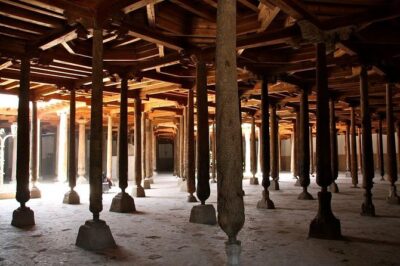

Browse the lists this tour appears in