
Review · FULL-DAY
Bukhara: Full-Day Guided Tour with English-Speaking Guide
Bukhara rewards slow looking. This private full-day tour links the city’s finest monuments with its old trading quarters, so you get both grand architecture and everyday craft traditions. I especially like the English-speaking guide and the route’s strong mix of major sights, from the Samanid Mausoleum to the Ark of Bukhara. The Tim Abdulla Khan Trading Dome also adds a useful Silk Road angle beyond the usual photo stops.
There are two things to plan for. You will walk a fair amount over uneven historic ground, and entrance fees, meals, drinks, and transport with a driver are extra. Guides named Lola, Paris, and Malika have been praised for clear English, warmth, and practical advice. Malika’s artisan workshop tip is particularly useful if you want quality scarves rather than a rushed market purchase.
In This Review
- Key points to know before booking
- Why this private Bukhara tour works well
- Starting at Lyabi Khauz
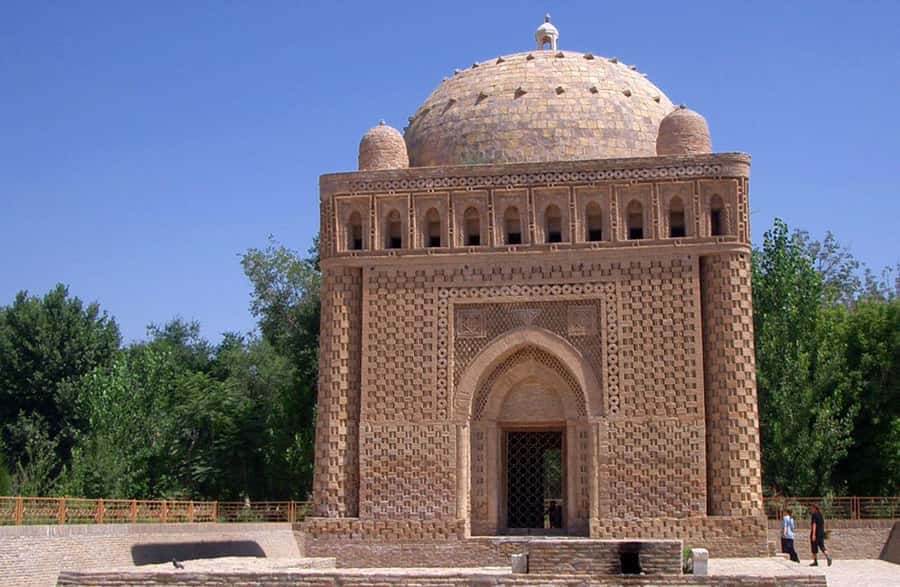
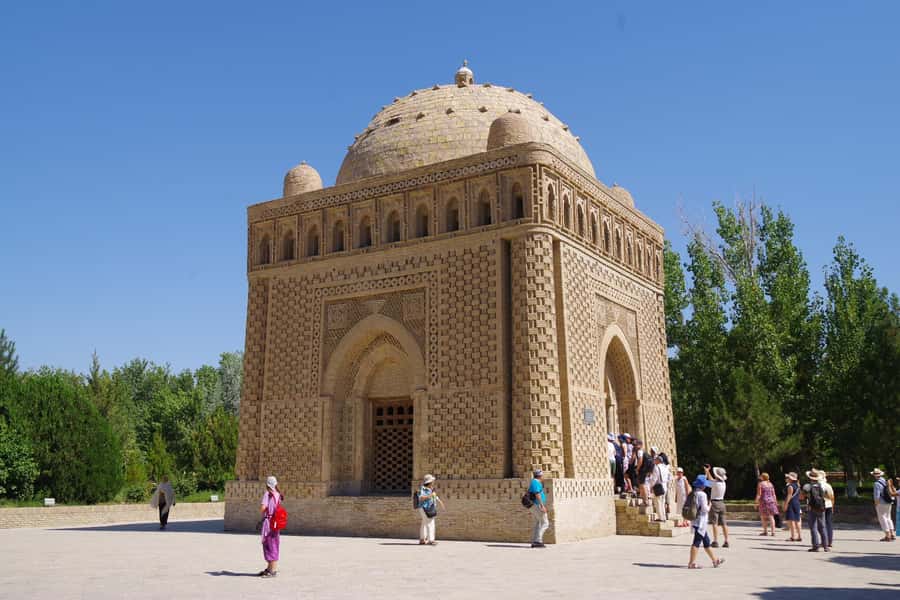
- Samanid Mausoleum: a lesson in brick
- Kalon Minaret and Poi Kalan Mosque
- Magok-i-Attari and Bukhara’s layered faiths
- Tim Abdulla Khan Trading Dome and smart shopping
- The Ark of Bukhara and royal power
- Bolo Haouz Mosque and the Emir’s place of worship
- Ending at Lyabi Khauz
- Is $80 a fair price?
- Who should book this tour?
- FAQ
- How long does the Bukhara guided tour last?
- Where does the tour begin?
- Where does the tour end?
- Is the tour private?
- What languages are available?
- Are entrance tickets included in the $80 price?
- Is the tour suitable for wheelchair users?
- Should you book it?
Key points to know before booking
- The Samanid Mausoleum begins the day with Central Asia’s finest brickwork, a 10th-century building valued for its balance and restrained design.
- The 47-meter Kalon Minaret anchors the central visit, with the Poi Kalan Mosque nearby and enough scale to make the old city feel much larger than it first appears.
- The route is private, giving you room to ask questions and spend more time at the places that interest you.
- The Tim Abdulla Khan Trading Dome connects monuments with commerce, and the artisan workshops can help you shop for better-quality scarves.
- The tour finishes at Lyabi Khauz, a shaded social plaza around one of Bukhara’s remaining historic ponds.
- The $80 price covers the certified guide, not the whole day’s spending, so budget separately for admissions, food, drinks, and any vehicle.
Why this private Bukhara tour works well
Bukhara is easiest to understand when its buildings are connected by a good storyteller. A minaret is more than a tall brick tower, and a trading dome is more than a place to buy souvenirs. The right guide shows you how faith, government, trade, and daily life all occupied the same compact city.
This experience is private, which is a real advantage in Bukhara. You can ask why a building has two entrances, pause for a closer look at brick patterns, or spend extra time examining a tiled courtyard without waiting for a large group. Guides speak English or Russian, and the English feedback for Lola, Paris, and Malika has been especially strong. Their names are worth requesting if the operator allows it, though guide assignments cannot be guaranteed.
The route covers a lot in one day. You move from the Samanid Mausoleum to the Kalon complex, then through older religious sites, a trading dome, the Ark, Bolo Haouz Mosque, and Lyabi Khauz. That makes this a useful first look at Bukhara, but it is not a relaxed day of sitting over tea. Wear shoes you can trust and expect several hours on foot.
A few more options to weigh up in Bukhara
- Best of Bukhara: All Day Private Old Town Tour
★ 5.0 · 66 reviews - Best of Bukhara: All Day Private Old Town Tour
★ 4.9 · 62 reviews - City Tour Around Bukhara
★ 5.0 · 55 reviews
Starting at Lyabi Khauz
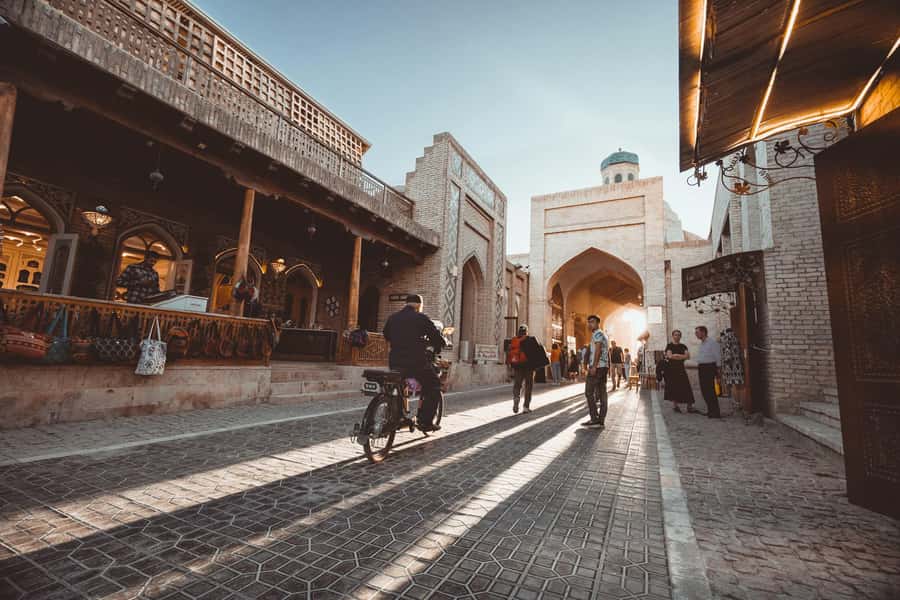
The meeting point is near the Hodja Nasreddin monument at Lyabi Khauz. This is a sensible place to begin because the plaza gives you an immediate feel for Bukhara’s old center. Its pond, madrassas, trees, and tea houses create a calmer first impression than a traffic-heavy street.
Your guide can also help you get oriented before the formal sightseeing begins. Bukhara’s old center is compact in places, but its monuments can blur together if you visit them without context. Starting with a guide helps you understand the city as a connected place rather than a string of isolated photo stops.
The tour ends back at the same meeting point. Transportation with a driver is not included, so ask ahead if a vehicle is needed between sections. The description emphasizes walking, and the main old-city sights are suited to a pedestrian route, but the transport note means you should not assume every transfer is covered.
Samanid Mausoleum: a lesson in brick
The Samanid Mausoleum is one of the day’s most rewarding stops. Built in the 10th century, it holds the remains of Ismail Samani, founder of the Samanid dynasty. It is also described as one of the oldest major monuments in Central Asia.
The building’s appeal comes from its brickwork rather than bright color. Repeated patterns create a delicate surface, while the square structure and domed form give it a calm, exact look. You will want time here to study how much decoration can be made from a single material.
This is a good place to listen closely to your guide. The mausoleum can seem simple at first, especially beside Bukhara’s later blue-tiled buildings. Its importance becomes clearer when you consider its age, its survival, and the skill required to create geometric ornament in brick.
Photography is allowed, but flash photography is not permitted inside monuments. Food and drinks are also not allowed within the historic buildings, so carry water for the walking sections but plan to drink it outdoors.
Kalon Minaret and Poi Kalan Mosque
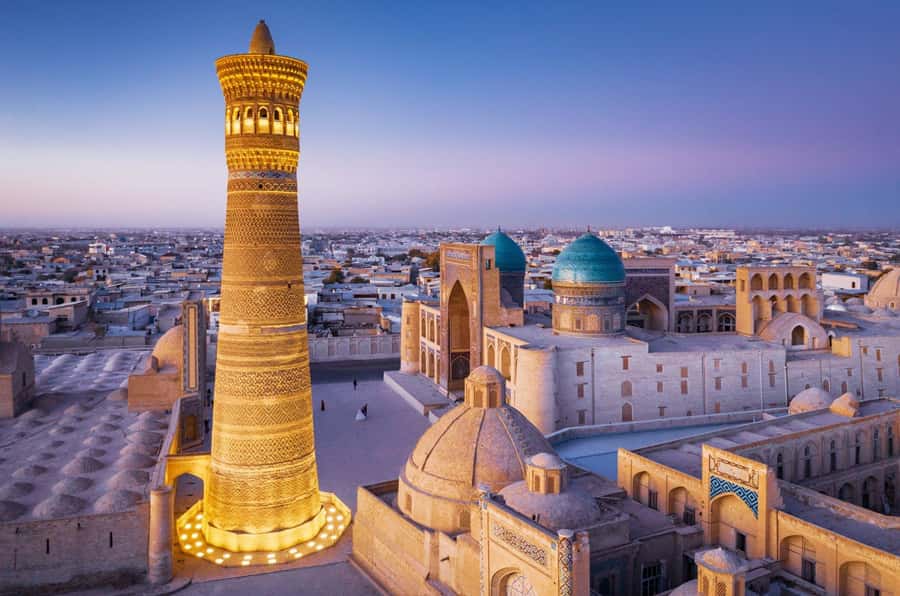
The Kalon Minaret, also called Minorai Kalon, is the tour’s great visual marker. At 47 meters tall, it has guided Silk Road caravans and survived repeated invasions since the 12th century. Its tapered brick form is impressive from close up, but it is even more useful as a way to understand how Bukhara was organized around major religious and civic spaces.
Your guide can explain the minaret’s practical and symbolic roles. It was a call-to-prayer tower, a landmark for people approaching the city, and a statement of Bukhara’s importance. Look at the bands of brick decoration as well as the height. The design is not simply large. It is carefully proportioned.
Nearby, the Poi Kalan Mosque gives the visit a much broader scale. Its courtyard can hold up to 10,000 worshippers, and the complex includes blue-tiled domes and an elaborate mihrab. You can expect a sharp change from the Samanid Mausoleum’s quiet brick geometry to a more open, ceremonial space.
The courtyard is the place to grasp the mosque’s capacity. You may find the interior less about small details and more about proportion, repetition, and movement. If you want photographs, this is a good point to ask your guide where flash-free images are permitted and how much time you have before moving on.
A completely different kind of day:
- Bukhara Full Day Old City Private Tour
★ 5.0 · 46 reviews - Yurt Camp Tour with Night from Bukhara
★ 3.8 · 35 reviews - All You Need To Know About Bukhara. A Walk In The Town
★ 4.9 · 31 reviews - One-Day Private Tour in the Old Town of Bukhara
★ 5.0 · 24 reviews
Magok-i-Attari and Bukhara’s layered faiths
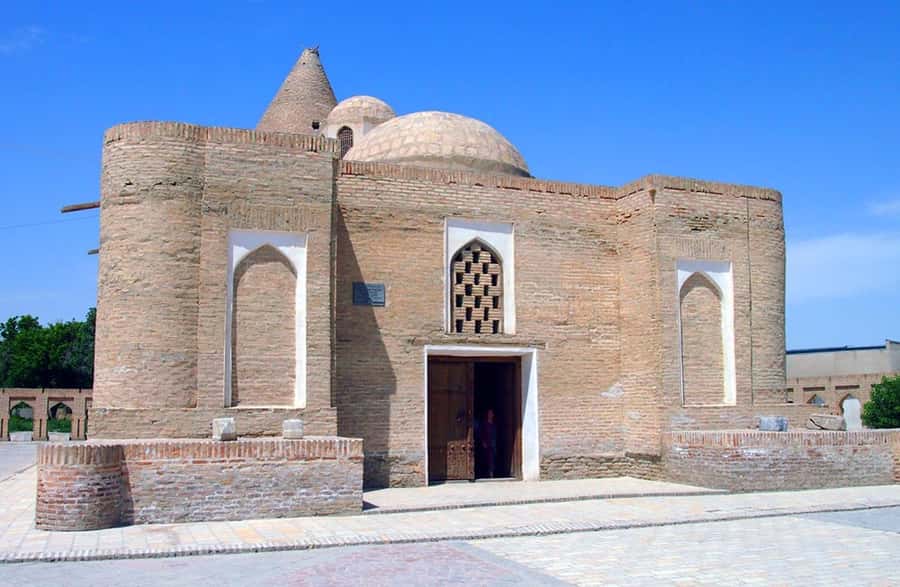
Magok-i-Attari Mosque offers one of the most unusual historical stops on the route. It was originally a Zoroastrian temple and later became a mosque in the 12th century. That change gives the building a layered identity that a quick sightseeing pass could easily miss.
The underground entrance is a key feature. It helps show how much the level of the city and its buildings has changed over time. Rather than looking only at the facade, pay attention to the way the entrance sits below the surrounding ground and ask your guide how the structure evolved.
This stop is valuable because it complicates a simple story of Bukhara. The city was not built in one period for one purpose. Religious buildings were adapted, reused, and folded into later urban life. A good explanation here can make the rest of the day more meaningful.
The site also reinforces the need for practical footwear. Historic entrances and floors may not offer the smooth, level walking you would find in a modern museum. The tour is not suitable for wheelchair users or people with major mobility limitations, and anyone who finds stairs or uneven surfaces difficult should think carefully before booking.
Tim Abdulla Khan Trading Dome and smart shopping
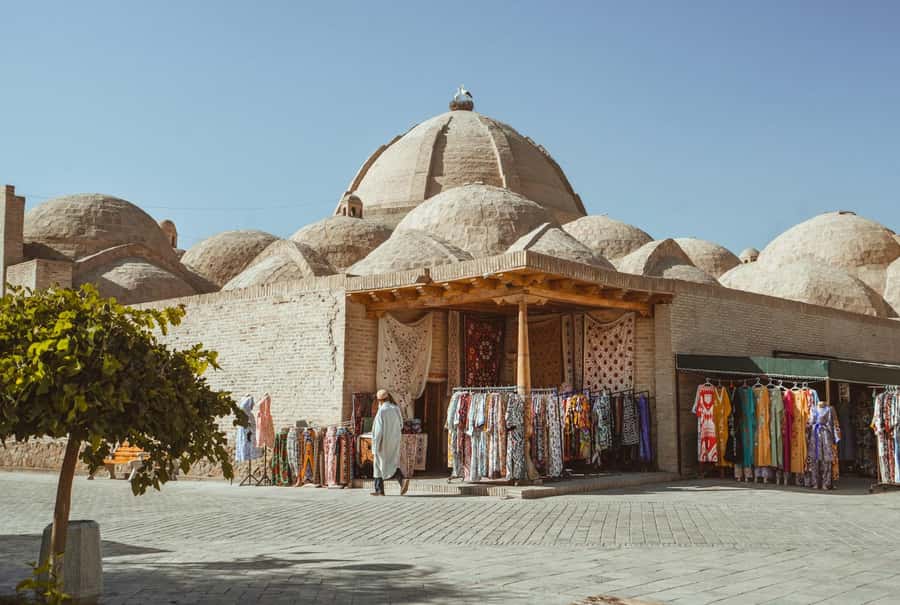
The Tim Abdulla Khan Trading Dome shifts the focus from worship and royal power to commerce. It is one of the remaining structures from Bukhara’s old Silk Road marketplace. Inside, you can browse local handicrafts while your guide explains how covered trading spaces supported long-distance trade.
This is not just a shopping break. The dome helps you picture a city where merchants, craftspeople, religious institutions, and rulers depended on one another. Its covered design offered a practical setting for trade in a hot climate, while its place within the old city tied commerce to the main religious and civic buildings.
You should still shop with care. Prices and product quality can vary, and the tour does not promise that purchases are included or fixed in cost. One useful tip from the guide experience is to wait before buying scarves. You may be shown artisan workshops where higher-quality pieces are available, giving you a better chance to compare workmanship before spending.
The private format helps here. You can ask about materials, production, and local craft rather than feeling pushed through a shop. Keep personal expenses separate from the tour price, and do not assume that browsing creates an obligation to buy.
The Ark of Bukhara and royal power
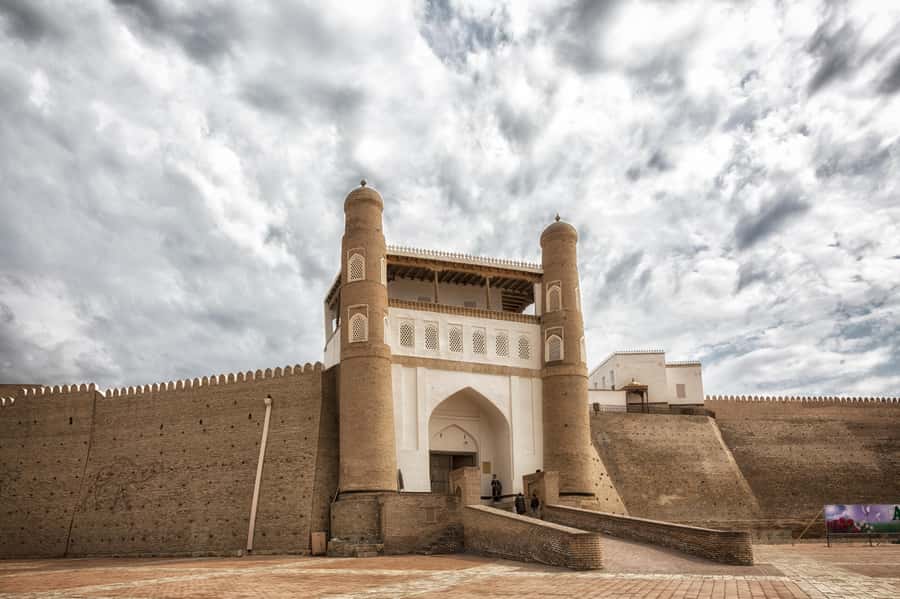
The Ark of Bukhara is a massive fortress and former royal residence. Its origins reach back to the 5th century, making it one of the day’s oldest and most politically important sites. The walls, courtyards, and chambers show that Bukhara was not only a religious center. It was also a seat of government and defense.
The fortress can feel imposing before you even consider its individual rooms. Your guide’s explanation matters because the Ark is best understood as a working complex, not just a pile of old walls. Its spaces supported rulers, administration, security, and court life.
Expect a change in mood here. The Kalon Mosque opens outward toward worshippers, while the Ark turns inward behind heavy defenses. That contrast helps you see how authority operated in the city. Bukhara’s rulers needed public religious spaces, but they also needed a protected base from which to govern.
As with the other monuments, food and drinks cannot be taken inside. If you are visiting during a hot part of the year, use shaded pauses outside the buildings and keep sunscreen, a hat, and water close at hand.
Bolo Haouz Mosque and the Emir’s place of worship
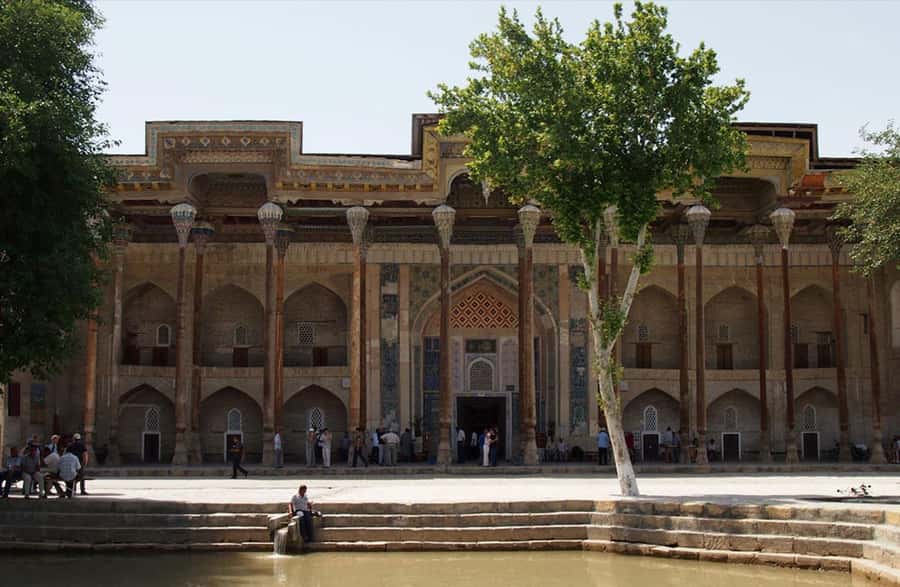
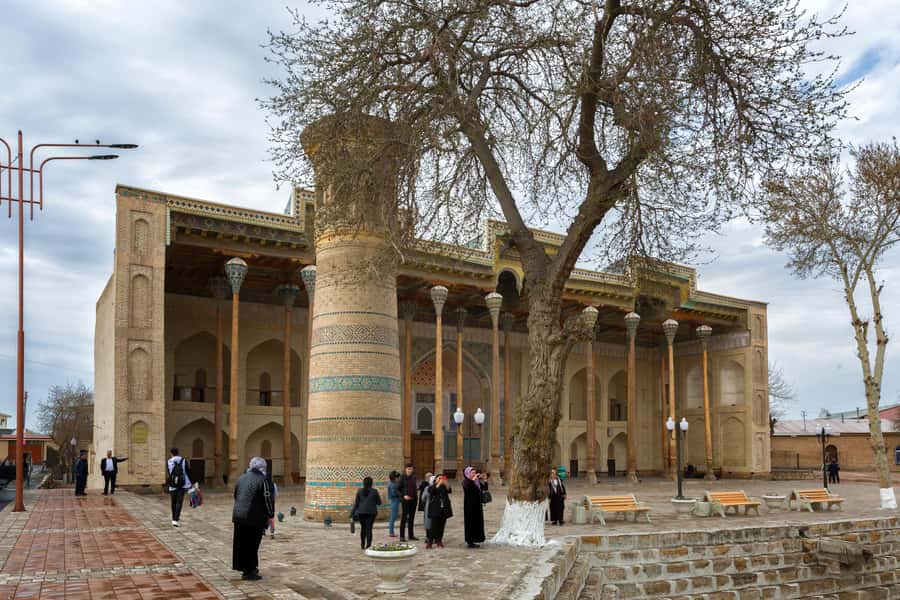
Bolo Haouz Mosque is smaller in feel than Poi Kalan, but its details can be just as rewarding. Built in the early 18th century, it served as the Emir of Bukhara’s official place of worship.
Its elegant wooden columns are the main visual feature. They create a graceful covered area and give the mosque a more intimate character than the vast courtyard of Poi Kalan. Take time to look upward and along the line of the columns, where craftsmanship becomes easier to appreciate than from a quick standing viewpoint.
This stop also adds political context. The mosque was not only a neighborhood place of prayer. Its connection with the Emir shows how religious practice and the ruling household were linked. Your guide can help place it within the broader story of Bukhara’s government and public life.
The mosque is a good reminder that Bukhara’s architecture is not all about height and grand scale. Some of the most memorable details are human-sized: carved wood, repeated column forms, and a quiet interior suited to prayer.
Ending at Lyabi Khauz
Returning to Lyabi Khauz gives the day a natural finish. The plaza surrounds one of Bukhara’s last remaining ponds and has long served as a social center. Madrassas, tea houses, trees, and water make it a pleasant place to slow down after the fortress and mosque visits.
This is where the day’s separate themes meet. Trade, religion, education, and public gathering all belonged to the same urban life. You can sit near the pond, review your photographs, or ask your guide a final question while the city’s old center carries on around you.
The ending is practical as well as atmospheric. Since the tour finishes at the starting point, you are returned to a familiar part of the old city rather than left at an unfamiliar monument. Meals and drinks are not included, so Lyabi Khauz is a convenient place to arrange your own refreshment after the guided portion.
Is $80 a fair price?
At $80 per person, the main value comes from the private certified guide and the number of major sights covered in one day. You are paying for interpretation, route planning, and the freedom to ask questions, not for an all-inclusive package.
The price does not include entrance tickets, food, drinks, accommodation, flights, train tickets, or transportation with a driver. That matters because the final cost will be higher than $80 if several sites charge admission or if you need vehicle transfers. Confirm the expected entrance fees and transport arrangements before you book.
For someone with one full day in Bukhara, the price can make sense. You cover the major monuments in a logical sequence and gain explanations that are difficult to get from signs alone. If you already know the city well or prefer to explore independently, the added guide cost may be less appealing.
The private format is the strongest reason to choose it over a larger group outing. It gives you a more personal pace, though the day still has a full schedule and moderate walking. Reserve now and pay later is available, and cancellation is allowed up to 24 hours before the tour for a full refund.
Who should book this tour?
I would choose this tour if you are visiting Bukhara for the first time and want the city’s major landmarks explained in one day. It also suits couples, families with older children, and independent visitors who enjoy asking detailed questions but do not want to arrange every stop themselves.
It is a good fit for architecture fans, history-minded visitors, and shoppers interested in local crafts. The artisan workshop suggestion can be particularly helpful if scarves are on your list, since it gives you a chance to look for quality rather than buying the first attractive item in the trading dome.
I would hesitate if you dislike walking, struggle with uneven historic sites, or need wheelchair access. I would also avoid booking without checking the extra costs if you want a tightly controlled budget. Bring comfortable shoes, a hat, sunscreen, a camera, and water, and dress for changing weather.
FAQ
How long does the Bukhara guided tour last?
It is a full-day tour covering the Samanid Mausoleum, Kalon Minaret, Poi Kalan Mosque, Magok-i-Attari Mosque, Tim Abdulla Khan Trading Dome, Ark of Bukhara, Bolo Haouz Mosque, and Lyabi Khauz.
Where does the tour begin?
The meeting point is at Lyabi Khauz, near the Hodja Nasreddin monument.
Where does the tour end?
The activity ends back at the meeting point near Lyabi Khauz.
Is the tour private?
Yes. A certified guide is provided for a private tour.
What languages are available?
The tour is available in English and Russian.
Are entrance tickets included in the $80 price?
No. Entrance tickets are paid separately on the spot. Meals, drinks, personal expenses, and transportation with a driver are also not included.
Is the tour suitable for wheelchair users?
No. The tour is not suitable for wheelchair users or people with significant mobility impairments because of the historic sites and the amount of walking involved.
Should you book it?
Book this tour if you want a strong first day in Bukhara, especially with an English-speaking guide who can connect monuments to the city’s religious, royal, and trading past. The private format, named guides praised for excellent English, and useful craft-shopping advice add real value.
Skip it if you want a short, low-cost walk with no extra admission fees or if uneven historic ground is a serious problem. For most able walkers with one day to spare, $80 is a reasonable starting price, provided you budget for the additional costs and confirm transport details before setting out.
Just added in Bukhara
- Yurt Camp & Aydarkul Adventure from Bukhara★ 5.0 · 1 review
- Private Tour in 3 top Places Outside of Bukhara City★ 5.0 · 2 reviews
- Full-Day Private Guided Tour to Islamic 7 Saints of Bukhara★ 4.5 · 3 reviews
- Nurata Mountain & Kyzyl-kum Desert 3 Day Tour From Samarkand or Bukhara★ 5.0 · 1 review
- Bukhara Hammam Bathhouse with Massage★ 5.0 · 2 reviews
- Bukhara: Tour Outside of Old Town. Guide with Transportation★ 5.0 · 2 reviews
- Discover Bukhara One Day Group Experience★ 4.5 · 2 reviews
- Bukhara Old City Walking Tour★ 5.0 · 1 review
Full-Day, compared.
Full Day Private Tour in Seven Lakes from Samarkand
Read our review →
Tashkent Private Full-Day City Tour on a Premium Car
Read our review →
Full-Day Private Guided Tour to Islamic 7 Saints of Bukhara
Read our review →
Full Day Private Tour to Fergana Valley from Tashkent
Read our review →Browse the lists this tour appears in