
Review · WALKING TOURS IN BUKHARA
All You Need To Know About Bukhara. A Walk In The Town
Bukhara makes more sense on foot. This 4.5-hour walk links the city’s grand monuments, trading domes, mosques, and old lanes while guide Hamza adds the historical connections that maps and guidebooks often miss. I especially like the strong focus on history and architecture and the chance to meet other people in a small group. The main consideration is that the $55 price is for a group of around 10 to 15 people, not a truly private tour.
I also like the route’s useful shape. It begins near Lyabi Khauz and works through the central old town before reaching the Ark area and the mausoleums farther west. That gives you a practical sense of where Bukhara’s main sights sit, which is valuable if you have only a short stay.
Hamza is the guide most often associated with this experience, and his English, humor, historical context, restaurant advice, and shopping tips are frequent strengths. The walk is easy to fit into a first day, but remember that entrance fees, food, transport, and accommodation are not included.
In This Review
- Key points to know before booking
- Why Bukhara is easier to understand with a guide
- Starting at Nadir Divan Begi Madrasah and Lyabi Khauz
- Trading domes, textiles, and the old commercial quarter
- Magok-i-Attari Mosque and Bukhara’s layered past
- Ulugbek Madrasah and the educational heart of the city
- Poi Kalon, the Great Minaret, and the city’s signature view
- The Ark Fortress and the political side of Bukhara
- Bolo Haouz Mosque, Chashma-Ayub, and the Samanid Mausoleum
- What the $55 price really gets you
- Timing, comfort, and what to bring
- Who will enjoy this Bukhara walk most
- Should you book this Bukhara walking tour?
- FAQ
- How long does the Bukhara walking tour last?
- What language is the tour conducted in?
- Is this a private tour?
- Where does the tour start?
- What sights are included on the route?
- Are entrance tickets included in the price?
- What should I bring?
Key points to know before booking
- A full old-town orientation in 4.5 hours: The route covers Lyabi Khauz, trading domes, the Kalon complex, Bolo Haouz Mosque, and the Samanid Mausoleum.
- History comes before random sightseeing: Hamza explains how dynasties, Silk Road commerce, religion, and architecture fit together.
- Group pricing keeps the cost reasonable: Expect around 10 to 15 people, although the group can be much smaller in quiet periods.
- The meeting point is near the donkey statue: Look for the meeting area by Nadir Divan Begi Madrasah and the statue.
- Shopping is part of the experience: Trading domes and old-town streets offer carpets, hand-woven textiles, spices, and other Uzbek crafts.
- You pay extra for admissions and meals: Bring money for monument tickets and plan lunch separately.
Why Bukhara is easier to understand with a guide
Bukhara is more than a collection of handsome blue-tiled buildings. Its historic center is protected as a UNESCO World Heritage site, and the old town brings together more than 2,000 years of Central Asian history.
That long timeline can be difficult to sort out alone. Rulers changed, religious schools rose and fell, merchants passed through, and buildings were repaired or rebuilt over many centuries. A good walking tour gives you a framework, so the monuments stop feeling like separate photo stops.
I like the way this tour puts history and architecture first. Hamza reportedly begins with wider Central Asian context before moving into Bukhara itself. That is useful if you are new to Uzbekistan, because you learn why Bukhara mattered rather than simply memorizing names and dates.
The route also helps with orientation. Bukhara’s old town has pedestrian-friendly lanes, covered bazaars, courtyards, and large open squares that can blur together at first. After this walk, you should have a better idea of where to return for a second look, a meal, or some shopping.
More Walking Tours in Bukhara
- Bukhara Historical City Highlights Guided Walking Tour
★ 4.5 · 16 reviews - Bukhara: Private Guided Walking Tour with Hotel Pickup
★ 5.0 · 11 reviews - Bukhara: Walking Tour with a Small Group
★ 5.0 · 10 reviews
Starting at Nadir Divan Begi Madrasah and Lyabi Khauz
The walk starts near Nadir Divan Begi Madrasah, close to the donkey statue. This is a practical meeting point in the heart of the old town, but check the exact location before setting out, since the area has several notable buildings close together.
The first major stop is Lyabi Khauz, the famous pool and plaza at the center of old Bukhara. It is a natural place to begin because several important buildings gather around it, including the Nadir Divan Begi Madrasah.
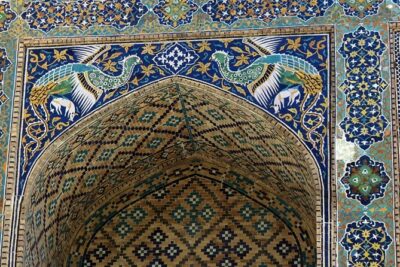
The guide spends only a short formal period here, but the location sets the tone for the rest of the walk. You see how public water, religious buildings, commerce, and social life once came together. It also gives you a first look at the city’s use of decorative brick, tile, portals, and carved details.
If you take this tour early in your stay, Lyabi Khauz becomes a useful reference point. You can return later without wondering which narrow lane leads where. The only limitation is that five minutes is not enough for a detailed architectural study, so you may want to revisit the square independently.
Trading domes, textiles, and the old commercial quarter
From Lyabi Khauz, the route moves toward Toqi Sarrafon Bazaar. Bukhara’s covered trading domes are among its most distinctive features, and the name Toqi Sarrafon is linked to money changers.
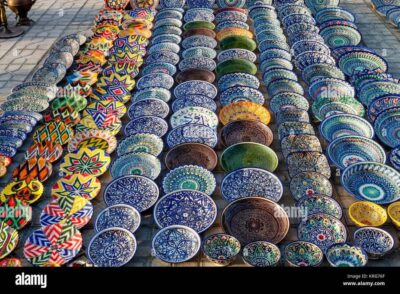
The domes were built to organize trade along the Silk Road. Today, you might find carpets, embroidered goods, hand-woven textiles, spices, jewelry, and other Uzbek crafts. The tour gives you the setting and background, while your guide can suggest where to browse and how to think about local purchases.
This is one of the places where a guide adds practical value. A market can be enjoyable, but it is easy to walk through without understanding why the buildings have their unusual shape or how the different trades were arranged. Hamza’s advice about shopping and restaurants also makes the stop more useful than a quick pass through a souvenir area.
Keep your expectations sensible. This is still a group walk, not a dedicated shopping appointment. If you want to compare carpets or spend serious time bargaining, return after the tour when you can move at your own pace.
Magok-i-Attari Mosque and Bukhara’s layered past
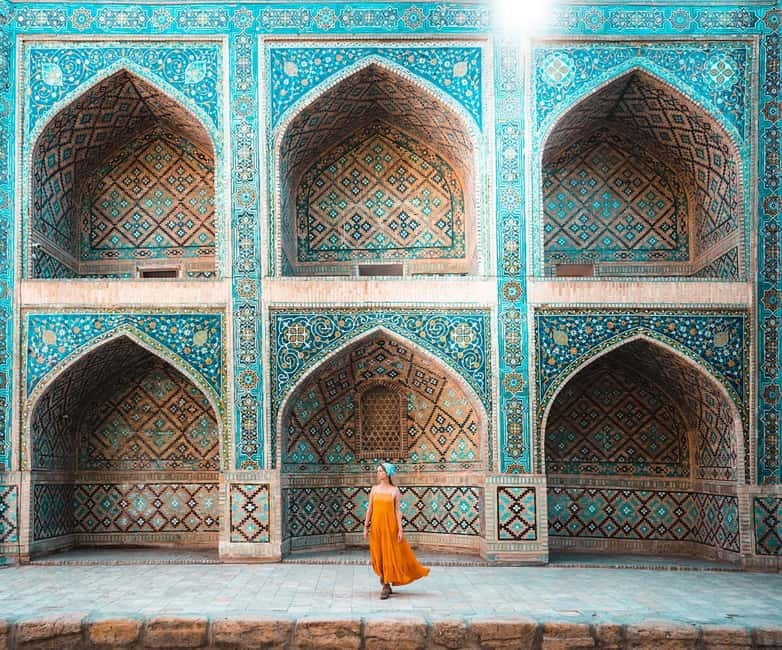
Magok-i-Attari Mosque is an important early stop because it shows how much older Bukhara is than its most famous monuments suggest. The building is associated with an earlier religious site and sits lower than the surrounding street level, reflecting changes in the ground and city over time.
A short explanation here can help you read Bukhara’s buildings as layers rather than isolated objects. The city changed under different rulers and religious traditions, and its architecture records those shifts.
The formal stop is brief, so do not expect a long interior lecture. Still, this is the kind of place you could easily miss or pass without context. The route includes several short explanations between larger sights, which keeps the walk moving but means you should ask questions when something catches your attention.
Q&A is one of the advertised strengths of the experience. That matters in Bukhara, where a simple question about a doorway, a dome, or a religious school can lead to a much clearer explanation of local customs and design.
A completely different kind of day:
- Best of Bukhara: All Day Private Old Town Tour
★ 5.0 · 66 reviews - Best of Bukhara: All Day Private Old Town Tour
★ 4.9 · 62 reviews - City Tour Around Bukhara
★ 5.0 · 55 reviews - Bukhara Full Day Old City Private Tour
★ 5.0 · 46 reviews
Ulugbek Madrasah and the educational heart of the city
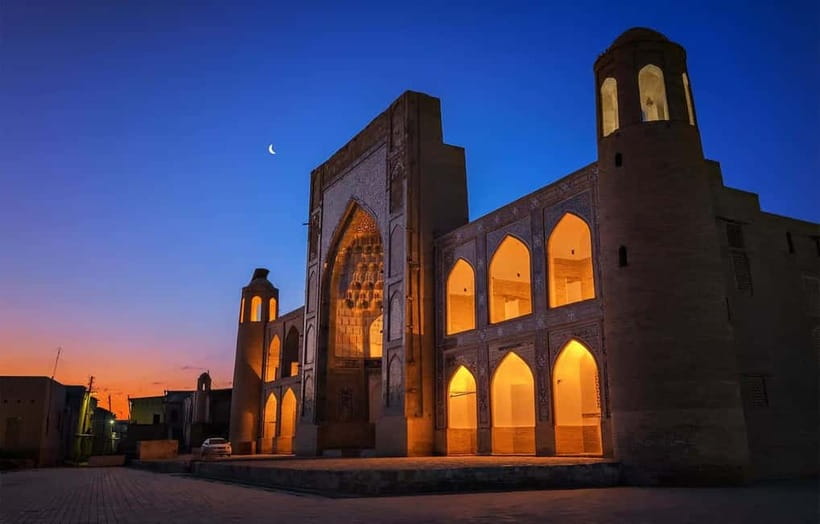
The route continues to Ulugbek Madrasah, one of the city’s important religious schools. Madrasahs were not simply decorative buildings. They were places of study, with rooms for students and spaces for teaching and prayer.
One useful detail from the tour is the explanation that a madrasah traditionally includes both a lecture hall and a mosque. That kind of practical architectural information makes the buildings easier to understand when you walk through the old town.
You will also see hand-woven textiles around many of these old buildings. Uzbekistan is well known for textile work, and the combination of historic brickwork, tiled façades, and colorful fabric gives the commercial streets much of their character.
The tour places Ulugbek Madrasah before the Kalon complex, creating a sensible progression from smaller religious buildings to Bukhara’s grandest ensemble. Some intermediate itinerary entries are not identified by name, so the exact amount of time at each minor stop may vary.
Poi Kalon, the Great Minaret, and the city’s signature view
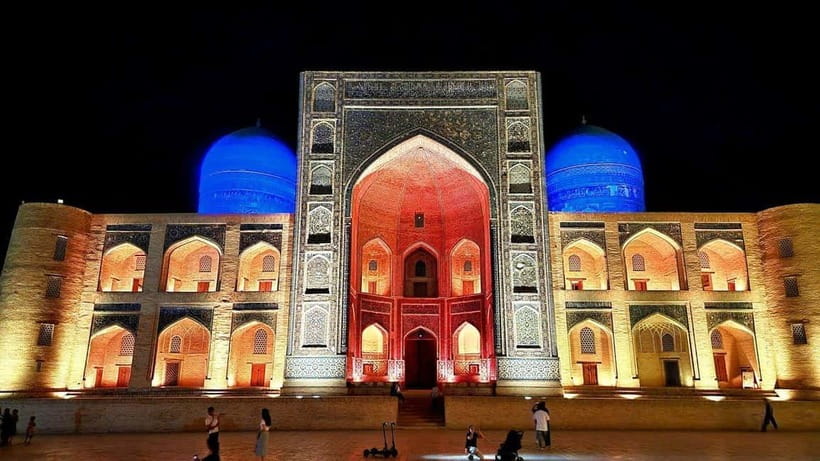
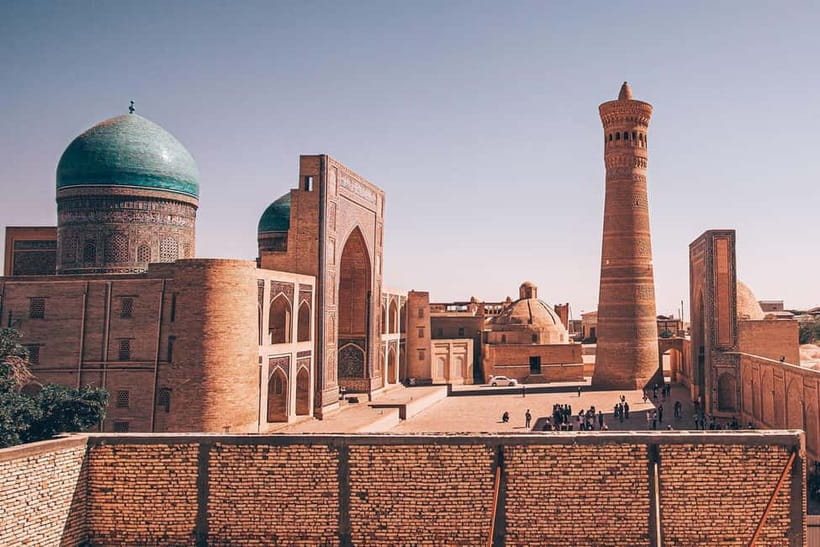
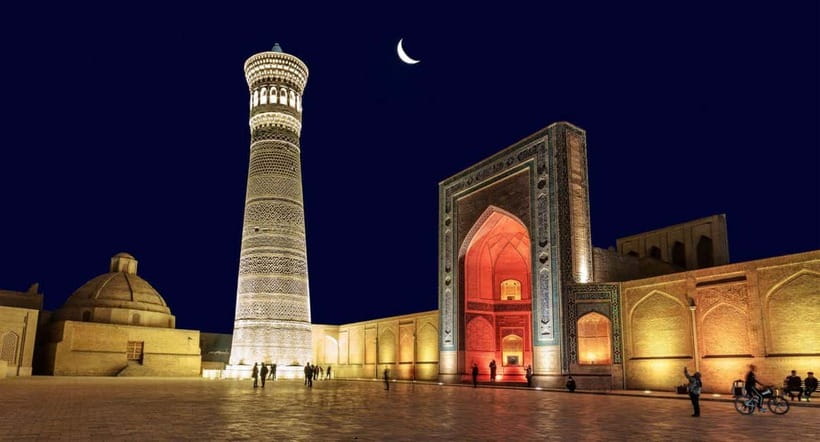
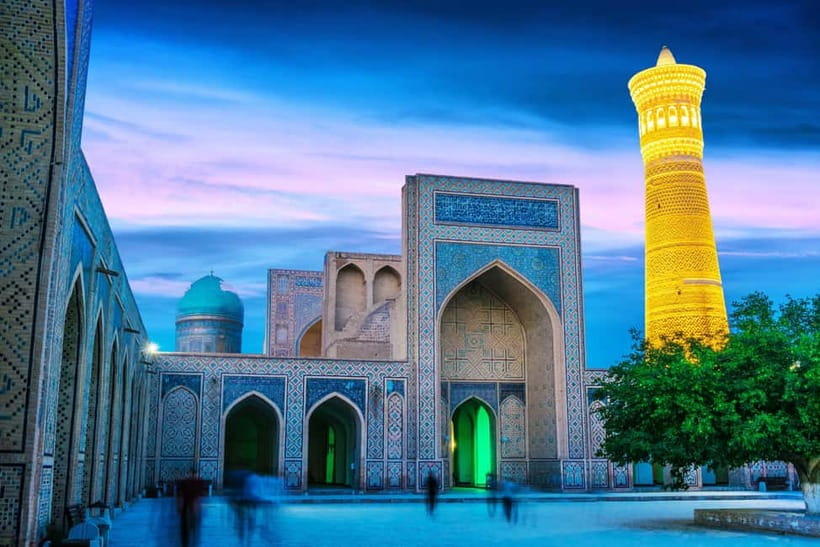
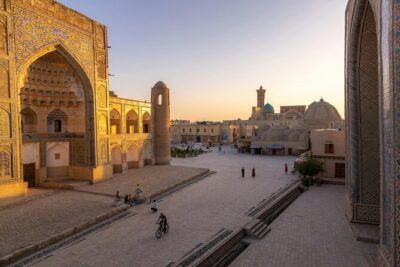
Poi Kalon is the visual centerpiece of the walk. The ensemble includes the Kalon Mosque, the Mir-i-Arab Madrasa, and the Great Minaret of Kalon.
The minaret is the landmark most people associate with Bukhara. Its size, brick pattern, and commanding position make it easy to understand why it has become the city’s symbol. The Kalon Mosque adds scale, with its broad courtyard and repeated architectural forms.
Mir-i-Arab Madrasa faces the mosque, creating one of the city’s most memorable compositions. Your guide explains how the buildings relate to one another and places them within Bukhara’s political and religious past.
This is a good place to slow down and ask questions. Five minutes at the mosque and two minutes at the madrasa are listed as guided portions, but the overall stop can take longer depending on walking pace, crowd conditions, and ticket arrangements.
The experience includes skip-the-ticket-line access, but entrance fees are not included in the $55 price. Bring cash or another accepted payment method for admissions, and ask your guide which buildings are open on the day of your visit.
One limitation is that you should not assume every madrasah interior will be open for a full visit. The tour shows you the major façades and explains their purpose, but access can differ by site.
The Ark Fortress and the political side of Bukhara
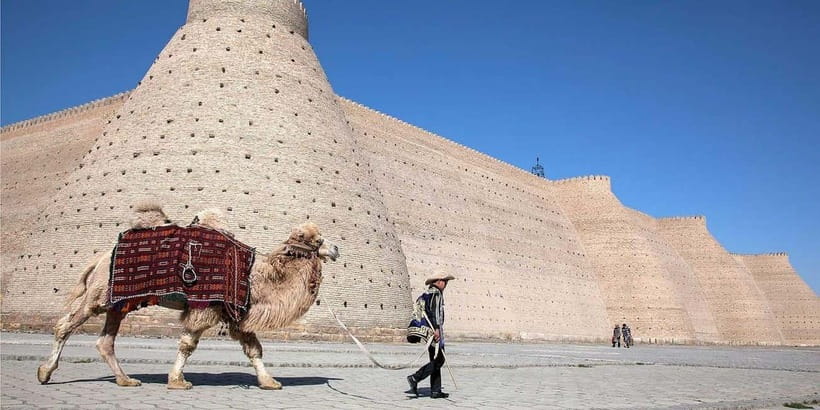
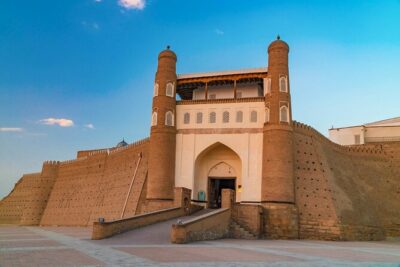
The route then reaches the Ark Fortress, the massive citadel that once served as the seat of Bukhara’s rulers. It is a dramatic change from the open religious complex at Poi Kalon.
The Ark helps explain how power worked in the city. Religious life, trade, scholarship, and government were all close together, but the fortress gave the ruling class its own fortified center.
The planned guided time here is around 20 minutes, one of the longer stops on the route. That makes sense. The Ark is not just one façade to photograph. It is a large complex with stories tied to rulers, administration, defense, and court life.
You may need to pay an entrance fee if the tour goes inside. Since tickets are separate, confirm what is covered before entering. If you prefer to keep costs low, the guide can still explain the fortress from the exterior, but the interior adds more substance to this part of the walk.
Bolo Haouz Mosque, Chashma-Ayub, and the Samanid Mausoleum
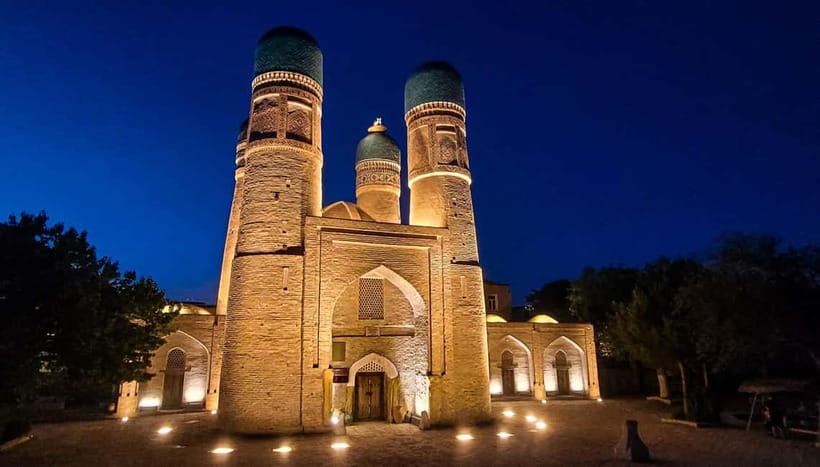
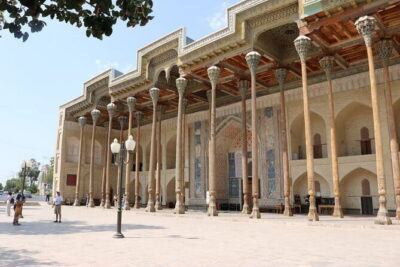
After the Ark, the walk continues to Bolo Haouz Mosque. Its carved wooden columns and ceiling make it different from the tiled monument groups earlier in the day. The stop is short, but the mosque gives you another example of Bukhara’s varied building traditions.
Next comes Chashma-Ayub Mausoleum, also called the Mausoleum of Job. Its shape and purpose offer another change of pace after the fortress and mosque. The guide can connect it to the city’s religious traditions and the many layers of belief attached to Bukhara.
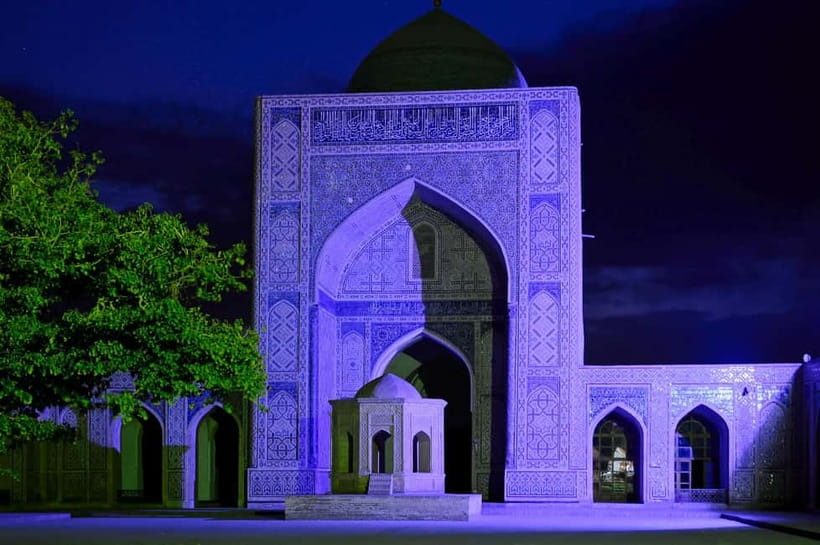
The final stop is the Ismail Samani Mausoleum, one of the most important early Islamic monuments in the city. Its brick construction is especially striking because the decoration comes from patterns in the brick itself, rather than relying mainly on colored tile.
Ending here makes sense. The mausoleum takes you back to an earlier period of Bukhara’s development and gives the tour a historical endpoint. It is also a quieter place to reflect on how much the city changed across centuries.
The tour finishes at the mausoleum rather than returning you to your hotel. That is worth noting when planning your afternoon. You can arrange your own transport afterward, continue exploring, or ask for a restaurant recommendation.
What the $55 price really gets you
At $55 per person, this is not the cheapest way to simply see Bukhara’s monuments. You can walk through parts of the old town without paying for a guide, and entrance tickets are extra.
The value comes from the amount of ground covered and the historical explanation along the way. You get a 4.5-hour route through the city’s major sights, a live English-speaking guide, practical suggestions, and help with orientation. For a first visit, that can save time and prevent the old town from becoming a confusing string of impressive façades.
The group format is the reason the price stays relatively low. Expect around 10 to 15 people, although one booking during the off-season became a one-person tour because no one else had reserved. That is a useful reminder that group size can change with the date.
Do not book this expecting the attention of a fully private guide. If you want to stop for detailed photography, spend a long time shopping, or set your own route, a private booking would suit you better. The provider says a private option can be arranged separately.
Timing, comfort, and what to bring
The walk lasts 4.5 hours, so comfortable shoes matter. Bukhara’s old town is suited to walking, but you will be on your feet for most of the experience.
Bring water, a sun hat, a camera, and a charged smartphone. Summer heat can make a long walk harder, while winter and rainy-season conditions call for an extra layer or rain protection. The walk has operated in poor weather, but rain may reduce the ease of moving between stops.
English is the available guide language. The tour is listed as wheelchair accessible, although the historic streets, entrances, and old buildings may still require you to confirm the details for your particular mobility needs before booking.
The schedule can work especially well on your first day. One visitor used it as an evening orientation, then returned to favorite sights the next day. If you arrive in the morning, the timing may also help you see the city soon after checking in.
Who will enjoy this Bukhara walk most
I would recommend this tour to you if you want:
- A clear introduction to Bukhara before exploring alone
- History and architecture rather than only photo stops
- A social group setting
- Restaurant and shopping suggestions
- A route covering the city’s main old-town sights
- An English-speaking guide who welcomes questions
It is a good match for first-time visitors, solo tourists, couples, and people with limited time. Hamza’s relaxed style, humor, and strong English are especially helpful if you want serious historical content without a stiff lecture.
You may want something else if you dislike group tours, need a slow photography schedule, or want every minute tailored to your interests. The advertised private-group wording can be confusing, so treat this as a shared tour unless you arrange a separate private service.
Should you book this Bukhara walking tour?
Yes, if you want a well-priced introduction to the old town with history at its center. The route covers Bukhara’s essential monuments, adds bazaars and local shopping, and gives you a useful map in your head for the rest of your stay.
The strongest reason to book is the guide. Hamza is repeatedly praised for clear English, broad historical context, humor, restaurant advice, and the ability to make even familiar buildings more interesting. The tour also appears willing to run with very small numbers in quiet periods.
Just budget for entrance tickets and lunch, and remember that a group of 10 to 15 people can limit flexibility. Book it early in your stay, wear good shoes, and use the remaining days to revisit the monuments and bazaars that catch your eye.
FAQ
How long does the Bukhara walking tour last?
The tour lasts 4.5 hours.
What language is the tour conducted in?
The live tour guide speaks English.
Is this a private tour?
The tour is described as a group experience with around 10 to 15 people. A separate private tour may be available by contacting the provider.
Where does the tour start?
The meeting point is near the donkey statue by Nadir Divan Begi Madrasah.
What sights are included on the route?
The route includes Lyabi Khauz, Toqi Sarrafon Bazaar, Magok-i-Attari Mosque, Ulugbek Madrasah, the Poi Kalon Mosque, Mir-i-Arab Madrasa, the Ark Fortress, Bolo Haouz Mosque, Chashma-Ayub Mausoleum, and the Ismail Samani Mausoleum.
Are entrance tickets included in the price?
No. Entrance tickets are not included and can be paid for on the spot.
What should I bring?
Bring a sun hat, water, a camera, and a charged smartphone. Comfortable walking shoes are also sensible for a 4.5-hour walking tour.
Just added in Bukhara
- Yurt Camp & Aydarkul Adventure from Bukhara★ 5.0 · 1 review
- Private Tour in 3 top Places Outside of Bukhara City★ 5.0 · 2 reviews
- Full-Day Private Guided Tour to Islamic 7 Saints of Bukhara★ 4.5 · 3 reviews
- Nurata Mountain & Kyzyl-kum Desert 3 Day Tour From Samarkand or Bukhara★ 5.0 · 1 review
- Bukhara Hammam Bathhouse with Massage★ 5.0 · 2 reviews
- Bukhara: Tour Outside of Old Town. Guide with Transportation★ 5.0 · 2 reviews
- Discover Bukhara One Day Group Experience★ 4.5 · 2 reviews
- Bukhara Old City Walking Tour★ 5.0 · 1 review
Walking Tours in Bukhara, compared.
Bukhara Historical City Highlights Guided Walking Tour
Read our review →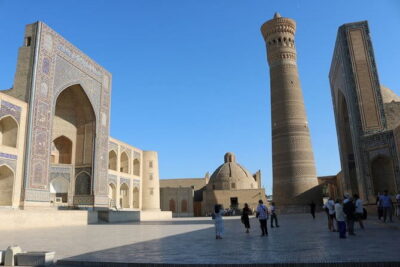
Browse the lists this tour appears in