
Review · CITY TOURS
Khiva City Tour
Khiva rewards slow looking. This private tour brings you into Itchan Kala, the walled heart of Khiva, where blue tile, carved wood, and sandy lanes create one of Central Asia’s most complete historic cities. I like the remarkable preservation and the way major sights sit close together. I also like the air-conditioned vehicle, included admissions, and lunch, which make a long morning easier. The main caution is value: one meal was found average and overpriced, so the $99 price depends on how much you value private transport and a guide.
I would choose this tour for a first visit, especially if you want the story behind the buildings instead of only taking photographs. The old city’s desert oasis setting gives Khiva a distinct character, and its traditional crafts add signs of daily life beyond the monuments. Still, the schedule is full, and a five-to-seven-hour visit may feel brisk if you prefer to sit quietly in courtyards or explore every side lane.
In This Review
- Key points to know before you book
- Why Khiva feels different from Samarkand
- Entering Itchan Kala, Khiva’s walled center
- Islam Khodja Complex and its blue details
- Muhammad Amin Khan Madrassah and the old school courtyard
- Kuhna Ark, the khan’s fortified residence
- Kalta Minor, the unfinished tower
- Tash-Hovli Palace and the royal household
- Pahlavan Mahmoud Mausoleum and a local saint
- Juma Mosque and its forest of wooden columns
- Is $99 a fair price for this Khiva tour?
- Timing, comfort, and who should book
- Should you book the Khiva City Tour?
- FAQ
- Where does the Khiva City Tour take place?
- What time does the tour begin?
- How long does the tour last?
- Is the tour private?
- Is pickup available?
- Are entrance fees included?
- Is lunch included?
- What happens if I need to cancel?
Key points to know before you book
- Itchan Kala is the heart of the day: The UNESCO-listed inner city gathers palaces, mosques, madrasahs, and mausoleums inside its historic walls.
- Eight major stops fit into one half-day: Most visits last 30 minutes, with longer periods at Itchan Kala and the Islam Khodja Complex.
- Kalta Minor is the visual star: Its unfinished tower, colorful tile bands, and unusual zigzag pattern make it one of Khiva’s most memorable sights.
- Lunch and entrance fees are included: That adds value, though the restaurant meal may not satisfy every budget-minded diner.
- The tour is private: Only your group participates, and pickup is offered, with a 9:00 am start.
- Khiva is best for history and architecture: If your main goal is modern city life or a packed shopping scene, the quiet old city may feel too focused on monuments.
Why Khiva feels different from Samarkand
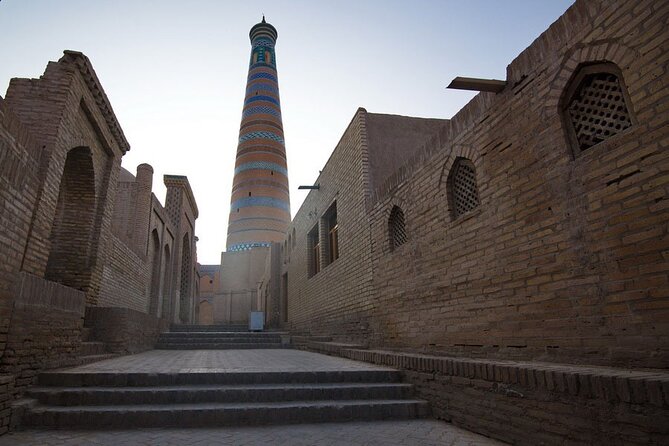
Samarkand has grand avenues and monumental spaces. Khiva gives you something more contained and atmospheric. Inside the walls of Itchan Kala, the main sights are close enough to reach on foot, while the mud-brick walls and tiled façades keep reminding you that this was once a fortified oasis city on the edge of the desert.
That compact setting is the strongest reason to take a guided tour here. You can see plenty in a single day, but the details are easy to miss without explanation. A madrassah may look like another blue-tiled façade until you learn how its courtyard worked. A mausoleum may seem small from outside until you notice its carved wood, glazed tile, or religious importance.
The city’s preserved appearance also has a practical benefit. You do not spend most of your sightseeing time traveling between distant monuments. The air-conditioned vehicle is useful for pickup and transfers, especially in warm weather, but the historic center is where the real work of the tour happens: walking, looking up, and moving from one courtyard to the next.
More city tours in Khiva and Urgench:
- Khiva: Historical City Highlights Guided Walking Tour
★ 4.8 · 156 reviews - Khiva Historical City Highlights Guided Walking Tour
★ 5.0 · 30 reviews - Private Samarkand City Tour With Transportation
★ 5.0 · 149 reviews
Entering Itchan Kala, Khiva’s walled center
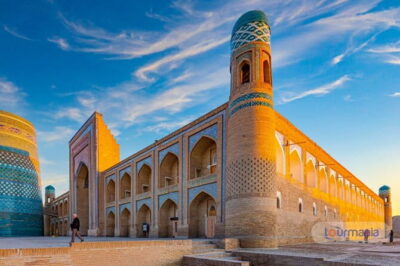
The tour begins with about an hour in Itchan Kala, the inner city protected by defensive walls. The area contains buildings from the 17th through 19th centuries, including palaces, mosques, madrasahs, and mausoleums. Admission is included, so you can focus on the setting rather than handling separate entrance payments.
I like starting here because it gives the rest of the tour a clear frame. Khiva is not simply a collection of unrelated monuments. Itchan Kala shows how religious buildings, royal residences, schools, and burial places were arranged within one fortified urban center.
Give yourself time to look beyond the famous façades. Traditional crafts are part of Khiva’s appeal, and you may find artisans and craft displays that make the old city feel less like a row of empty monuments. The supplied information does not promise a specific workshop visit, so think of crafts as part of the atmosphere rather than a scheduled activity.
The one-hour visit is enough to get your bearings, but not enough for every corner. If photography is important to you, you may wish the stop were longer. That is one tradeoff of a guided route with eight stops: you gain structure, but you give up some free wandering.
Islam Khodja Complex and its blue details
The Islam Khodja Complex receives about an hour, making it one of the tour’s main stops. The mausoleum is dedicated to Ismail Khodja, described as a prominent 16th-century Sufi leader and poet, while the structure itself dates from the late 19th century.
This is a good place to pay attention to surface detail. The complex combines Islamic and Uzbek architectural styles, with intricate tile work, carvings, blue domes, and a decorated façade. I would not rush through this stop. The appeal is not only the overall shape of the building, but the repeated patterns and careful craftsmanship that appear when you stand close.
The name can appear in different forms, including Islam Khodja and Ismlo Khodja. If you are taking notes or searching for information later, keep that variation in mind.
The long visit also helps balance the faster stops later. A guide can explain the religious purpose of the mausoleum and place it within Khiva’s wider history. Since this is a private tour, you can ask for clarification rather than waiting for a large group to catch up.
Muhammad Amin Khan Madrassah and the old school courtyard
The Muhammad Amin Khan Madrassah gets about 30 minutes. Built in the 19th century and named for Muhammad Amin Khan, a governor of Khiva, it follows the familiar madrassah plan with a central courtyard, decorated façade, and domed roof.
I find courtyards especially useful for understanding these buildings. From the street, the madrassah can seem like a flat wall covered in tile. Inside, the courtyard shows how the building was organized as a place of study and religious life.
Look for the tile work and calligraphy. These are not just decoration added for modern visitors. They form part of the building’s visual language, and a guide can help you read the façade as more than a pretty blue surface.
Thirty minutes is a sensible introduction, though anyone who enjoys architectural photography may want extra time. The tour does not promise an extended independent visit, so take your best look during the scheduled stop.
A few more options to weigh up in Khiva and Urgench
- Transfer: Bukhara – Khiva via Ancient Fortresses
★ 4.5 · 101 reviews - Daytrip From Khiva To Ancient Fortresses
★ 4.6 · 60 reviews - Aral Sea Adventures (2 day)
★ 5.0 · 30 reviews - Guided Tour To Old Fortresses
★ 5.0 · 25 reviews
Kuhna Ark, the khan’s fortified residence
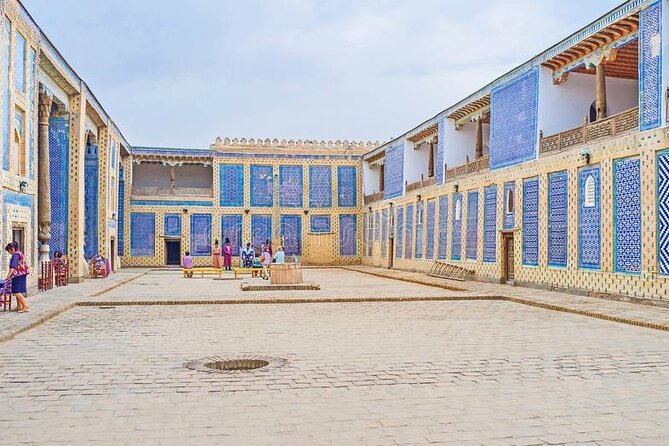
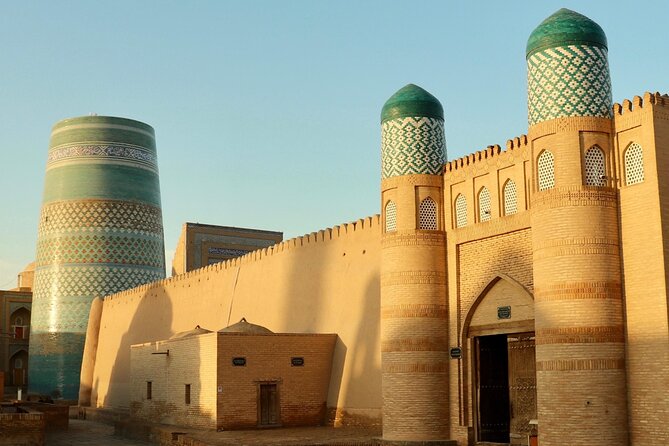
Kuhna Ark is a centuries-old fortress and former residence of Khiva’s rulers. The tour allows 30 minutes to see its blue tiles and ornate gateway, flanked by two towers.
This stop changes the mood. The madrassahs and mausoleums point toward study, worship, and remembrance, while Kuhna Ark speaks to government and royal power. Its fortified design helps explain why Khiva developed as a protected oasis settlement rather than an open city.
I would pay special attention to the entrance. The gateway and towers give you a quick sense of the building’s defensive role, even if the short stop does not allow a full exploration of every part of the fortress.
The limitation is simple: half an hour goes quickly at a large residence. If the guide provides extra historical detail, you may need to choose between listening closely and taking photographs. I prefer listening first, then using the final minutes for pictures.
Kalta Minor, the unfinished tower
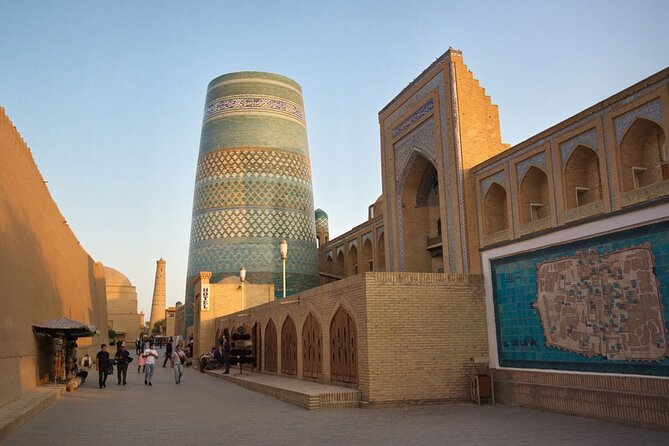
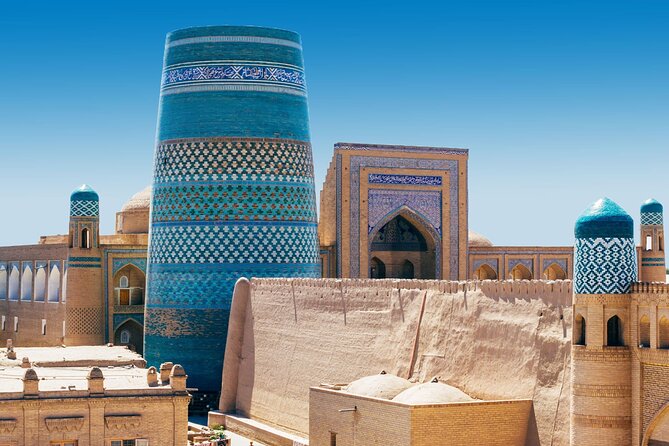
Kalta Minor is perhaps the most instantly recognizable sight in Khiva. The 19th-century tower was intended to become the tallest minaret in the world, but construction stopped before it was finished. It still rises about 70 meters, according to the tour information, and is covered with brick and tile work.
Its colorful zigzag design, described as a viper’s head pattern, gives the tower a look unlike the more restrained minarets you may see elsewhere. The unfinished nature is part of its charm. You are looking at an ambitious project that never reached its planned height, not a damaged monument.
The tour gives you 30 minutes here. That is plenty of time to study the exterior and understand why Kalta Minor dominates photographs of Khiva. The tower is also associated with views over the city and surrounding desert setting, although the exact access arrangements are not specified, so you should not assume that climbing is included.
I like this stop because it is easy to remember. After a morning of courtyards and façades, Kalta Minor provides a strong visual marker. If you have limited time in Khiva, this is one sight I would not skip.
Tash-Hovli Palace and the royal household
Tash-Hovli Palace was built in the 19th century as a residence for the khan and his family. Today, it functions as a museum, with rooms that include an audience hall, bedrooms, and private quarters. The museum also displays traditional costumes, ceramics, and jewelry.
This is one of the most useful stops for seeing how power worked inside the city. Kuhna Ark gives you a fortress and royal center, while Tash-Hovli lets you consider domestic life, court rooms, and formal reception spaces.
The palace is known for tile work, ornate carvings, and courtyards. I recommend looking at the contrast between public and private areas. An audience hall was designed to impress, while bedrooms and private quarters show a more personal side of palace life.
Again, the allotted 30 minutes creates a clear limit. You will get an introduction rather than a slow museum visit. The included entrance fee removes one small hassle, but you may still want to return later if your schedule allows and the ticket terms permit it. The tour details do not state whether reentry is possible, so ask before leaving if that matters to you.
Pahlavan Mahmoud Mausoleum and a local saint
The Pahlavan Mahmoud Mausoleum dates from the 14th through 18th centuries and honors Pahlavan Mahmud, a famous Central Asian wrestler and saint. Its blue glazed dome sits above a rectangular base, while the interior includes frescoes and wood carvings.
This stop adds a more personal and spiritual note to the day. Pahlavan Mahmud was remembered not only for physical strength but also as a holy figure, and that combination helps explain why the mausoleum became an important place of respect.
The 30-minute visit should give you time to take in the dome and interior decoration. I would keep your voice low and your pace measured here. A mausoleum is not simply another photogenic building, and the religious setting deserves more care than a quick snapshot.
The tilework is the obvious draw, but do not overlook the wooden details. Khiva is often associated with blue and turquoise surfaces, yet its carved wood traditions are just as important to the city’s character.
Juma Mosque and its forest of wooden columns
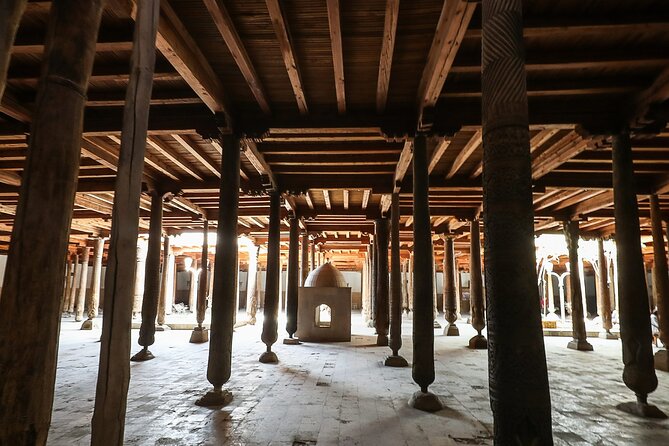
The Juma Mosque is described as one of Khiva’s oldest and largest mosques, dating to the 10th century. Its spacious interior can hold up to 2,000 worshipers and includes wooden columns, ornate carvings, a central dome, smaller domes, tilework, and calligraphy.
I find this a fitting final stop because the mosque pulls together several themes from the day. You see religious architecture, skilled woodwork, decorative surfaces, and a scale that differs from the smaller mausoleums.
The wooden columns are the feature to watch for. They give the interior a distinct rhythm and make the space feel different from a mosque dominated by bright tile. A guide can help explain the building’s age and design, while you can focus on the changing shapes of the columns and ceiling.
Half an hour is enough for a focused visit. It is not enough to study every carving, so resist the urge to photograph everything at once. Pick a few details and give yourself time to look at them properly.
Is $99 a fair price for this Khiva tour?
At $99 per person, the tour is not the cheapest way to walk around Itchan Kala. Much of the old city can be explored independently, especially because the major sights are close together.
The price makes more sense if you value the full package. You receive an air-conditioned vehicle, entrance fees, lunch, pickup, and a private tour for your group. You also avoid spending time working out which monuments to visit and how the buildings connect.
The private format matters most for people who ask questions, need a flexible pace, or do not want to follow a large group. It can also suit families and small groups who would rather have one guide focused on them.
Lunch is the uncertain part of the value calculation. One dining experience associated with the tour was considered average and overpriced at the Terrace restaurant. I would treat the included meal as convenient rather than a major culinary reason to book. If food is central to your trip, ask where lunch will be served before confirming.
Group discounts may improve the per-person cost, though no discount amount is provided. For a solo visitor, $99 may feel high. For a small private group that wants transport, admissions, lunch, and a guide in one booking, it can be reasonable.
Timing, comfort, and who should book
The tour begins at 9:00 am and lasts about five to seven hours. That is a substantial block of the day, but the schedule is not wasteful. The eight stops are concentrated around Khiva’s historic core, with most visits lasting 30 minutes and the first two receiving an hour each.
An air-conditioned vehicle is a useful comfort feature, particularly in a desert oasis setting. Pickup is offered, though the exact meeting location is not specified in the supplied details. Confirm the pickup point when you book.
This tour suits you best if you:
- Want a structured first look at Khiva
- Care about architecture, religious sites, and royal history
- Prefer a private group rather than a shared tour
- Value included entrance fees and lunch
- Have one main sightseeing day in the city
- Enjoy learning what you are looking at
You may prefer independent touring if you want to linger at one monument, eat wherever you choose, or spend most of the day browsing crafts. The route is efficient, but efficiency can feel rushed when every courtyard invites another ten minutes.
Most travelers can participate, according to the tour details. The activity is private, so only your group takes part. Confirmation is provided at booking, and free cancellation is available up to 24 hours before the start time. Poor weather or failure to reach the minimum number of participants can lead to a new date, another experience, or a full refund.
Should you book the Khiva City Tour?
Book it if Khiva is new to you and you want the main sights explained in one well-organized day. The strongest reasons are the private format, included admissions, air-conditioned transport, and access to the city’s most important buildings, from Kalta Minor to Juma Mosque.
I would be more cautious if you already know Itchan Kala well or if the $99 price leaves little room in your budget. You can walk between many of these sights yourself, and the included lunch may not feel special enough to justify the cost alone.
My practical choice would be to book this for a first visit, then keep some free time afterward. The tour gives you the structure and context. Your extra hours let you return to the monument you liked best, look for traditional crafts, and enjoy Khiva without checking the clock.
FAQ
Where does the Khiva City Tour take place?
The tour takes place in Khiva, Uzbekistan, with the main sightseeing inside Itchan Kala, the city’s inner walled area.
What time does the tour begin?
The scheduled start time is 9:00 am.
How long does the tour last?
The tour lasts approximately five to seven hours.
Is the tour private?
Yes. Only your group participates in this private activity.
Is pickup available?
Pickup is offered. The specific pickup location is not stated, so confirm it when booking.
Are entrance fees included?
Yes. Entrance fees for the included sightseeing are covered.
Is lunch included?
Yes. Lunch is included in the tour price.
What happens if I need to cancel?
You can receive a full refund if you cancel at least 24 hours before the experience start time. Cancellations or changes made less than 24 hours in advance are not accepted for a refund.
Just added in Khiva and Urgench
- Urgench Airport / Railway Station – Khiva Transfer★ 3.0 · 2 reviews
- Traditional Khiva Cooking Class with Market Visit & Lunch★ 5.0 · 4 reviews
- Uzbekistan 6 Days Private Tour Khiva-Bukhara-Samarkand by Train★ 5.0 · 4 reviews
- Transfer From Khiva To Bukhara★ 5.0 · 2 reviews
- Old Khiva Stories with Your Local Guide★ 5.0 · 5 reviews
- Day Trip Top 3 Fortresses departure from Khiva Self-Guided Tour★ 5.0 · 2 reviews
- Plov Tour : Taste, Tradition & History of Plov with a local guide★ 5.0 · 1 review
- Master Class – Uzbek Bread (Khiva)★ 3.5 · 4 reviews
City Tours, compared.
Private Samarkand City Tour With Transportation
Read our review →
A City Tour Of Samarkand: The Pearl Of The East
Read our review →
Khiva Historical City Highlights Guided Walking Tour
Read our review →
Samarkand Historical City Highlights Guided Walking Tour
Read our review →
Private Guided Tour Samarkand city history and culture
Read our review →
Samarkand City Tour with a Professional Photographer
Read our review →Browse the lists this tour appears in