
Review · WALKING TOURS IN BUKHARA
Bukhara Walking Tour
Bukhara reveals itself one monument at a time. This private walking tour links the city’s major Islamic sites, old trading domes, Jewish quarter, museums, and mausoleums in one long route. I especially like the chance to see the unusual puppet theater collection and the ancient Magoki Attori Mosque, two stops that add local character beyond the famous monuments.
I also like the strong guide element. Peri is patient and clear, while Nilufar is described as punctual, energetic, and able to explain her hometown in excellent English. The main consideration is the length: five to six hours on foot, with monument entrance fees and lunch extra.
- A full-day walking route: Ten stops connect Bukhara’s best-known sights, from Lyab-i-Hauz to the Samanid Mausoleum.
- A private experience: Only your group takes part, with guide languages including English, Spanish, French, German, and Russian.
- Ancient and unusual sights: The route includes a pre-Mongol mosque, Central Asia’s first mausoleum, a puppet theater collection, and a Jewish quarter.
- A useful price point: At $28, the tour includes a professional guide and taxes, but not entry tickets, meals, or transport.
- A route with a clear finish: The walk ends at the Samanid Mausoleum, not back at the starting point.
- Flexible booking terms: You receive confirmation at booking, and cancellation is free up to 24 hours before the start.
In This Review
- Why Bukhara Works So Well on Foot
- Starting at Lyab-i-Hauz
- A Two-Minute Puppet Theater Surprise
- Magoki Attori Mosque and the Carpet Museum
- The Oldest Madrasah and the Most Ornate One
- Poi Kalyan, Bukhara’s Great Monument Group
- Inside the Ark, the Emir’s Former City
- Bolo Hauz and the Reflection Trick
- Chashmai Ayub and the Story of Water
- Finishing at the Samanid Mausoleum
- What the $28 Price Really Covers
- Guide Quality and Language Choice
- Who Should Book This Walk
- Practical Advice Before You Book
- Should You Book the Bukhara Walking Tour?
- FAQ
- Where does the Bukhara Walking Tour begin?
- Where does the tour end?
- How long does the walking tour last?
- Is this a private tour?
- What languages can the guide speak?
- Are monument entrance fees included?
- Is lunch included?
- Can I cancel for a full refund?
Why Bukhara Works So Well on Foot
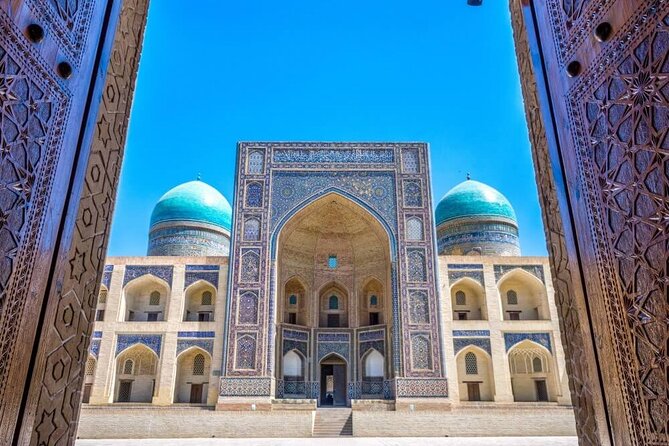
Bukhara is a city where major sights sit close enough to connect by walking, yet each monument belongs to a different period and serves a different purpose. This tour uses that layout well. You begin in a social square, pass through former centers of study and worship, then finish among the oldest surviving buildings in the region.
The experience is private, which matters in Bukhara. You can ask why a building matters, pause for a detail, or request a little more time without trying to keep pace with a large group. The guide is the main value here, since entrance tickets are not included and the monuments themselves may require separate payments.
You should allow most of a day. The listed duration is about five to six hours, and the route has ten stops. Since an air-conditioned vehicle is not included, you should expect this to be a walking experience rather than a sightseeing trip with transfers.
Starting at Lyab-i-Hauz
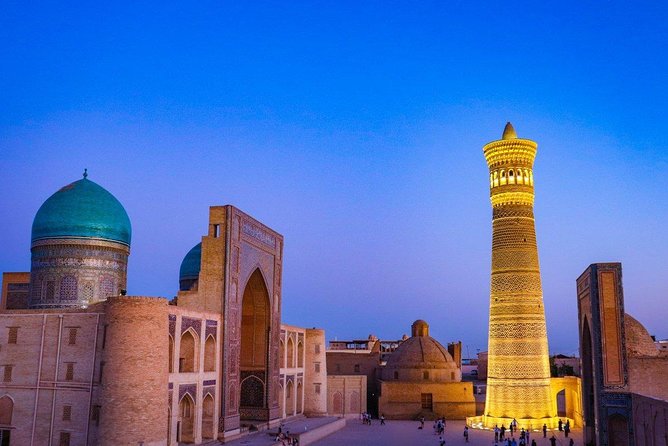
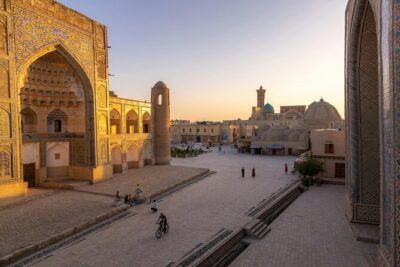
The tour begins at the Lyab-i-Hauz ensemble, the traditional center of Bukhara’s social life. Its name refers to the pool, or hauz, around which the complex developed. The setting is useful as an opening stop because it gives you a sense of how public life once gathered around water, religious schools, and places for spiritual retreat.
You see the Kukeldash Madrasah, the Nadir Divanbegi Madrasah, and a khanaka. A madrasah was a school for religious study, while a khanaka provided lodging and space for dervishes. Those labels can blur together when you are rushing from one monument to the next, so having a guide explain their different roles makes the square far more meaningful.
The scheduled time is about an hour, although admission fees are not included. This is one place where you may want to listen carefully before deciding which interiors are worth paying to enter. The complex is also said to become more active in the evening, so a morning or daytime visit gives you the monuments in a quieter setting, while a later visit may offer more social energy.
More Walking Tours in Bukhara
- All You Need To Know About Bukhara. A Walk In The Town
★ 4.9 · 31 reviews - Bukhara Historical City Highlights Guided Walking Tour
★ 4.5 · 16 reviews - Bukhara: Private Guided Walking Tour with Hotel Pickup
★ 5.0 · 11 reviews
A Two-Minute Puppet Theater Surprise
The puppet theater stop is one of the tour’s most distinctive features. It is described as the only place in Uzbekistan where you can learn about Central Asian puppets and puppet theater.
You can watch a short, two-minute performance by the master himself. That is not a full theater production, but it gives the visit a personal touch and breaks up the run of mosques, madrasahs, and tombs. If luck is on your side, you may also find puppets available there.
I like this stop because it connects Bukhara to everyday culture and performance, not only grand religious architecture. The visit lasts about 20 minutes, and admission is not included. Keep your expectations sensible: this is a brief introduction, not a long show.
Magoki Attori Mosque and the Carpet Museum
Magoki Attori Mosque carries some of the strongest historical weight on the route. It is presented as the first mosque in Bukhara and the whole of Uzbekistan, and the site predates the Mongol invasion.
Before the arrival of Islam, the location was associated with the sale of pagan idols. That earlier use gives the building a layered story. You are not simply looking at a mosque, but at a place where religious practice and commerce changed over time.
The stop also includes a carpet museum. The visit is scheduled for about 15 minutes, so you should expect a concise explanation rather than a long museum session. Admission costs extra. I would pay close attention here to the guide’s explanation of what remains from the earlier period, since the building’s importance is not always obvious from its exterior.
The Oldest Madrasah and the Most Ornate One
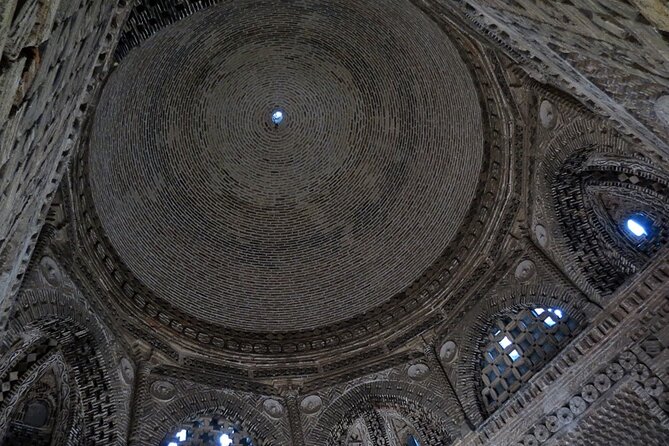
The route then moves to the Ulugbek Madrasah, described as the oldest madrasah in Bukhara and the only monument from the Timurid period in the city. Its connection to Ulugbek gives it an important place in the region’s intellectual and architectural story.
You have about 15 minutes here. That is enough to understand why the building matters, but it may feel short if you want to study every decoration or architectural detail. The guide’s explanation is especially useful because the significance lies in its age and Timurid connection, not just its facade.
Next comes the Abdulaziz-Khan Madrasah, called the most magnificent madrasah in Bukhara. It was also the first monument in the city where yellow was used in its decoration. That small detail is exactly the sort of thing easy to miss when walking alone.
The two madrasahs work well as a pair. Ulugbek represents an earlier Timurid phase, while Abdulaziz-Khan gives you a later, more decorative expression. Each stop receives about 15 minutes, and entry is extra.
A completely different kind of day:
- Best of Bukhara: All Day Private Old Town Tour
★ 5.0 · 66 reviews - Best of Bukhara: All Day Private Old Town Tour
★ 4.9 · 62 reviews - City Tour Around Bukhara
★ 5.0 · 55 reviews - Bukhara Full Day Old City Private Tour
★ 5.0 · 46 reviews
Poi Kalyan, Bukhara’s Great Monument Group
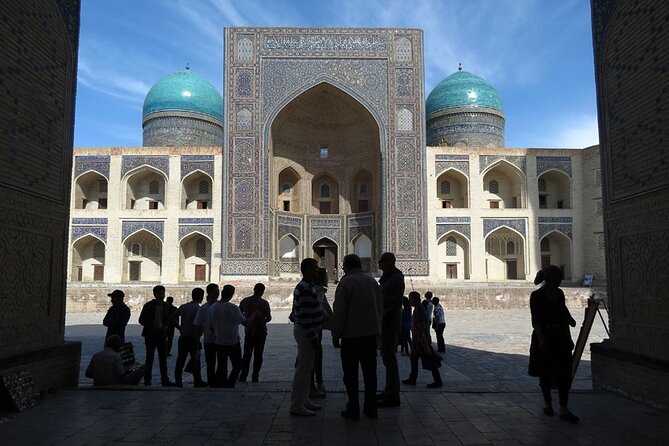
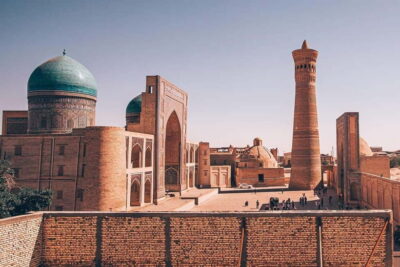
Poi Kalyan is the visual center of the walking tour. The complex contains the Kalyan Minaret, the Kalyan Mosque, and the Miri Arab Madrasah. You spend about an hour here, making it one of the longest visits on the route.
The Kalyan Minaret is a pre-Mongol monument and the tallest minaret in the city. It is one of the three pre-Mongol monuments specifically highlighted on the tour. Its survival gives you a direct link to Bukhara before the Mongol invasion, a period often lost beneath later additions and restorations.
The Kalyan Mosque is described as the largest medieval mosque in the city. It was restored, so you should understand that what you see today is not untouched medieval fabric. Even so, its scale and place within the complex make it one of the essential stops.
Miri Arab Madrasah is still a functioning madrasah for men. That active use matters. You are seeing a religious institution that remains part of present-day life, not only a preserved monument. Respect the setting and follow your guide’s instructions about where you may go.
The one-hour schedule is welcome here, but paid entry can add to the total cost. If you are trying to hold the budget near $28, ask the guide which areas are included in the walking portion and which require tickets.
Inside the Ark, the Emir’s Former City
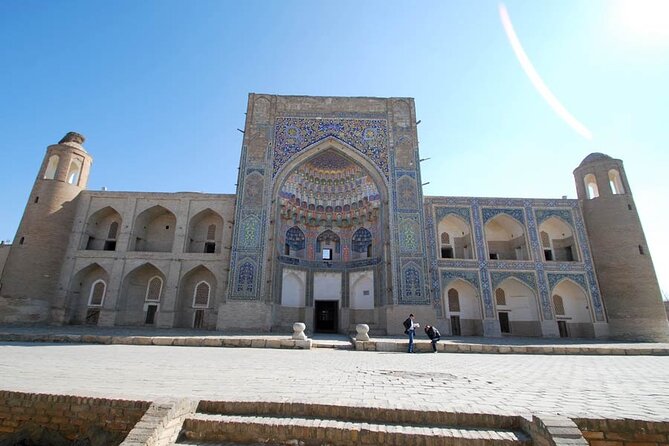
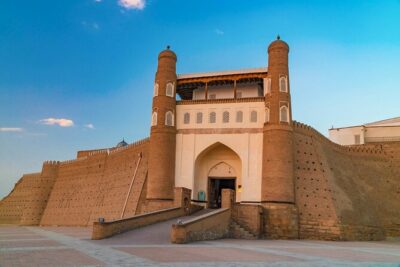
The Ark of Bukhara was the winter residence of the Bukhara emirs and was regarded as a city within the city. That description helps you picture its former role. This was not simply a palace building, but a fortified center with its own functions and hierarchy.
The scheduled visit lasts 40 minutes. That gives you enough time for a useful overview, though the full complex can reward a slower look if you return later. As with the other major monuments, entrance is not included.
I consider the Ark a strong middle-to-late stop because it shifts the focus from religious schools and mosques to political power. You can compare the ruler’s fortified world with the public spaces you saw earlier at Lyab-i-Hauz and the trading domes.
Bolo Hauz and the Reflection Trick
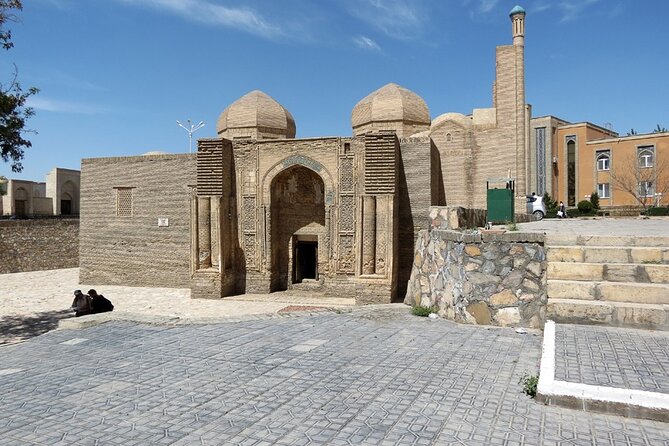
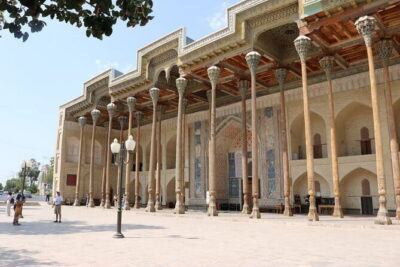
Bolo Hauz Mosque is known for having the city’s highest columns. It is also called Chilustun, or 40 columns, although the mosque has 20 columns. The explanation comes from the reservoir, where their reflections create the impression of 40.
That is a fine example of Bukhara’s visual wit. The building’s appearance depends not only on what was constructed, but also on the water in front of it. The visit lasts about 20 minutes, which should allow time to see the columns and understand the reflection.
This stop also provides a change of scale after the Ark. Instead of a fortified residence, you are looking at an elegant mosque facade and its relationship with the nearby water.
Chashmai Ayub and the Story of Water
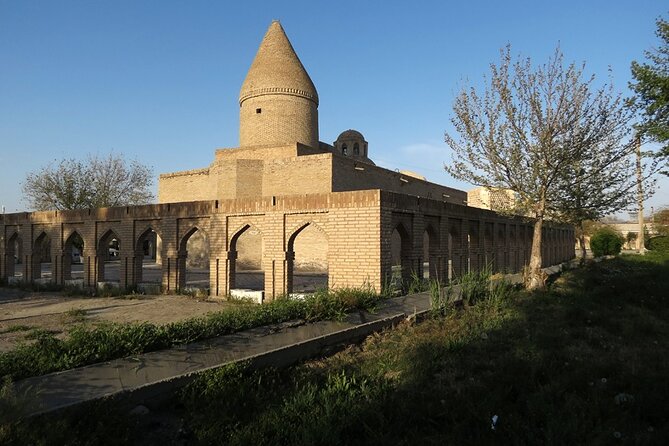
Chashmai Ayub Mausoleum serves two purposes. It is a mausoleum associated with Saint Job, and it houses Bukhara’s water supply museum.
The combination makes this more than a tomb visit. Water has always shaped life in Central Asian cities, so a museum devoted to supply systems gives context to the hauz, reservoirs, and public spaces seen earlier in the day. The stop lasts about 20 minutes.
Admission is extra, and you may need to decide how much you want to spend on interiors throughout the route. If water management interests you, this is one of the more unusual paid stops. If your priority is architecture, the exterior and the guide’s explanation may be enough.
Finishing at the Samanid Mausoleum
The walk ends at the Ismail Samani Mausoleum, an excellent final stop. It is described as the first mausoleum in Central Asia and the second mausoleum in the Islamic world. It was built for the founder of the first local Central Asian empire.
The building is also a pre-Mongol monument, giving the day a fitting close among some of Bukhara’s oldest surviving structures. Its importance is architectural, political, and religious, so the guide can bring together several themes from the earlier stops.
The tour does not return to Lyab-i-Hauz. It ends at the Samanid Mausoleum, so plan your next move from there. The route also passes through the Jewish quarter and the trading domes, even though the listed stop times focus on the larger monuments. These sections help show that Bukhara was not only a religious center, but also a city shaped by trade and several faith communities.
What the $28 Price Really Covers
At $28, the tour offers good value if you want a private guide for a long, structured introduction to Bukhara. The price includes a professional guide and all fees and taxes connected with the tour service.
It does not include monument admission, lunch, personal expenses, or an air-conditioned vehicle. Those exclusions matter. The headline price is low, but your final spending will depend on which sites you enter and whether you buy food or other items along the way.
The strongest value comes from the route and explanation. A guide can point out why Ulugbek is important, explain the unusual column reflection at Bolo Hauz, and place Magoki Attori Mosque in its pre-Islamic setting. If you want a private introduction without paying for a vehicle, this is a sensible choice.
Group discounts are available, although the experience itself is private and limited to your own party. For two or more people, the per-person cost may become especially reasonable if the discount applies to your booking.
Guide Quality and Language Choice
The guide can conduct the tour in English, Spanish, French, German, or Russian. That range makes the experience accessible to different kinds of visitors, but you should select your preferred language carefully at booking.
The strongest praise goes to the guides’ patience, clarity, flexibility, and command of English. Peri is described as patient and precise when explaining the monuments. Nilufar is noted for her punctuality, energy, excellent English, and remarkable grasp of Bukhara’s story.
Those qualities matter on a route with ten stops. You need a guide who can keep the pace moving without turning every building into a lecture. You also need someone willing to answer questions and adjust the amount of detail. The comments about patience and flexibility suggest this is a particular strength of the experience.
Who Should Book This Walk
I would recommend this tour to a first-time visitor with limited time in Bukhara who wants the main sights organized into one route. It suits anyone who prefers explanations to simply taking photographs, especially visitors interested in Islamic architecture, Central Asian history, and the city’s religious institutions.
It is also a good fit for couples, families, or small private groups who want to ask questions freely. The guide can focus on your interests instead of following a large group’s fixed pace.
You should think twice if you dislike long walks, want every entrance included, or expect a vehicle between stops. The day is substantial, and paid admissions can raise the cost. It may also be less suitable for someone who prefers a slow, unstructured afternoon in one neighborhood.
Practical Advice Before You Book
Wear comfortable walking shoes and plan for a five to six hour outing. Since lunch is not included, arrange your meal plans before the tour or ask the guide how the schedule handles a food break.
Keep some flexibility in your budget for monument tickets. The exact total depends on which interiors you enter, and the tour price alone does not cover them.
Remember that the endpoint is the Samanid Mausoleum. If your accommodation or next activity is near Lyab-i-Hauz, you will need to arrange your return independently. Confirmation arrives at booking, and free cancellation is available up to 24 hours before the local start time. Changes or cancellations inside that window are not refunded.
Should You Book the Bukhara Walking Tour?
Book it if you want a private, guide-led introduction to Bukhara that covers far more than the central square. The route combines major monuments with smaller cultural stops, and the praised guides, especially Peri and Nilufar, appear to be the strongest reason to choose it.
Skip it if you want transport, included entrance tickets, or a short sightseeing session. For most visitors who have one day to understand Bukhara, the $28 starting price offers a useful framework, as long as you remember to budget for admissions and food.
FAQ
Where does the Bukhara Walking Tour begin?
The tour begins at the Lyab-i-Hauz ensemble, at Divan-Beghi in Bukhara.
Where does the tour end?
The tour ends at the Ismail Samani Mausoleum.
How long does the walking tour last?
The experience lasts approximately five to six hours.
Is this a private tour?
Yes. Only your group participates in the activity.
What languages can the guide speak?
The professional guide is available in English, Spanish, French, German, and Russian.
Are monument entrance fees included?
No. Entrance to the monuments listed in the program is not included in the tour price.
Is lunch included?
No. Lunch and personal expenses are not included.
Can I cancel for a full refund?
Yes, if you cancel at least 24 hours before the experience start time. Cancellations made less than 24 hours in advance are not refunded.
Just added in Bukhara
- Yurt Camp & Aydarkul Adventure from Bukhara★ 5.0 · 1 review
- Private Tour in 3 top Places Outside of Bukhara City★ 5.0 · 2 reviews
- Full-Day Private Guided Tour to Islamic 7 Saints of Bukhara★ 4.5 · 3 reviews
- Nurata Mountain & Kyzyl-kum Desert 3 Day Tour From Samarkand or Bukhara★ 5.0 · 1 review
- Bukhara Hammam Bathhouse with Massage★ 5.0 · 2 reviews
- Bukhara: Tour Outside of Old Town. Guide with Transportation★ 5.0 · 2 reviews
- Discover Bukhara One Day Group Experience★ 4.5 · 2 reviews
- Bukhara Old City Walking Tour★ 5.0 · 1 review
Walking Tours in Bukhara, compared.
All You Need To Know About Bukhara. A Walk In The Town
Read our review →
Bukhara Historical City Highlights Guided Walking Tour
Read our review →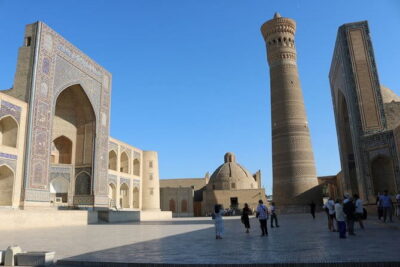
Browse the lists this tour appears in